

8.2 A Generic Approach to Quality
313
(f) Quality systems are not constant in time; rather, they vary with the conception of quality of an entity (product, system, service) as a result of
ceaseless social, economic, scientific and technical changes.
8.2.2 Types of Quality
The literature about quality is frequently confusing, partly as a result of the types
of quality that arise in approaching it from various points of view not being
clearly distinguished.
First, one should take into account that quality can be ascribed to the output
(products or services) of a body or to its organization. The most immediate classification of quality, external and internal, is especially important with a view to
avoiding so much misunderstanding in this context.
Second, quality can be assigned attributes that depend on its characteristics
and on the qualifier. There are four types of quality according to this criterion,
namely: (a) quality designed or planned by the body concerned; (b) quality
achieved by it; (c) quality required and expected by the user or client, which
should normally coincide with that planned by the body; and (d) quality perceived by the user or client.
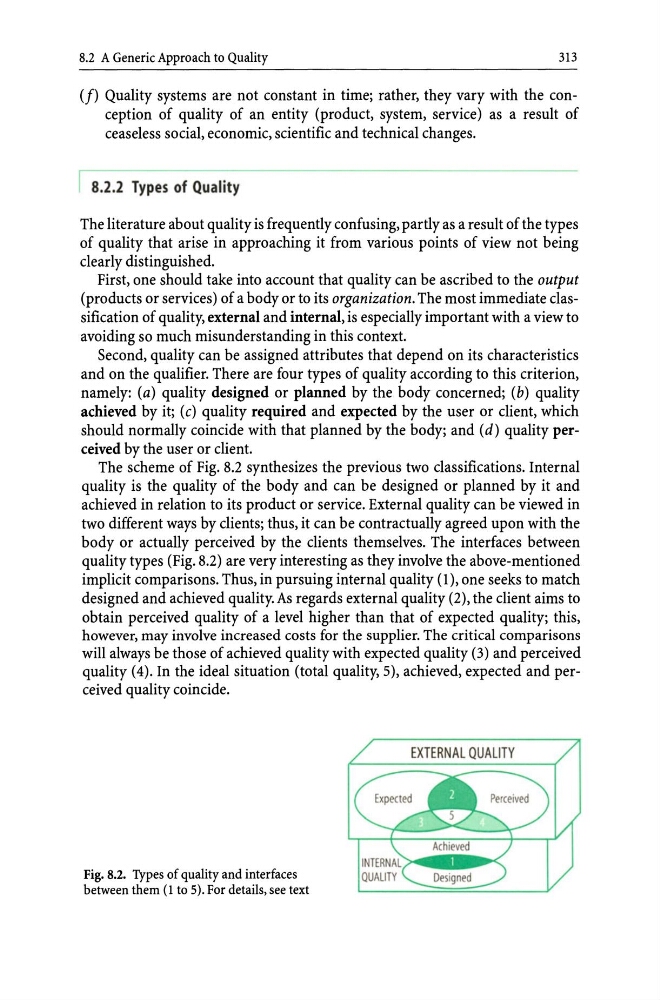
The scheme of Fig. 8.2 synthesizes the previous two classifications. Internal
quality is the quality of the body and can be designed or planned by it and
achieved in relation to its product or service. External quality can be viewed in
two different ways by clients; thus, it can be contractually agreed upon with the
body or actually perceived by the clients themselves. The interfaces between
quality types (Fig. 8.2) are very interesting as they involve the above-mentioned
implicit comparisons. Thus, in pursuing internal quality (1), one seeks to match
designed and achieved quality. As regards external quality (2), the client aims to
obtain perceived quality of a level higher than that of expected quality; this,
however, may involve increased costs for the supplier. The critical comparisons
will always be those of achieved quality with expected quality (3) and perceived
quality (4). In the ideal situation (total quality, 5), achieved, expected and perceived quality coincide.
Fig. 8.2. Types of quality and interfaces
between them (1 to 5). For details, see text
313
(f) Quality systems are not constant in time; rather, they vary with the conception of quality of an entity (product, system, service) as a result of
ceaseless social, economic, scientific and technical changes.
8.2.2 Types of Quality
The literature about quality is frequently confusing, partly as a result of the types
of quality that arise in approaching it from various points of view not being
clearly distinguished.
First, one should take into account that quality can be ascribed to the output
(products or services) of a body or to its organization. The most immediate classification of quality, external and internal, is especially important with a view to
avoiding so much misunderstanding in this context.
Second, quality can be assigned attributes that depend on its characteristics
and on the qualifier. There are four types of quality according to this criterion,
namely: (a) quality designed or planned by the body concerned; (b) quality
achieved by it; (c) quality required and expected by the user or client, which
should normally coincide with that planned by the body; and (d) quality perceived by the user or client.
The scheme of Fig. 8.2 synthesizes the previous two classifications. Internal
quality is the quality of the body and can be designed or planned by it and
achieved in relation to its product or service. External quality can be viewed in
two different ways by clients; thus, it can be contractually agreed upon with the
body or actually perceived by the clients themselves. The interfaces between
quality types (Fig. 8.2) are very interesting as they involve the above-mentioned
implicit comparisons. Thus, in pursuing internal quality (1), one seeks to match
designed and achieved quality. As regards external quality (2), the client aims to
obtain perceived quality of a level higher than that of expected quality; this,
however, may involve increased costs for the supplier. The critical comparisons
will always be those of achieved quality with expected quality (3) and perceived
quality (4). In the ideal situation (total quality, 5), achieved, expected and perceived quality coincide.
Fig. 8.2. Types of quality and interfaces
between them (1 to 5). For details, see text