

8.2 A Generic Approach to Quality
Characteristi(s
Attribute(s)
Properties
Comparison
Qualitative
QUALITY
Indi
Integral
Usefulness. ability
Meet
requirements
--Quantitative
Satisfy needs
Follow
dire
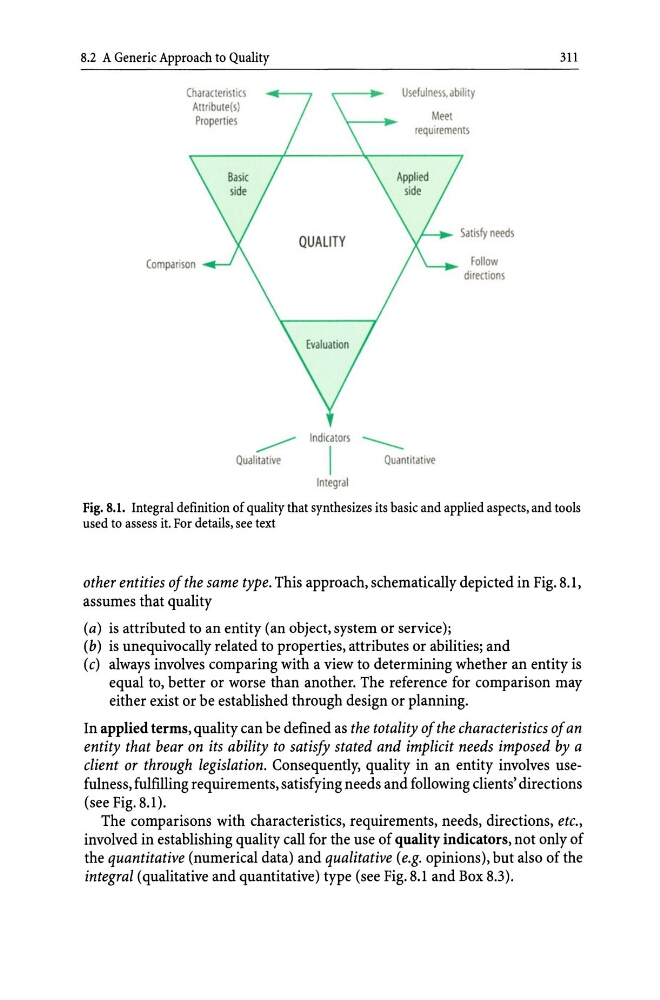
Fig. 8.1. Integral definition of quality that synthesizes its basic and applied aspects, and tools
used to assess it. For details, see text
other entities of the same type. This approach, schematically depicted in Fig. 8.1,
assumes that quality
(a) is attributed to an entity (an object, system or service);
(b) is unequivocally related to properties, attributes or abilities; and
(c) always involves comparing with a view to determining whether an entity is
equal to, better or worse than another. The reference for comparison may
either exist or be established through design or planning.
In applied terms, quality can be defined as the totality of the characteristics of an
entity that bear on its ability to satisfy stated and implicit needs imposed by a
client or through legislation. Consequently, quality in an entity involves usefulness, fulfilling requirements, satisfying needs and following clients' directions
(see Fig. 8.1).
The comparisons with characteristics, requirements, needs, directions, etc.,
involved in establishing quality call for the use of quality indicators, not only of
the quantitative (numerical data) and qualitative (e.g. opinions), but also of the
integral (qualitative and quantitative) type (see Fig. 8.1 and Box 8.3).
Characteristi(s
Attribute(s)
Properties
Comparison
Qualitative
QUALITY
Indi
Integral
Usefulness. ability
Meet
requirements
--Quantitative
Satisfy needs
Follow
dire
Fig. 8.1. Integral definition of quality that synthesizes its basic and applied aspects, and tools
used to assess it. For details, see text
other entities of the same type. This approach, schematically depicted in Fig. 8.1,
assumes that quality
(a) is attributed to an entity (an object, system or service);
(b) is unequivocally related to properties, attributes or abilities; and
(c) always involves comparing with a view to determining whether an entity is
equal to, better or worse than another. The reference for comparison may
either exist or be established through design or planning.
In applied terms, quality can be defined as the totality of the characteristics of an
entity that bear on its ability to satisfy stated and implicit needs imposed by a
client or through legislation. Consequently, quality in an entity involves usefulness, fulfilling requirements, satisfying needs and following clients' directions
(see Fig. 8.1).
The comparisons with characteristics, requirements, needs, directions, etc.,
involved in establishing quality call for the use of quality indicators, not only of
the quantitative (numerical data) and qualitative (e.g. opinions), but also of the
integral (qualitative and quantitative) type (see Fig. 8.1 and Box 8.3).