

S.l Introduction
Box 8.1
Consistency Between the Results of the Determination of Metal Traces in the
Same Lichen Specimen Produced by Fourteen Expert Laboratories
309
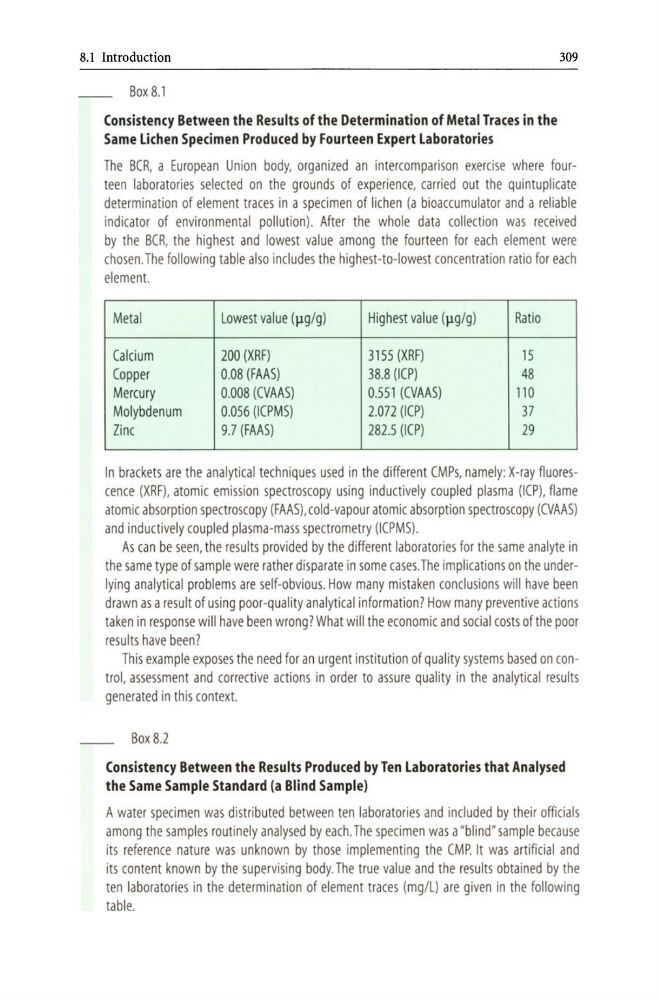
The BCR, a European Union body, organized an intercomparison exercise where fourteen laboratories selected on the grounds of experience, carried out the quintuplicate
determination of element traces in a specimen of lichen (a bioaccumulator and a reliable
indicator of environmental pollution). After the whole data collection was received
by the BCR. the highest and lowest value among the fourteen for each element were
chosen. The following table also includes the highest-to-Iowest concentration ratio for each
element.
Metal
Lowest value ( ~g/g)
Highest va lue (~g/g)
Ratio
Calcium
200 (XRF)
3155 (XRF)
15
Copper
0.08 (FAAS)
38.8 (ICP)
48
Mercury
0.008 (CVAAS)
0.551 (CVAAS)
110
Molybdenum
0.056 (lCPMS)
2.072 (lCP)
37
Zinc
9.7 (FAAS)
282.5 (ICP)
29
In brackets are the analytical techniques used in the different CMPs, namely: X-ray fluorescence (XRF), atomic emission spectroscopy using inductively coupled plasma (lCP), flame
atomic absorption spectroscopy (FAASl. cold-vapour atomic absorption spectroscopy (CVAAS)
and inductively coupled plasma-mass spectrometry (ICPMS).
As can be seen, the results provided by the different laboratories for the same analyte in
the same type of sample were rather disparate in some cases. The implications on the underlying analytical problems are self-obvious. How many mistaken conclusions will have been
drawn as a result of using poor-quality analytical information? How many preventive actions
taken in response will have been wrong? What will the economic and social costs of the poor
results have been?
This example exposes the need for an urgent institution of quality systems based on control, assessment and corrective actions in order to assure quality in the analytical results
generated in this context.
__ Box 8.2
Consistency Between the Results Produced by Ten Laboratories that Analysed
the Same Sample Standard (a Blind Sample)
A water specimen was distributed between ten laboratories and included by their officials
among the samples routinely analysed by each. The specimen was a "blind" sample because
its reference nature was unknown by those implementing the CMP. It was artificial and
its content known by the supervising body. The true va lue and the results obtained by the
ten laboratories in the determination of element traces (mg/L) are given in the following
table.
Box 8.1
Consistency Between the Results of the Determination of Metal Traces in the
Same Lichen Specimen Produced by Fourteen Expert Laboratories
309
The BCR, a European Union body, organized an intercomparison exercise where fourteen laboratories selected on the grounds of experience, carried out the quintuplicate
determination of element traces in a specimen of lichen (a bioaccumulator and a reliable
indicator of environmental pollution). After the whole data collection was received
by the BCR. the highest and lowest value among the fourteen for each element were
chosen. The following table also includes the highest-to-Iowest concentration ratio for each
element.
Metal
Lowest value ( ~g/g)
Highest va lue (~g/g)
Ratio
Calcium
200 (XRF)
3155 (XRF)
15
Copper
0.08 (FAAS)
38.8 (ICP)
48
Mercury
0.008 (CVAAS)
0.551 (CVAAS)
110
Molybdenum
0.056 (lCPMS)
2.072 (lCP)
37
Zinc
9.7 (FAAS)
282.5 (ICP)
29
In brackets are the analytical techniques used in the different CMPs, namely: X-ray fluorescence (XRF), atomic emission spectroscopy using inductively coupled plasma (lCP), flame
atomic absorption spectroscopy (FAASl. cold-vapour atomic absorption spectroscopy (CVAAS)
and inductively coupled plasma-mass spectrometry (ICPMS).
As can be seen, the results provided by the different laboratories for the same analyte in
the same type of sample were rather disparate in some cases. The implications on the underlying analytical problems are self-obvious. How many mistaken conclusions will have been
drawn as a result of using poor-quality analytical information? How many preventive actions
taken in response will have been wrong? What will the economic and social costs of the poor
results have been?
This example exposes the need for an urgent institution of quality systems based on control, assessment and corrective actions in order to assure quality in the analytical results
generated in this context.
__ Box 8.2
Consistency Between the Results Produced by Ten Laboratories that Analysed
the Same Sample Standard (a Blind Sample)
A water specimen was distributed between ten laboratories and included by their officials
among the samples routinely analysed by each. The specimen was a "blind" sample because
its reference nature was unknown by those implementing the CMP. It was artificial and
its content known by the supervising body. The true va lue and the results obtained by the
ten laboratories in the determination of element traces (mg/L) are given in the following
table.