

7.5 Steps of the Analytical Problem-solving Process
Material and human
resou rces available
Factors infl uencing the
choice of CMP
Characteristics of the object/sample and analytes
Agreed cost, global
or per analysis
295
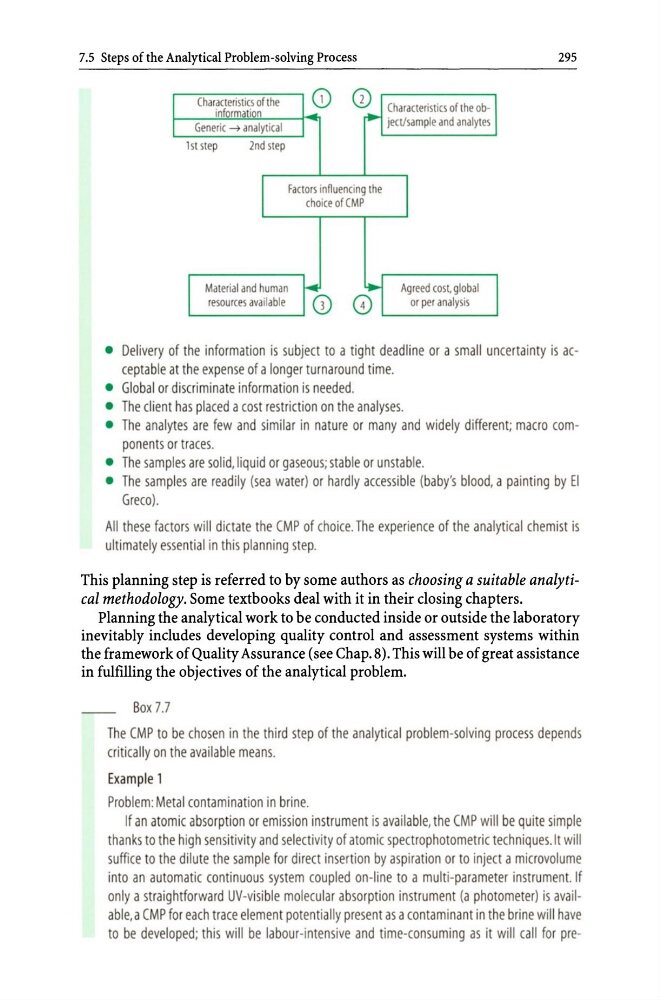
• Delivery of the information is su bject to a tight deadline or a small uncertainty is acceptable at the expense of a longer turnaround time.
• Global or discriminate information is needed.
• The cl ient has placed a cost restriction on the analyses.
• The analytes are few and simila r in nature or many and widely different; macro components or traces.
• The samples are solid, liquid or gaseous; stable or unstable.
• The samples are readily (sea water) or hardly accessible (baby's blood, a painting by EI
Greco).
All these factors will dictate the CMP of choice. The experience of the analytical chemist is
ultimately essential in this planning step.
This planning step is referred to by some authors as choosing a suitable analytical methodology. Some textbooks deal with it in their closing chapters.
Planning the analytical work to be conducted inside or outside the laboratory
inevitably includes developing quality control and assessment systems within
the framework of Quality Assurance (see Chap. 8). This will be of great assistance
in fulfilling the objectives of the analytical problem.
Box 7.7
The CMP to be chosen in the third step of the analytical problem-solving process depends
critically on the available means.
Example 1
Problem: Metal contamination in brine.
If an atomic absorption or emission instrument is available, the CMP will be quite simple
thanks to the high sensitivity and selectivity of atomic spectrophotometric techniques. It will
suffice to the dilute the sample for direct insertion by aspiration or to inject a microvolume
into an automatic continuous system coupled on-line to a multi-parameter instrument. If
only a straightforward UV-visible molecular absorption instrument (a photometer) is available,a CMP for each trace element potentially present as a contaminant in the brine will have
to be developed; this will be labour-intensive and time-consuming as it will call for pre-
Material and human
resou rces available
Factors infl uencing the
choice of CMP
Characteristics of the object/sample and analytes
Agreed cost, global
or per analysis
295
• Delivery of the information is su bject to a tight deadline or a small uncertainty is acceptable at the expense of a longer turnaround time.
• Global or discriminate information is needed.
• The cl ient has placed a cost restriction on the analyses.
• The analytes are few and simila r in nature or many and widely different; macro components or traces.
• The samples are solid, liquid or gaseous; stable or unstable.
• The samples are readily (sea water) or hardly accessible (baby's blood, a painting by EI
Greco).
All these factors will dictate the CMP of choice. The experience of the analytical chemist is
ultimately essential in this planning step.
This planning step is referred to by some authors as choosing a suitable analytical methodology. Some textbooks deal with it in their closing chapters.
Planning the analytical work to be conducted inside or outside the laboratory
inevitably includes developing quality control and assessment systems within
the framework of Quality Assurance (see Chap. 8). This will be of great assistance
in fulfilling the objectives of the analytical problem.
Box 7.7
The CMP to be chosen in the third step of the analytical problem-solving process depends
critically on the available means.
Example 1
Problem: Metal contamination in brine.
If an atomic absorption or emission instrument is available, the CMP will be quite simple
thanks to the high sensitivity and selectivity of atomic spectrophotometric techniques. It will
suffice to the dilute the sample for direct insertion by aspiration or to inject a microvolume
into an automatic continuous system coupled on-line to a multi-parameter instrument. If
only a straightforward UV-visible molecular absorption instrument (a photometer) is available,a CMP for each trace element potentially present as a contaminant in the brine will have
to be developed; this will be labour-intensive and time-consuming as it will call for pre-