

256
6 Quantitative Aspects of Analytical Chemistry
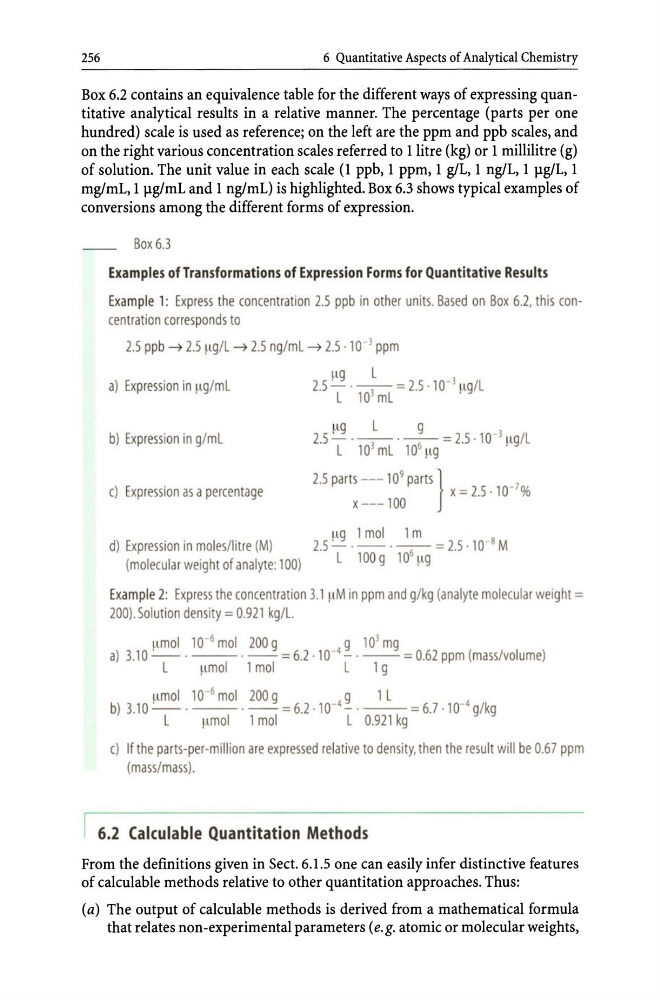
Box 6.2 contains an equivalence table for the different ways of expressing quantitative analytical results in a relative manner. The percentage (parts per one
hundred) scale is used as reference; on the left are the ppm and ppb scales, and
on the right various concentration scales referred to 1 litre (kg) or 1 millilitre (g)
of solution. The unit value in each scale (1 ppb, 1 ppm, 1 gIL, 1 ng/L, 1 }lg/L, 1
mg/mL, 1 }lg/mL and 1 ng/mL) is highlighted. Box 6.3 shows typical examples of
conversions among the different forms of expression.
__ Box6.3
Examples of Transformations of Expression Forms for Quantitative Results
Example 1: Express the concentration 2.5 ppb in other units. Based on Box 6.2, this concentration corresponds to
2.5 ppb --7 2.5 ~lg/ L --7 2.5 ng/mL --72.5·10 l ppm
~lg
L
a) Expression in ~lg/mL
2.5 - . - - = 2.5 . 10- 3 ~Lg/l
L 10 3 mL
b) Expression in g/mL
c) Expression as a percentage
d) Expression in moles/litre (M)
(molecular weight of analyte: 100)
~lg
L
9
2.5 - · - -. - - = 2 5 .1O- J [[gIL
L 101mL 106 ~Lg'
.
2.5 parts --- 10 9 parts}
7
x= 2.5·10 - %
x --- 100
~lg 1 mol 1 m
- 8
2.5 - · _
·- - = 2.5·10 M
L 100 9 10 6 ~lg
Example 2: Express the concentration 3.1 ~lM in ppm and g/kg (analyte molecular weight =
200). Solution density = 0.921 kg/L.
~Lmol 10- 6 mol 200 9
4 9 10 J mg
a) 3.10 - - . - - . - - = 6.2 ·10- - . - - = 0.62 ppm (mass/volume)
L
~Lmo l
1 mol
L 1 9
~lmol 10- 6 mol 200 9
- 4 9
1 L
- 4
b) 3.10- · - - · - = 6.2· 10 - · - - = 6.7·10 g/ kg
L
~lmol
1 mol
L 0.921 kg
c) If the parts-per-million are expressed relative to density, then the result wil l be 0.67 ppm
(mass/mass).
6.2 Calculable Quantitation Methods
From the definitions given in Sect. 6.1.5 one can easily infer distinctive features
of calculable methods relative to other quantitation approaches. Thus:
(a) The output of calculable methods is derived from a mathematical formula
that relates non -experimental parameters (e. g. atomic or molecular weights,
6 Quantitative Aspects of Analytical Chemistry
Box 6.2 contains an equivalence table for the different ways of expressing quantitative analytical results in a relative manner. The percentage (parts per one
hundred) scale is used as reference; on the left are the ppm and ppb scales, and
on the right various concentration scales referred to 1 litre (kg) or 1 millilitre (g)
of solution. The unit value in each scale (1 ppb, 1 ppm, 1 gIL, 1 ng/L, 1 }lg/L, 1
mg/mL, 1 }lg/mL and 1 ng/mL) is highlighted. Box 6.3 shows typical examples of
conversions among the different forms of expression.
__ Box6.3
Examples of Transformations of Expression Forms for Quantitative Results
Example 1: Express the concentration 2.5 ppb in other units. Based on Box 6.2, this concentration corresponds to
2.5 ppb --7 2.5 ~lg/ L --7 2.5 ng/mL --72.5·10 l ppm
~lg
L
a) Expression in ~lg/mL
2.5 - . - - = 2.5 . 10- 3 ~Lg/l
L 10 3 mL
b) Expression in g/mL
c) Expression as a percentage
d) Expression in moles/litre (M)
(molecular weight of analyte: 100)
~lg
L
9
2.5 - · - -. - - = 2 5 .1O- J [[gIL
L 101mL 106 ~Lg'
.
2.5 parts --- 10 9 parts}
7
x= 2.5·10 - %
x --- 100
~lg 1 mol 1 m
- 8
2.5 - · _
·- - = 2.5·10 M
L 100 9 10 6 ~lg
Example 2: Express the concentration 3.1 ~lM in ppm and g/kg (analyte molecular weight =
200). Solution density = 0.921 kg/L.
~Lmol 10- 6 mol 200 9
4 9 10 J mg
a) 3.10 - - . - - . - - = 6.2 ·10- - . - - = 0.62 ppm (mass/volume)
L
~Lmo l
1 mol
L 1 9
~lmol 10- 6 mol 200 9
- 4 9
1 L
- 4
b) 3.10- · - - · - = 6.2· 10 - · - - = 6.7·10 g/ kg
L
~lmol
1 mol
L 0.921 kg
c) If the parts-per-million are expressed relative to density, then the result wil l be 0.67 ppm
(mass/mass).
6.2 Calculable Quantitation Methods
From the definitions given in Sect. 6.1.5 one can easily infer distinctive features
of calculable methods relative to other quantitation approaches. Thus:
(a) The output of calculable methods is derived from a mathematical formula
that relates non -experimental parameters (e. g. atomic or molecular weights,