

1.1 Analytical Chemistry Today
5
The analyte species to be determined in analytical chemical measurement processes can be chemical (drugs, fat, inorganic ions), biochemical (aminoacids,
proteins, enzymes) and, occasionally, also biological (microbes, pollen). The
naturally occurring or artificial material to be analysed can be chemical (an
alloy, a pharmaceutical preparation, a solvent), biochemical (serum, urine, sage)
or biological (animal or plant tissue). Whether Analytical Chemistry is to deal
with "biological" information and analytes may be a matter for debate; that it
must deal with biological materials is beyond dispute.
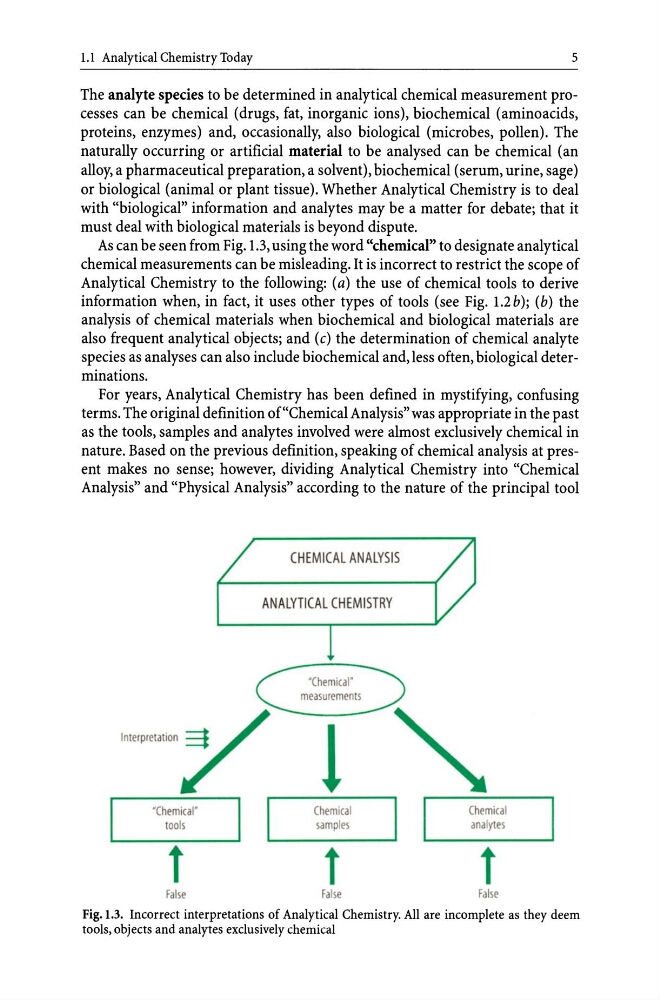
As can be seen from Fig. 1.3, using the word "chemical" to designate analytical
chemical measurements can be misleading. It is incorrect to restrict the scope of
Analytical Chemistry to the following: (a) the use of chemical tools to derive
information when, in fact, it uses other types of tools (see Fig. l.2b); (b) the
analysis of chemical materials when biochemical and biological materials are
also frequent analytical objects; and (c) the determination of chemical analyte
species as analyses can also include biochemical and, less often, biological determinations.
For years, Analytical Chemistry has been defined in mystifying, confusing
terms. The original definition of "Chemical Analysis" was appropriate in the past
as the tools, samples and analytes involved were almost exclusively chemical in
nature. Based on the previous definition, speaking of chemical analysis at present makes no sense; however, dividing Analytical Chemistry into "Chemical
Analysis" and "Physical Analysis" according to the nature of the principal tool
' Chemical"
lools
t
False
CHEMICAL ANALYSIS
ANALYTICAL CHEMISTRY
"Chemical"
measurements
1" r--------...,
Chemical
Chemical
samples
ana lyles
t
t
False
False
Fig. 1.3. Incorrect interpretations of Analytical Chemistry. All are incomplete as they deem
tools, objects and analytes exclusively chemical
5
The analyte species to be determined in analytical chemical measurement processes can be chemical (drugs, fat, inorganic ions), biochemical (aminoacids,
proteins, enzymes) and, occasionally, also biological (microbes, pollen). The
naturally occurring or artificial material to be analysed can be chemical (an
alloy, a pharmaceutical preparation, a solvent), biochemical (serum, urine, sage)
or biological (animal or plant tissue). Whether Analytical Chemistry is to deal
with "biological" information and analytes may be a matter for debate; that it
must deal with biological materials is beyond dispute.
As can be seen from Fig. 1.3, using the word "chemical" to designate analytical
chemical measurements can be misleading. It is incorrect to restrict the scope of
Analytical Chemistry to the following: (a) the use of chemical tools to derive
information when, in fact, it uses other types of tools (see Fig. l.2b); (b) the
analysis of chemical materials when biochemical and biological materials are
also frequent analytical objects; and (c) the determination of chemical analyte
species as analyses can also include biochemical and, less often, biological determinations.
For years, Analytical Chemistry has been defined in mystifying, confusing
terms. The original definition of "Chemical Analysis" was appropriate in the past
as the tools, samples and analytes involved were almost exclusively chemical in
nature. Based on the previous definition, speaking of chemical analysis at present makes no sense; however, dividing Analytical Chemistry into "Chemical
Analysis" and "Physical Analysis" according to the nature of the principal tool
' Chemical"
lools
t
False
CHEMICAL ANALYSIS
ANALYTICAL CHEMISTRY
"Chemical"
measurements
1" r--------...,
Chemical
Chemical
samples
ana lyles
t
t
False
False
Fig. 1.3. Incorrect interpretations of Analytical Chemistry. All are incomplete as they deem
tools, objects and analytes exclusively chemical