

Annex II
KCN solution prepare a series of standards
containing from 0.2 to 6 }lg CN in 20 mL
solution using the 2 g NaOH/L solution for all
dilutions. Treat standards in accordance with
Section b below. Plot absorbance of standards against CN concentration (micrograms).
Recheck calibration curve periodically
and each time a new reagent is prepared.
On the basis of the first calibration curve,
prepare additional standards containing less
than 0.2 and more than 6 }lg CN to determine
the limits measurable with the photometer
being used.
b. Colour development: Adjust photometer to zero absorbance each time using a
blank consisting of the NaOH dilution solution and all reagents. Take a portion of
absorption liquid obtained in Method B, such
that the CN concentration falls in the measurable range, and dilute to 20 mL with NaOH
solution. Place the portion in a 50-mL volumetric flask. Add 4 mL phosphate buffer and
mix thoroughly. Add 2.0 mL chloramine-T
solution and swirl to mix. Immediately, add
5 mL pyridine-barbituric acid solution and
swirl gently to mix. Dilute to mark with
water; mix well by inversion.
Measure absorbance with the photometer
at 578 nm after 8 min but within 15 min from
the time of adding the pyridine-barbituric
acid reagent. Even with the specified time of
185
8 to 15 min there is a slight change in absorbance. To minimize this, standardize time
for all readings. Using the calibration curve
and the formula in Section 5 below, determine CN concentration in original sample.
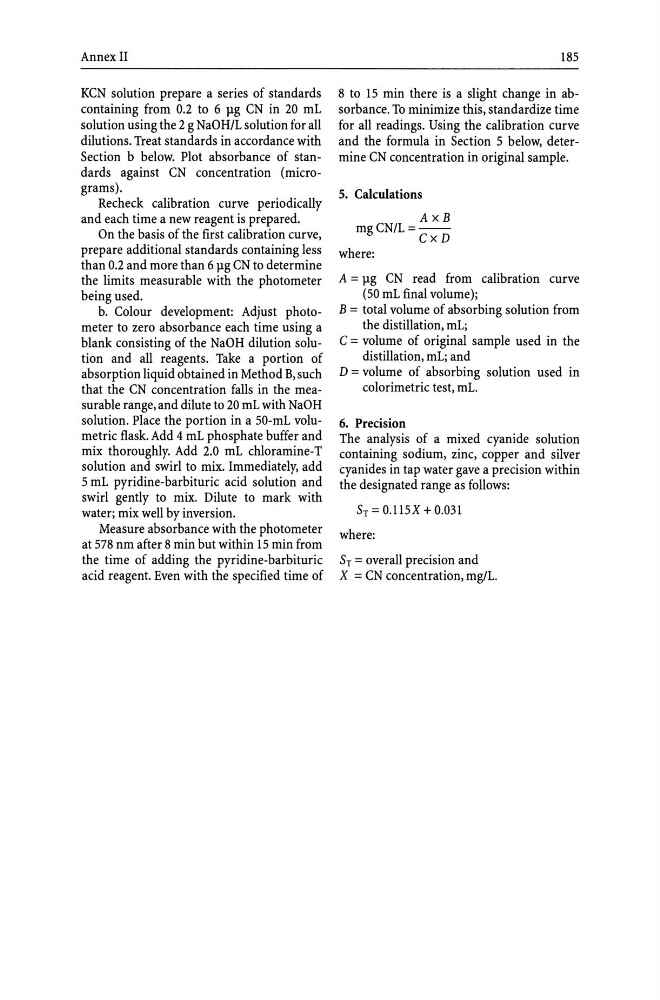
5. Calculations
AxB
mgCN/L=-CxD
where:
A =}lg CN read from calibration curve
(50 mL final volume);
B = total volume of absorbing solution from
the distillation, mL;
C = volume of original sample used in the
distillation, mL; and
D = volume of absorbing solution used in
colorimetric test, mL.
6. Precision
The analysis of a mixed cyanide solution
containing sodium, zinc, copper and silver
cyanides in tap water gave a precision within
the designated range as follows:
Sr = 0.115X + 0.031
where:
Sr = overall precision and
X = CN concentration, mg/L.
KCN solution prepare a series of standards
containing from 0.2 to 6 }lg CN in 20 mL
solution using the 2 g NaOH/L solution for all
dilutions. Treat standards in accordance with
Section b below. Plot absorbance of standards against CN concentration (micrograms).
Recheck calibration curve periodically
and each time a new reagent is prepared.
On the basis of the first calibration curve,
prepare additional standards containing less
than 0.2 and more than 6 }lg CN to determine
the limits measurable with the photometer
being used.
b. Colour development: Adjust photometer to zero absorbance each time using a
blank consisting of the NaOH dilution solution and all reagents. Take a portion of
absorption liquid obtained in Method B, such
that the CN concentration falls in the measurable range, and dilute to 20 mL with NaOH
solution. Place the portion in a 50-mL volumetric flask. Add 4 mL phosphate buffer and
mix thoroughly. Add 2.0 mL chloramine-T
solution and swirl to mix. Immediately, add
5 mL pyridine-barbituric acid solution and
swirl gently to mix. Dilute to mark with
water; mix well by inversion.
Measure absorbance with the photometer
at 578 nm after 8 min but within 15 min from
the time of adding the pyridine-barbituric
acid reagent. Even with the specified time of
185
8 to 15 min there is a slight change in absorbance. To minimize this, standardize time
for all readings. Using the calibration curve
and the formula in Section 5 below, determine CN concentration in original sample.
5. Calculations
AxB
mgCN/L=-CxD
where:
A =}lg CN read from calibration curve
(50 mL final volume);
B = total volume of absorbing solution from
the distillation, mL;
C = volume of original sample used in the
distillation, mL; and
D = volume of absorbing solution used in
colorimetric test, mL.
6. Precision
The analysis of a mixed cyanide solution
containing sodium, zinc, copper and silver
cyanides in tap water gave a precision within
the designated range as follows:
Sr = 0.115X + 0.031
where:
Sr = overall precision and
X = CN concentration, mg/L.