

182
4 The Measurement Process in Chemistry
Annex II
Determination of cyanide in water
Learning objective:
To illustrate the analytical process for the determination of total cyanide ( viz. free cyanide and
cyanide bound as metal complexes) in water. Following distillation to avoid matrix effects and
preconcentrate the analyte, cyanide can be determined in two ways: titrimetrically and photometrically.
Reference:
Standard Methods for Examination of Water and Wastewater
American Public Health Association, Washington, D.C., 1989, pp 317-322.
412 B. Total Cyanide after Distillation
1. General Discussion
Hydrogen cyanide (HCN) is liberated from
an acidified sample by distillation and
purging with air. The HCN gas is collected by
passing it through an NaOH scrubbing solution. Cyanide concentration in the scrubbing
solution is determined by either titrimetric,
colorimetric or potentiometric procedures.
2. Apparatus
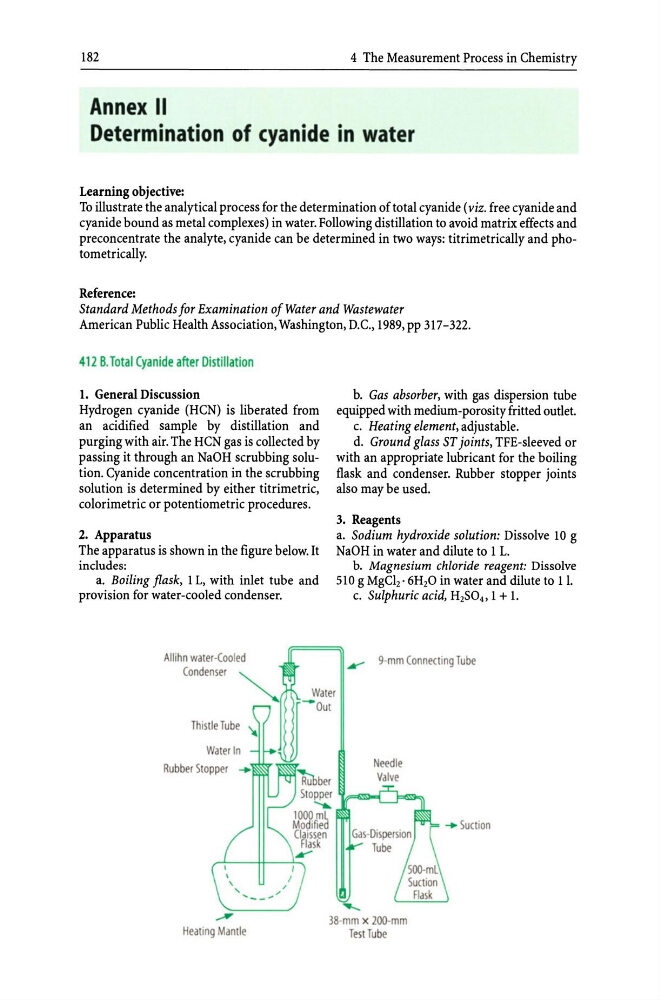
The apparatus is shown in the figure below. It
includes:
a. Boiling flask, 1 L, with inlet tube and
provision for water-cooled condenser.
Allihn water-Cooled
Condenser
Water In
Rubber Stopper ...
--Heating Mantle
b. Gas absorber, with gas dispersion tube
equipped with medium-porosity fritted outlet.
c. Heating element, adjustable.
d. Ground glass ST joints, TFE-sleeved or
with an appropriate lubricant for the boiling
flask and condenser. Rubber stopper joints
also may be used.
3. Reagents
a. Sodium hydroxide solution: Dissolve 10 g
NaOH in water and dilute to 1 L.
b. Magnesium chloride reagent: Dissolve
510 g MgCh· 6H20 in water and dilute to 11.
c. Sulphuric acid, H2S04 , 1 + 1.
,¥'
9-mm Connecting Tube
Needle
Valve
38·mm x 200·mm
Test Tube
4 The Measurement Process in Chemistry
Annex II
Determination of cyanide in water
Learning objective:
To illustrate the analytical process for the determination of total cyanide ( viz. free cyanide and
cyanide bound as metal complexes) in water. Following distillation to avoid matrix effects and
preconcentrate the analyte, cyanide can be determined in two ways: titrimetrically and photometrically.
Reference:
Standard Methods for Examination of Water and Wastewater
American Public Health Association, Washington, D.C., 1989, pp 317-322.
412 B. Total Cyanide after Distillation
1. General Discussion
Hydrogen cyanide (HCN) is liberated from
an acidified sample by distillation and
purging with air. The HCN gas is collected by
passing it through an NaOH scrubbing solution. Cyanide concentration in the scrubbing
solution is determined by either titrimetric,
colorimetric or potentiometric procedures.
2. Apparatus
The apparatus is shown in the figure below. It
includes:
a. Boiling flask, 1 L, with inlet tube and
provision for water-cooled condenser.
Allihn water-Cooled
Condenser
Water In
Rubber Stopper ...
--Heating Mantle
b. Gas absorber, with gas dispersion tube
equipped with medium-porosity fritted outlet.
c. Heating element, adjustable.
d. Ground glass ST joints, TFE-sleeved or
with an appropriate lubricant for the boiling
flask and condenser. Rubber stopper joints
also may be used.
3. Reagents
a. Sodium hydroxide solution: Dissolve 10 g
NaOH in water and dilute to 1 L.
b. Magnesium chloride reagent: Dissolve
510 g MgCh· 6H20 in water and dilute to 11.
c. Sulphuric acid, H2S04 , 1 + 1.
,¥'
9-mm Connecting Tube
Needle
Valve
38·mm x 200·mm
Test Tube