

180
4 The Measurement Process in Chemistry
303 B. Determination of Low Concentrations of Cadmium, Chromium, Coball, Copper, Iron. Lead, Manganese, Nickel, Silver and Zinc by Chelation with Ammonium Pyrrolidine Dilhiocarbamale (APDC) and Extraction into Methyl Isobutyl ketone (MIBK)
1. Apparatus
a. Atomic absorption spectrophotometer and
associated equipment: See Section 303.2.
b. Burner head, conventional. Consult
manufacturer's operating manual for suggested burner head.
c. Separatory funnels, 250 mL, with TFE
stopcocks.
2. Reagents
a. Air: See 303A.2a.
b. Acetylene: See 303A.2 b.
c. Metal-free water: See 303A.2c.
d. Methyl isobutyl ketone (MIBK), reagent
grade. For trace analysis, purify MIBK by
redistillation or by sub-boiling distillation.
e. Ammonium pyrrolidine dithiocarbamate (APDC) solution: Dissolve 4 g APDC in
100 mL water. If necessary, purify APDC with
an equal volume of MIBK. Shake 30 s in a
separatory funnel, let separate, and withdraw
lower portion. Discard MIBK layer.
f. Nitric acid, HN03, conc., ultrapure.
g. Standard metal solutions: See 303A.21.
h. Potassium permanganate solution,
KMn04, 5% aqueous.
i. Sodium sulphate, Na2S04' anhydrous.
j. Water-saturated MIBK: Mix one part
purified MIBK with one part water in a separatory funnel. Shake 30 s and let separate.
Discard aqueous layer. Save MIBK layer.
3. Procedure
a. Instrument operation: See Section 303 A.3 a.
After final adjusting of burner position,
aspirate water-saturated MIBK into flame
and gradually reduce fuel flow until flame is
similar to that before aspiration of solvent.
b. Standardization: Select at least three
standard metal solutions (prepared as in
303A.21) to bracket expected sample metal
concentration and to be, after extraction, in
the optimum concentration range of the
instrument. Adjust 100 mL of each standard
and 100 mL of a metal-free water blank to pH
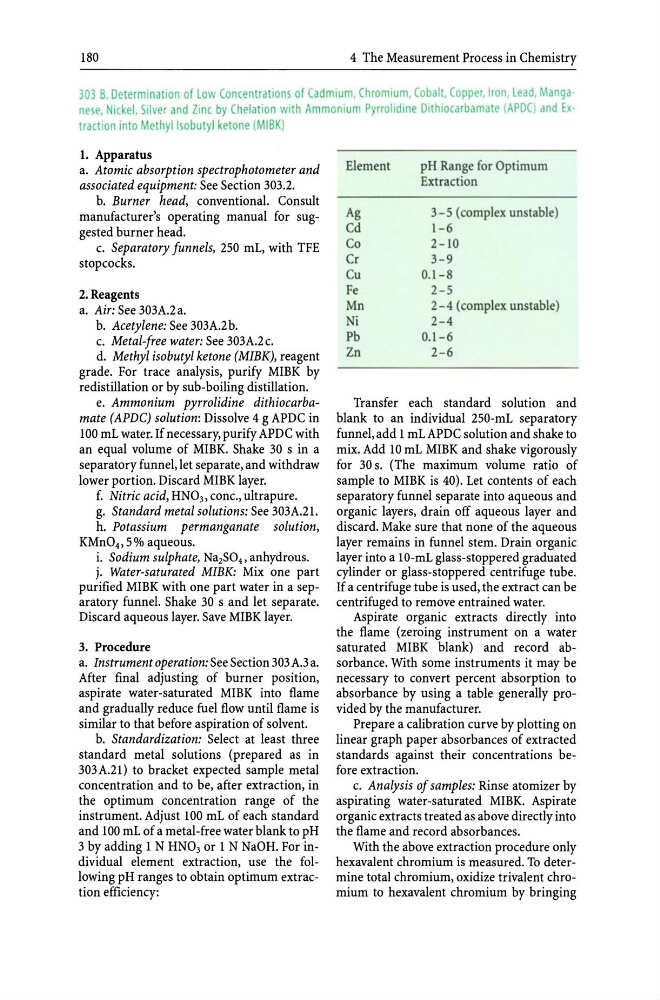
3 by adding 1 N HN03 or 1 N NaOH. For individual element extraction, use the following pH ranges to obtain optimum extraction efficiency:
Element
Ag
Cd
Co
Cr
Cu
Fe
Mn
I
Pb
Zn
pH Range for Optimum
Extraction
3 - 5 (complex unstable)
1-6
2-10
3- 9
0.1-8
2 - 5
2-4 (complex unstable)
2 - 4
0_1- 6
2- 6
Transfer each standard solution and
blank to an individual 250-mL separatory
funnel, add 1 mL APDC solution and shake to
mix. Add 10 mL MIBK and shake vigorously
for 30 s. (The maximum volume ratio of
sample to MIBK is 40). Let contents of each
separatory funnel separate into aqueous and
organic layers, drain off aqueous layer and
discard. Make sure that none of the aqueous
layer remains in funnel stem. Drain organic
layer into a lO-mL glass-stoppered graduated
cylinder or glass-stoppered centrifuge tube.
If a centrifuge tube is used, the extract can be
centrifuged to remove entrained water.
Aspirate organic extracts directly into
the flame (zeroing instrument on a water
saturated MIBK blank) and record absorbance. With some instruments it may be
necessary to convert percent absorption to
absorbance by using a table generally provided by the manufacturer.
Prepare a calibration curve by plotting on
linear graph paper absorbances of extracted
standards against their concentrations before extraction.
c. Analysis of samples: Rinse atomizer by
aspirating water-saturated MIBK. Aspirate
organic extracts treated as above directly into
the flame and record absorbances.
With the above extraction procedure only
hexavalent chromium is measured. To determine total chromium, oxidize trivalent chromium to hexavalent chromium by bringing
4 The Measurement Process in Chemistry
303 B. Determination of Low Concentrations of Cadmium, Chromium, Coball, Copper, Iron. Lead, Manganese, Nickel, Silver and Zinc by Chelation with Ammonium Pyrrolidine Dilhiocarbamale (APDC) and Extraction into Methyl Isobutyl ketone (MIBK)
1. Apparatus
a. Atomic absorption spectrophotometer and
associated equipment: See Section 303.2.
b. Burner head, conventional. Consult
manufacturer's operating manual for suggested burner head.
c. Separatory funnels, 250 mL, with TFE
stopcocks.
2. Reagents
a. Air: See 303A.2a.
b. Acetylene: See 303A.2 b.
c. Metal-free water: See 303A.2c.
d. Methyl isobutyl ketone (MIBK), reagent
grade. For trace analysis, purify MIBK by
redistillation or by sub-boiling distillation.
e. Ammonium pyrrolidine dithiocarbamate (APDC) solution: Dissolve 4 g APDC in
100 mL water. If necessary, purify APDC with
an equal volume of MIBK. Shake 30 s in a
separatory funnel, let separate, and withdraw
lower portion. Discard MIBK layer.
f. Nitric acid, HN03, conc., ultrapure.
g. Standard metal solutions: See 303A.21.
h. Potassium permanganate solution,
KMn04, 5% aqueous.
i. Sodium sulphate, Na2S04' anhydrous.
j. Water-saturated MIBK: Mix one part
purified MIBK with one part water in a separatory funnel. Shake 30 s and let separate.
Discard aqueous layer. Save MIBK layer.
3. Procedure
a. Instrument operation: See Section 303 A.3 a.
After final adjusting of burner position,
aspirate water-saturated MIBK into flame
and gradually reduce fuel flow until flame is
similar to that before aspiration of solvent.
b. Standardization: Select at least three
standard metal solutions (prepared as in
303A.21) to bracket expected sample metal
concentration and to be, after extraction, in
the optimum concentration range of the
instrument. Adjust 100 mL of each standard
and 100 mL of a metal-free water blank to pH
3 by adding 1 N HN03 or 1 N NaOH. For individual element extraction, use the following pH ranges to obtain optimum extraction efficiency:
Element
Ag
Cd
Co
Cr
Cu
Fe
Mn
I
Pb
Zn
pH Range for Optimum
Extraction
3 - 5 (complex unstable)
1-6
2-10
3- 9
0.1-8
2 - 5
2-4 (complex unstable)
2 - 4
0_1- 6
2- 6
Transfer each standard solution and
blank to an individual 250-mL separatory
funnel, add 1 mL APDC solution and shake to
mix. Add 10 mL MIBK and shake vigorously
for 30 s. (The maximum volume ratio of
sample to MIBK is 40). Let contents of each
separatory funnel separate into aqueous and
organic layers, drain off aqueous layer and
discard. Make sure that none of the aqueous
layer remains in funnel stem. Drain organic
layer into a lO-mL glass-stoppered graduated
cylinder or glass-stoppered centrifuge tube.
If a centrifuge tube is used, the extract can be
centrifuged to remove entrained water.
Aspirate organic extracts directly into
the flame (zeroing instrument on a water
saturated MIBK blank) and record absorbance. With some instruments it may be
necessary to convert percent absorption to
absorbance by using a table generally provided by the manufacturer.
Prepare a calibration curve by plotting on
linear graph paper absorbances of extracted
standards against their concentrations before extraction.
c. Analysis of samples: Rinse atomizer by
aspirating water-saturated MIBK. Aspirate
organic extracts treated as above directly into
the flame and record absorbances.
With the above extraction procedure only
hexavalent chromium is measured. To determine total chromium, oxidize trivalent chromium to hexavalent chromium by bringing