

2
1 Introduction to Analytical Chemistry
Unlike mathematical, grammar, economic and historical analysis, for example, Analytical Chemistry is concerned with the most tangible analytical
targets, viz. objects and systems. Depending on the nature of the qualitative and
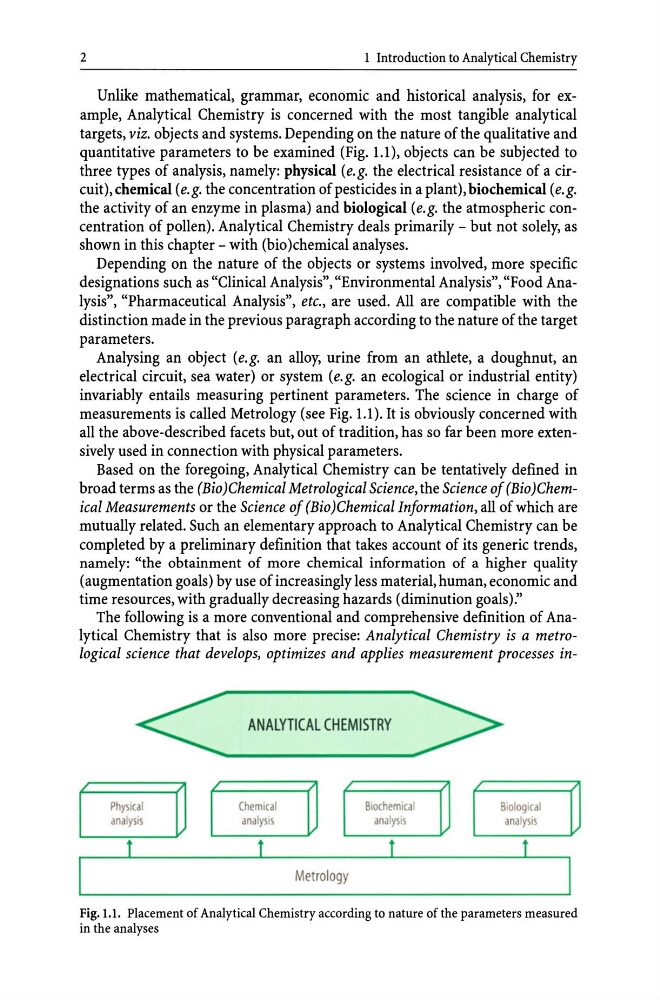
quantitative parameters to be examined (Fig. 1.1), objects can be subjected to
three types of analysis, namely: physical (e.g. the electrical resistance of a circuit), chemical (e. g. the concentration of pesticides in a plant), biochemical (e.g.
the activity of an enzyme in plasma) and biological (e.g. the atmospheric concentration of pollen). Analytical Chemistry deals primarily - but not solely, as
shown in this chapter - with (bio )chemical analyses.
Depending on the nature of the objects or systems involved, more specific
designations such as "Clinical Analysis", "Environmental Analysis", "Food Analysis", "Pharmaceutical Analysis", etc., are used. All are compatible with the
distinction made in the previous paragraph according to the nature of the target
parameters.
Analysing an object (e.g. an alloy, urine from an athlete, a doughnut, an
electrical circuit, sea water) or system (e.g. an ecological or industrial entity)
invariably entails measuring pertinent parameters. The science in charge of
measurements is called Metrology (see Fig. 1.1). It is obviously concerned with
all the above-described facets but, out of tradition, has so far been more extensively used in connection with physical parameters.
Based on the foregoing, Analytical Chemistry can be tentatively defined in
broad terms as the (Bio )Chemical Metrological Science, the Science of (Bio )Chemical Measurements or the Science of (Bio )Chemical Information, all of which are
mutually related. Such an elementary approach to Analytical Chemistry can be
completed by a preliminary definition that takes account of its generic trends,
namely: "the obtainment of more chemical information of a higher quality
(augmentation goals) by use of increasingly less material, human, economic and
time resources, with gradually decreasing hazards (diminution goals);'
The following is a more conventional and comprehensive definition of Analytical Chemistry that is also more precise: Analytical Chemistry is a metrological science that develops, optimizes and applies measurement processes in< ANALYTICAL CHEMISTRY >
PhySical
Chemical
Biochemical
Biological
analysis
analysis
analysis
analysis
t
t
t
t
Metrology
Fig.1.1. Placement of Analytical Chemistry according to nature of the parameters measured
in the analyses
1 Introduction to Analytical Chemistry
Unlike mathematical, grammar, economic and historical analysis, for example, Analytical Chemistry is concerned with the most tangible analytical
targets, viz. objects and systems. Depending on the nature of the qualitative and
quantitative parameters to be examined (Fig. 1.1), objects can be subjected to
three types of analysis, namely: physical (e.g. the electrical resistance of a circuit), chemical (e. g. the concentration of pesticides in a plant), biochemical (e.g.
the activity of an enzyme in plasma) and biological (e.g. the atmospheric concentration of pollen). Analytical Chemistry deals primarily - but not solely, as
shown in this chapter - with (bio )chemical analyses.
Depending on the nature of the objects or systems involved, more specific
designations such as "Clinical Analysis", "Environmental Analysis", "Food Analysis", "Pharmaceutical Analysis", etc., are used. All are compatible with the
distinction made in the previous paragraph according to the nature of the target
parameters.
Analysing an object (e.g. an alloy, urine from an athlete, a doughnut, an
electrical circuit, sea water) or system (e.g. an ecological or industrial entity)
invariably entails measuring pertinent parameters. The science in charge of
measurements is called Metrology (see Fig. 1.1). It is obviously concerned with
all the above-described facets but, out of tradition, has so far been more extensively used in connection with physical parameters.
Based on the foregoing, Analytical Chemistry can be tentatively defined in
broad terms as the (Bio )Chemical Metrological Science, the Science of (Bio )Chemical Measurements or the Science of (Bio )Chemical Information, all of which are
mutually related. Such an elementary approach to Analytical Chemistry can be
completed by a preliminary definition that takes account of its generic trends,
namely: "the obtainment of more chemical information of a higher quality
(augmentation goals) by use of increasingly less material, human, economic and
time resources, with gradually decreasing hazards (diminution goals);'
The following is a more conventional and comprehensive definition of Analytical Chemistry that is also more precise: Analytical Chemistry is a metrological science that develops, optimizes and applies measurement processes in< ANALYTICAL CHEMISTRY >
PhySical
Chemical
Biochemical
Biological
analysis
analysis
analysis
analysis
t
t
t
t
Metrology
Fig.1.1. Placement of Analytical Chemistry according to nature of the parameters measured
in the analyses