

3.6 Specific Meanings of Traceability
V">
V">
u.J
Z
u.J
:>
>=
~
z
u.J
V">
u.J
a::
... u.J
a::
Social-e(onomic
problem
1
Analytical
problem
1
Object
133
Sample custody chain
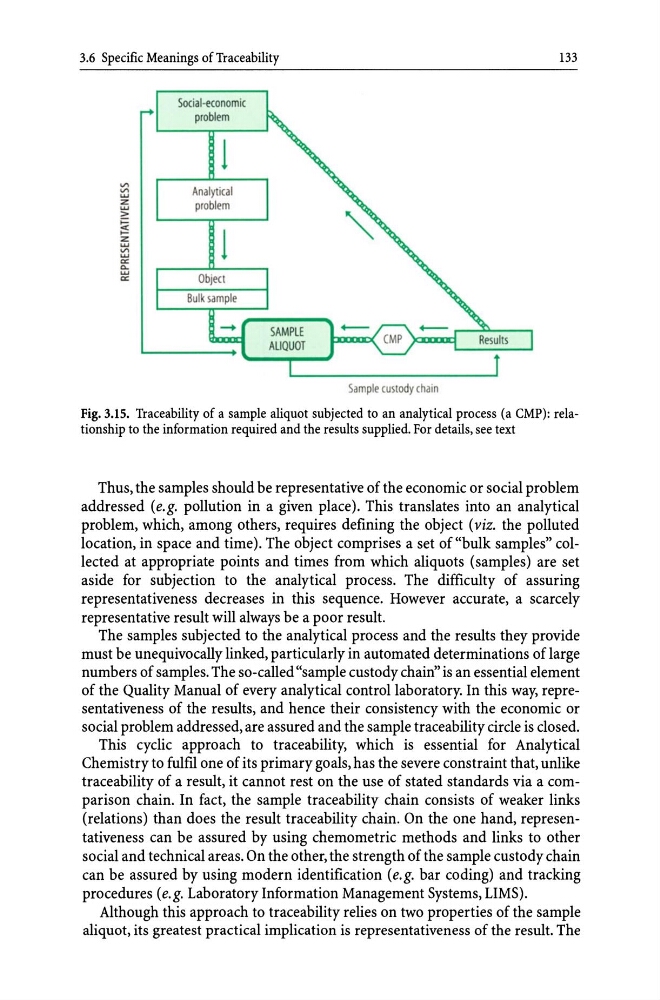
Fig. 3.15. Traceability of a sample aliquot subjected to an analytical process (a eMP): relationship to the information required and the results supplied. For details, see text
Thus, the samples should be representative of the economic or social problem
addressed (e.g. pollution in a given place). This translates into an analytical
problem, which, among others, requires defining the object (viz. the polluted
location, in space and time). The object comprises a set of "bulk samples" collected at appropriate points and times from which aliquots (samples) are set
aside for subjection to the analytical process. The difficulty of assuring
representativeness decreases in this sequence. However accurate, a scarcely
representative result will always be a poor result.
The samples subjected to the analytical process and the results they provide
must be unequivocally linked, particularly in automated determinations of large
numbers of samples. The so-called "sample custody chain" is an essential element
of the Quality Manual of every analytical control laboratory. In this way, representativeness of the results, and hence their consistency with the economic or
social problem addressed, are assured and the sample traceability circle is closed.
This cyclic approach to traceability, which is essential for Analytical
Chemistry to fulfil one of its primary goals, has the severe constraint that, unlike
traceability of a result, it cannot rest on the use of stated standards via a comparison chain. In fact, the sample traceability chain consists of weaker links
(relations) than does the result traceability chain. On the one hand, representativeness can be assured by using chemometric methods and links to other
social and technical areas. On the other, the strength of the sample custody chain
can be assured by using modern identification (e.g. bar coding) and tracking
procedures (e.g. Laboratory Information Management Systems, LIMS).
Although this approach to traceability relies on two properties of the sample
aliquot, its greatest practical implication is representativeness of the result. The
V">
V">
u.J
Z
u.J
:>
>=
~
z
u.J
V">
u.J
a::
... u.J
a::
Social-e(onomic
problem
1
Analytical
problem
1
Object
133
Sample custody chain
Fig. 3.15. Traceability of a sample aliquot subjected to an analytical process (a eMP): relationship to the information required and the results supplied. For details, see text
Thus, the samples should be representative of the economic or social problem
addressed (e.g. pollution in a given place). This translates into an analytical
problem, which, among others, requires defining the object (viz. the polluted
location, in space and time). The object comprises a set of "bulk samples" collected at appropriate points and times from which aliquots (samples) are set
aside for subjection to the analytical process. The difficulty of assuring
representativeness decreases in this sequence. However accurate, a scarcely
representative result will always be a poor result.
The samples subjected to the analytical process and the results they provide
must be unequivocally linked, particularly in automated determinations of large
numbers of samples. The so-called "sample custody chain" is an essential element
of the Quality Manual of every analytical control laboratory. In this way, representativeness of the results, and hence their consistency with the economic or
social problem addressed, are assured and the sample traceability circle is closed.
This cyclic approach to traceability, which is essential for Analytical
Chemistry to fulfil one of its primary goals, has the severe constraint that, unlike
traceability of a result, it cannot rest on the use of stated standards via a comparison chain. In fact, the sample traceability chain consists of weaker links
(relations) than does the result traceability chain. On the one hand, representativeness can be assured by using chemometric methods and links to other
social and technical areas. On the other, the strength of the sample custody chain
can be assured by using modern identification (e.g. bar coding) and tracking
procedures (e.g. Laboratory Information Management Systems, LIMS).
Although this approach to traceability relies on two properties of the sample
aliquot, its greatest practical implication is representativeness of the result. The