

116
3 Traceability: Reference Materials
Reference wavelengths
Holmium fi lter
Didymium fil ter
241.5
573.0
279.4
586.0
287.5
685.0
333.7
360.9
418.4
453.2
536.2
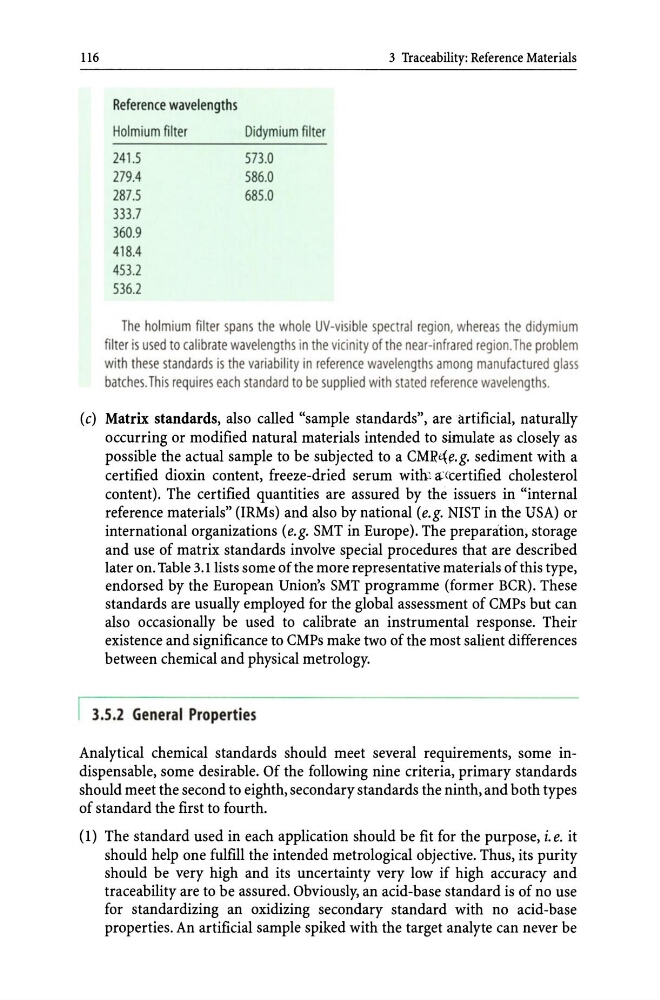
The holmium fil ter spa ns the whole UV-visible spectral region, whereas the didymium
filter is used to calibrate wavelengths in the vicinity of the near-i nfrared region.The problem
with these standards is the variability in reference wavelengths among manufactured glass
batches. This requi res each standard to be supplied with stated reference wavelengths.
(c) Matrix standards, also called "sample standards", arellrtificial, naturally
occurring or modified natural materials intended to simulate as closely as
possible the actual sample to be subjected to a CMRt\~.g. sediment with a
certified dioxin content, freeze-dried serum with; a:ccertified cholesterol
content). The certified quantities are assured by the issuers in "internal
reference materials" (IRMs) and also by national (e.g. NIST in the USA) or
international organizations (e.g. SMT in Europe). The preparation, storage
and use of matrix standards involve special procedures that are described
later on. Table 3.1 lists some of the more representative materials of this type,
endorsed by the European Union's SMT programme (former BCR). These
standards are usually employed for the global assessment of CMPs but can
also occasionally be used to calibrate an instrumental response. Their
existence and significance to CMPs make two of the most salient differences
between chemical and physical metrology.
3.5.2 General Properties
Analytical chemical standards should meet several requirements, some indispensable, some desirable. Of the following nine criteria, primary standards
should meet the second to eighth, secondary standards the ninth, and both types
of standard the first to fourth.
(1) The standard used in each application should be fit for the purpose, i.e. it
should help one fulfill the intended metrological objective. Thus, its purity
should be very high and its uncertainty very low if high accuracy and
traceability are to be assured. Obviously, an acid-base standard is of no use
for standardizing an oxidizing secondary standard with no acid-base
properties. An artificial sample spiked with the target analyte can never be
3 Traceability: Reference Materials
Reference wavelengths
Holmium fi lter
Didymium fil ter
241.5
573.0
279.4
586.0
287.5
685.0
333.7
360.9
418.4
453.2
536.2
The holmium fil ter spa ns the whole UV-visible spectral region, whereas the didymium
filter is used to calibrate wavelengths in the vicinity of the near-i nfrared region.The problem
with these standards is the variability in reference wavelengths among manufactured glass
batches. This requi res each standard to be supplied with stated reference wavelengths.
(c) Matrix standards, also called "sample standards", arellrtificial, naturally
occurring or modified natural materials intended to simulate as closely as
possible the actual sample to be subjected to a CMRt\~.g. sediment with a
certified dioxin content, freeze-dried serum with; a:ccertified cholesterol
content). The certified quantities are assured by the issuers in "internal
reference materials" (IRMs) and also by national (e.g. NIST in the USA) or
international organizations (e.g. SMT in Europe). The preparation, storage
and use of matrix standards involve special procedures that are described
later on. Table 3.1 lists some of the more representative materials of this type,
endorsed by the European Union's SMT programme (former BCR). These
standards are usually employed for the global assessment of CMPs but can
also occasionally be used to calibrate an instrumental response. Their
existence and significance to CMPs make two of the most salient differences
between chemical and physical metrology.
3.5.2 General Properties
Analytical chemical standards should meet several requirements, some indispensable, some desirable. Of the following nine criteria, primary standards
should meet the second to eighth, secondary standards the ninth, and both types
of standard the first to fourth.
(1) The standard used in each application should be fit for the purpose, i.e. it
should help one fulfill the intended metrological objective. Thus, its purity
should be very high and its uncertainty very low if high accuracy and
traceability are to be assured. Obviously, an acid-base standard is of no use
for standardizing an oxidizing secondary standard with no acid-base
properties. An artificial sample spiked with the target analyte can never be