

114
Use
Types
L.....
' - - - ' - - - - . . J I
RMs
Quantities r
3 Traceability: Reference Materials
Physical
standards
Pwe chemical
substances
(OJ mixtures)
Matrix
standards
'------,
CRMs
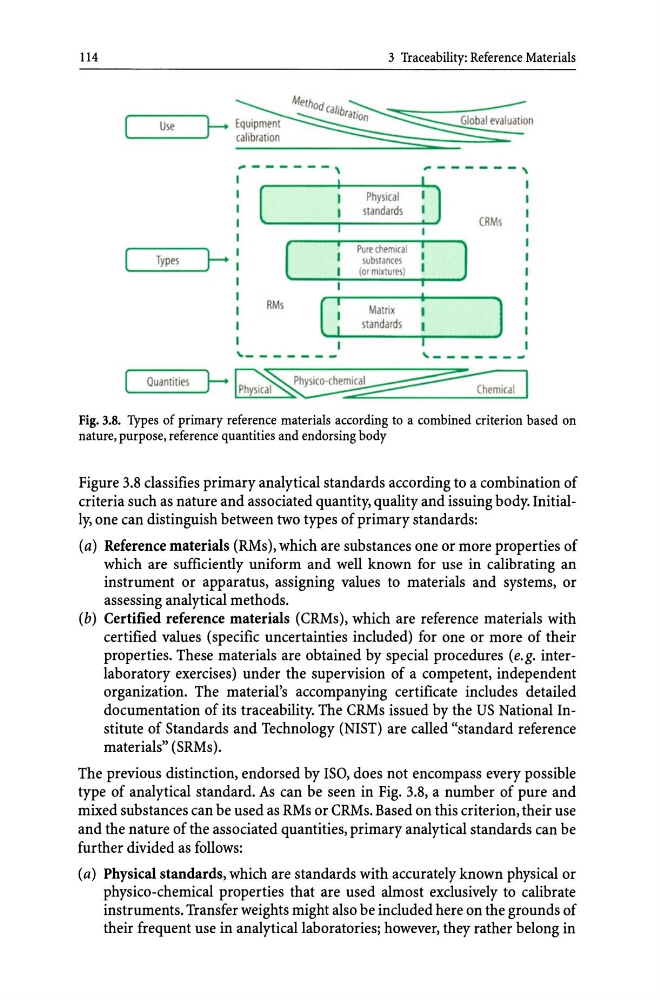
,,------Fig. 3.8. Types of primary reference materials according to a combined criterion based on
nature, purpose, reference quantities and endorsing body
Figure 3.8 classifies primary analytical standards according to a combination of
criteria such as nature and associated quantity, quality and issuing body. Initially, one can distinguish between two types of primary standards:
(a) Reference materials (RMs), which are substances one or more properties of
which are sufficiently uniform and well known for use in calibrating an
instrument or apparatus, assigning values to materials and systems, or
assessing analytical methods.
(b) Certified reference materials (CRMs), which are reference materials with
certified values (specific uncertainties included) for one or more of their
properties. These materials are obtained by special procedures (e.g. interlaboratory exercises) under the supervision of a competent, independent
organization. The material's accompanying certificate includes detailed
documentation of its traceability. The CRMs issued by the US National Institute of Standards and Technology (NIST) are called "standard reference
materials" (SRMs).
The previous distinction, endorsed by ISO, does not encompass every possible
type of analytical standard. As can be seen in Fig. 3.8, a number of pure and
mixed substances can be used as RMs or CRMs. Based on this criterion, their use
and the nature of the associated quantities, primary analytical standards can be
further divided as follows:
(a) Physical standards, which are standards with accurately known physical or
physico-chemical properties that are used almost exclusively to calibrate
instruments. Transfer weights might also be included here on the grounds of
their frequent use in analytical laboratories; however, they rather belong in
Use
Types
L.....
' - - - ' - - - - . . J I
RMs
Quantities r
3 Traceability: Reference Materials
Physical
standards
Pwe chemical
substances
(OJ mixtures)
Matrix
standards
'------,
CRMs
,,------Fig. 3.8. Types of primary reference materials according to a combined criterion based on
nature, purpose, reference quantities and endorsing body
Figure 3.8 classifies primary analytical standards according to a combination of
criteria such as nature and associated quantity, quality and issuing body. Initially, one can distinguish between two types of primary standards:
(a) Reference materials (RMs), which are substances one or more properties of
which are sufficiently uniform and well known for use in calibrating an
instrument or apparatus, assigning values to materials and systems, or
assessing analytical methods.
(b) Certified reference materials (CRMs), which are reference materials with
certified values (specific uncertainties included) for one or more of their
properties. These materials are obtained by special procedures (e.g. interlaboratory exercises) under the supervision of a competent, independent
organization. The material's accompanying certificate includes detailed
documentation of its traceability. The CRMs issued by the US National Institute of Standards and Technology (NIST) are called "standard reference
materials" (SRMs).
The previous distinction, endorsed by ISO, does not encompass every possible
type of analytical standard. As can be seen in Fig. 3.8, a number of pure and
mixed substances can be used as RMs or CRMs. Based on this criterion, their use
and the nature of the associated quantities, primary analytical standards can be
further divided as follows:
(a) Physical standards, which are standards with accurately known physical or
physico-chemical properties that are used almost exclusively to calibrate
instruments. Transfer weights might also be included here on the grounds of
their frequent use in analytical laboratories; however, they rather belong in