

Recoverable, Soluble Polymer-Supported Organic Catalysts
313
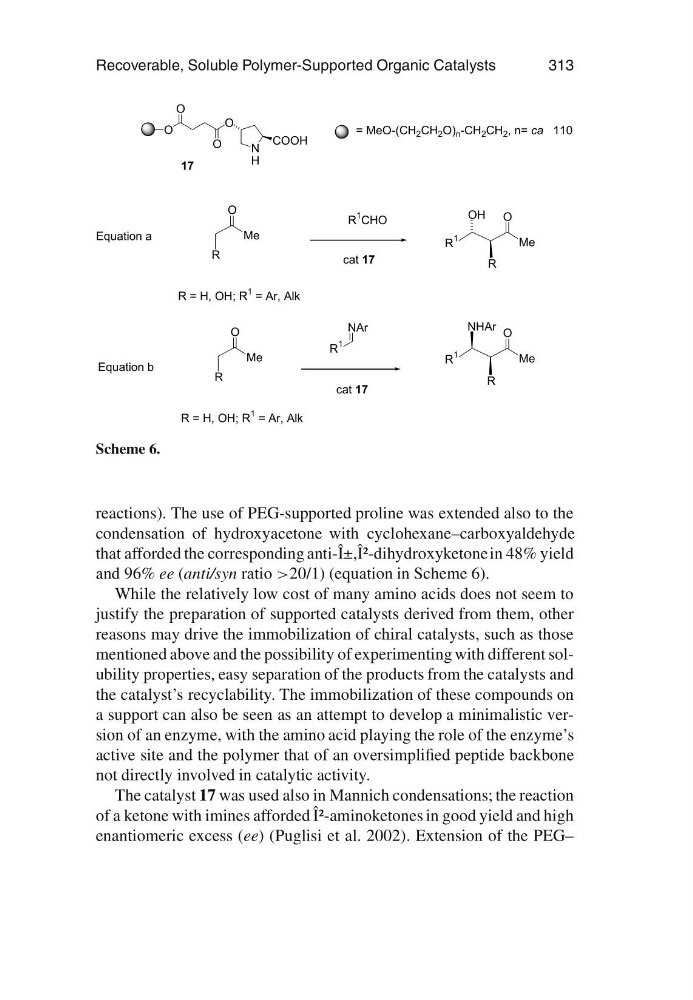
Scheme 6.
reactions). The use of PEG-supported proline was extended also to the
condensation of hydroxyacetone with cyclohexane–carboxyaldehyde
that afforded the corresponding anti-α,β-dihydroxyketone in 48% yield
and 96% ee (anti/syn ratio >20/1) (equation in Scheme 6).
While the relatively low cost of many amino acids does not seem to
justify the preparation of supported catalysts derived from them, other
reasons may drive the immobilization of chiral catalysts, such as those
mentioned above and the possibility of experimenting with different solubility properties, easy separation of the products from the catalysts and
the catalyst’s recyclability. The immobilization of these compounds on
a support can also be seen as an attempt to develop a minimalistic version of an enzyme, with the amino acid playing the role of the enzyme’s
active site and the polymer that of an oversimplified peptide backbone
not directly involved in catalytic activity.
The catalyst 17 was used also in Mannich condensations; the reaction
of a ketone with imines afforded β-aminoketones in good yield and high
enantiomeric excess (ee) (Puglisi et al. 2002). Extension of the PEG–