

310
M. Benaglia
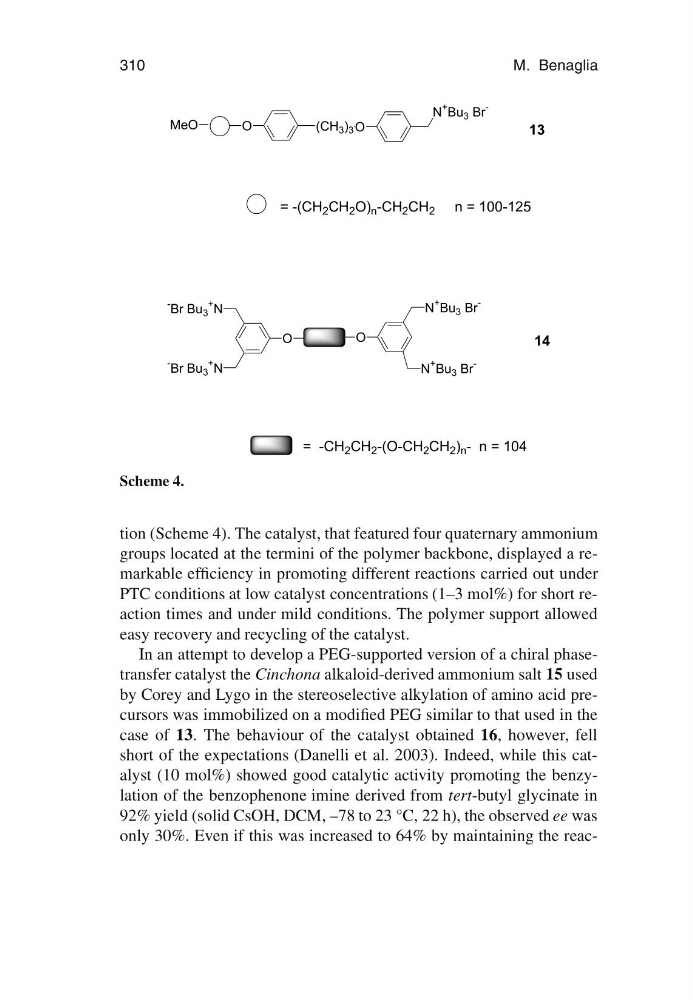
Scheme 4.
tion (Scheme 4). The catalyst, that featured four quaternary ammonium
groups located at the termini of the polymer backbone, displayed a remarkable efficiency in promoting different reactions carried out under
PTC conditions at low catalyst concentrations (1–3 mol%) for short reaction times and under mild conditions. The polymer support allowed
easy recovery and recycling of the catalyst.
In an attempt to develop a PEG-supported version of a chiral phasetransfer catalyst the Cinchona alkaloid-derived ammonium salt 15 used
by Corey and Lygo in the stereoselective alkylation of amino acid precursors was immobilized on a modified PEG similar to that used in the
case of 13. The behaviour of the catalyst obtained 16, however, fell
short of the expectations (Danelli et al. 2003). Indeed, while this catalyst (10 mol%) showed good catalytic activity promoting the benzylation of the benzophenone imine derived from tert-butyl glycinate in
92% yield (solid CsOH, DCM, –78 to 23 °C, 22 h), the observed ee was
only 30%. Even if this was increased to 64% by maintaining the reac-