

Recoverable, Soluble Polymer-Supported Organic Catalysts
307
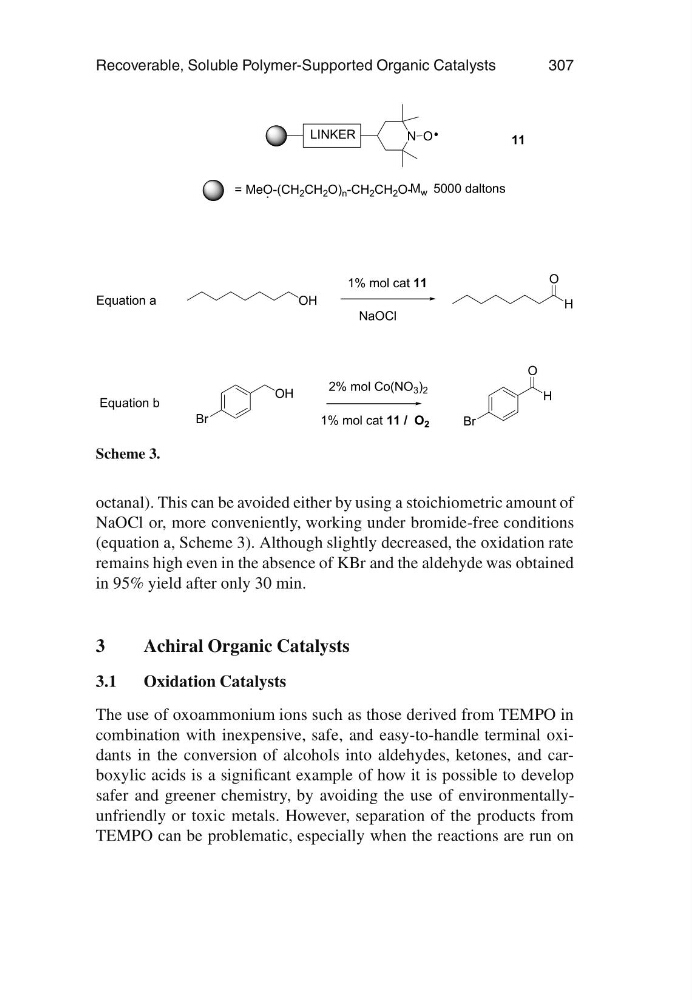
Scheme 3.
octanal). This can be avoided either by using a stoichiometric amount of
NaOCl or, more conveniently, working under bromide-free conditions
(equation a, Scheme 3). Although slightly decreased, the oxidation rate
remains high even in the absence of KBr and the aldehyde was obtained
in 95% yield after only 30 min.
3
Achiral Organic Catalysts
3.1
Oxidation Catalysts
The use of oxoammonium ions such as those derived from TEMPO in
combination with inexpensive, safe, and easy-to-handle terminal oxidants in the conversion of alcohols into aldehydes, ketones, and carboxylic acids is a significant example of how it is possible to develop
safer and greener chemistry, by avoiding the use of environmentallyunfriendly or toxic metals. However, separation of the products from
TEMPO can be problematic, especially when the reactions are run on