

Recoverable, Soluble Polymer-Supported Organic Catalysts
303
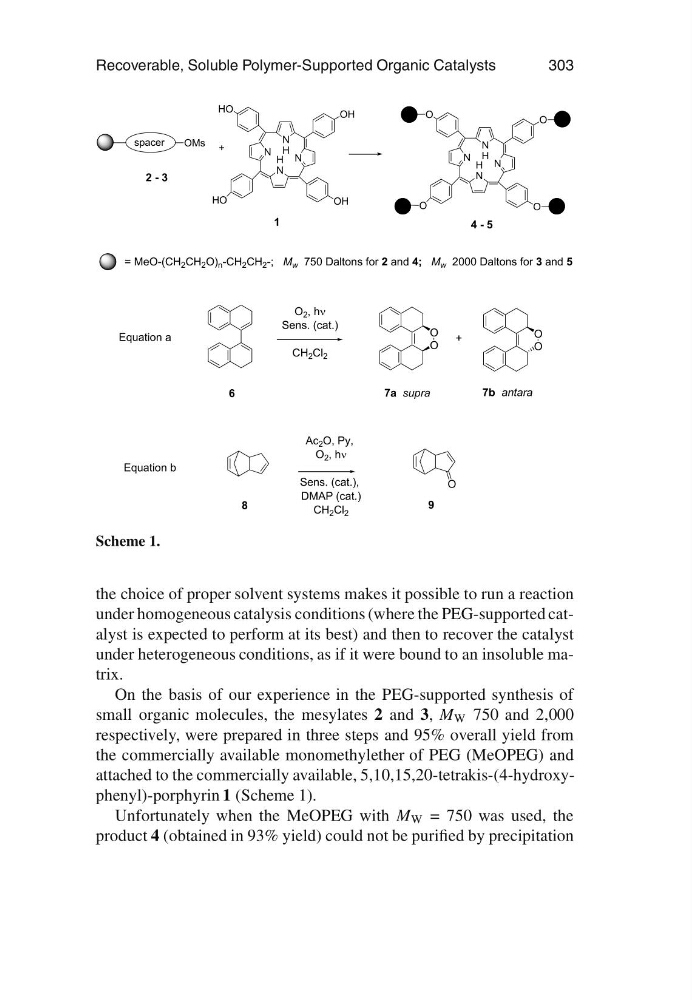
Scheme 1.
the choice of proper solvent systems makes it possible to run a reaction
under homogeneous catalysis conditions (where the PEG-supported catalyst is expected to perform at its best) and then to recover the catalyst
under heterogeneous conditions, as if it were bound to an insoluble matrix.
On the basis of our experience in the PEG-supported synthesis of
small organic molecules, the mesylates 2 and 3, M W 750 and 2,000
respectively, were prepared in three steps and 95% overall yield from
the commercially available monomethylether of PEG (MeOPEG) and
attached to the commercially available, 5,10,15,20-tetrakis-(4-hydroxyphenyl)-porphyrin 1 (Scheme 1).
Unfortunately when the MeOPEG with M W = 750 was used, the
product 4 (obtained in 93% yield) could not be purified by precipitation