

Organocatalysis by Hydrogen Bonding Networks
285
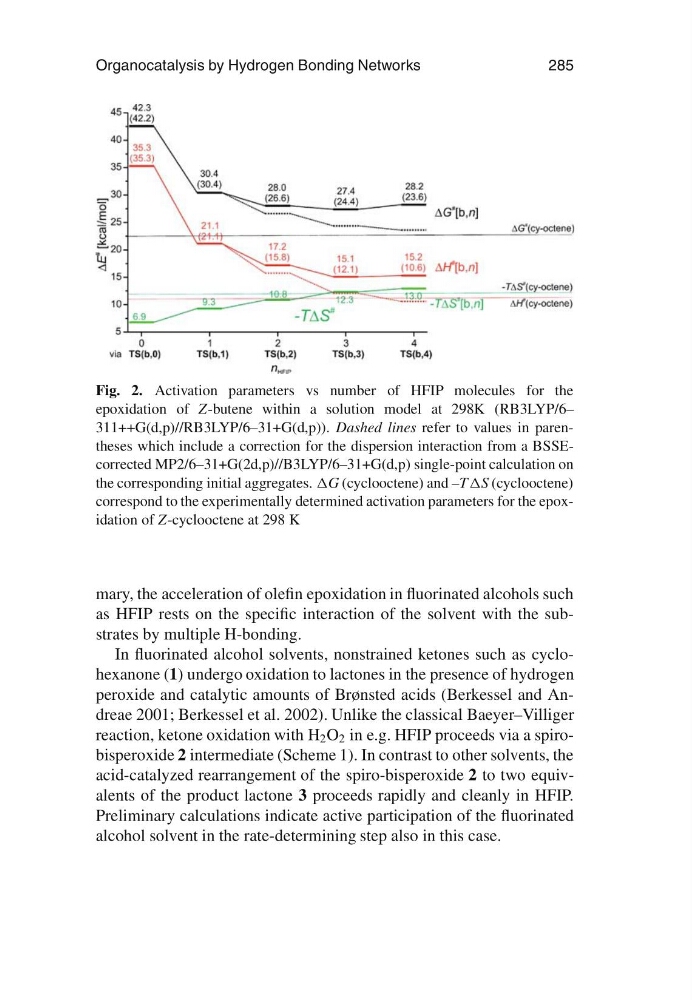
Fig. 2. Activation parameters vs number of HFIP molecules for the
epoxidation of Z-butene within a solution model at 298K (RB3LYP/6–
311++G(d,p)//RB3LYP/6–31+G(d,p)). Dashed lines refer to values in parentheses which include a correction for the dispersion interaction from a BSSEcorrected MP2/6–31+G(2d,p)//B3LYP/6–31+G(d,p) single-point calculation on
the corresponding initial aggregates. ∆G (cyclooctene) and –T∆S (cyclooctene)
correspond to the experimentally determined activation parameters for the epoxidation of Z-cyclooctene at 298 K
mary, the acceleration of olefin epoxidation in fluorinated alcohols such
as HFIP rests on the specific interaction of the solvent with the substrates by multiple H-bonding.
In fluorinated alcohol solvents, nonstrained ketones such as cyclohexanone (1) undergo oxidation to lactones in the presence of hydrogen
peroxide and catalytic amounts of Brønsted acids (Berkessel and Andreae 2001; Berkessel et al. 2002). Unlike the classical Baeyer–Villiger
reaction, ketone oxidation with H 2 O 2 in e.g. HFIP proceeds via a spirobisperoxide 2 intermediate (Scheme 1). In contrast to other solvents, the
acid-catalyzed rearrangement of the spiro-bisperoxide 2 to two equivalents of the product lactone 3 proceeds rapidly and cleanly in HFIP.
Preliminary calculations indicate active participation of the fluorinated
alcohol solvent in the rate-determining step also in this case.