

274
S. Breitenlechner, P. Selig, T. Bach
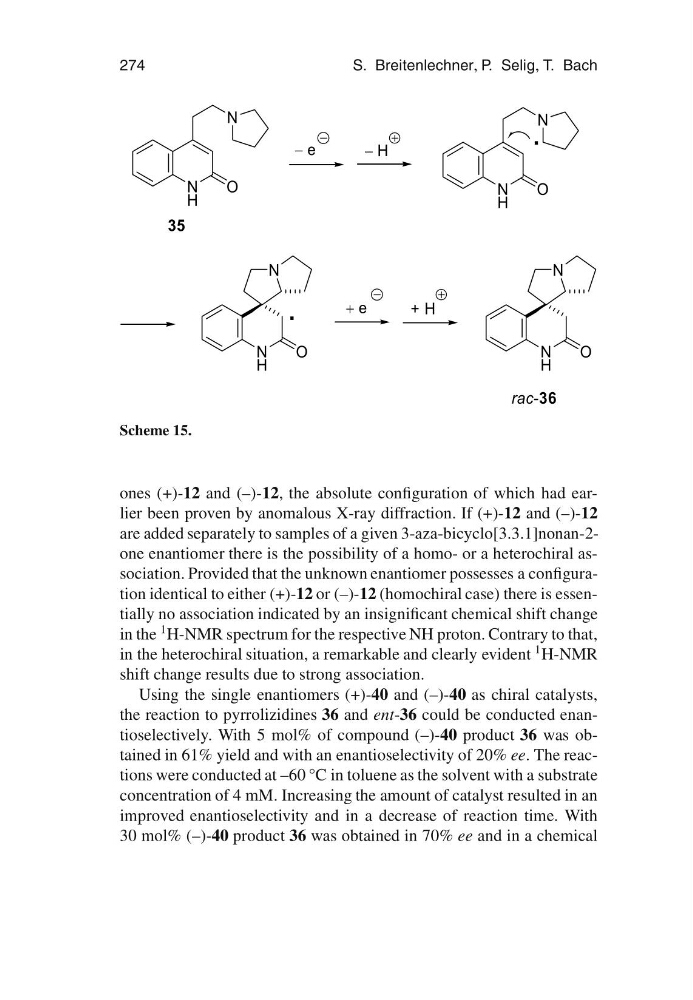
Scheme 15.
ones (+)-12 and (–)-12, the absolute configuration of which had earlier been proven by anomalous X-ray diffraction. If (+)-12 and (–)-12
are added separately to samples of a given 3-aza-bicyclo[3.3.1]nonan-2one enantiomer there is the possibility of a homo- or a heterochiral association. Provided that the unknown enantiomer possesses a configuration identical to either (+)-12 or (–)-12 (homochiral case) there is essentially no association indicated by an insignificant chemical shift change
in the
1 H-NMR spectrum for the respective NH proton. Contrary to that,
in the heterochiral situation, a remarkable and clearly evident
1 H-NMR
shift change results due to strong association.
Using the single enantiomers (+)-40 and (–)-40 as chiral catalysts,
the reaction to pyrrolizidines 36 and ent-36 could be conducted enantioselectively. With 5 mol% of compound (–)-40 product 36 was obtained in 61% yield and with an enantioselectivity of 20% ee. The reactions were conducted at –60 °C in toluene as the solvent with a substrate
concentration of 4 mM. Increasing the amount of catalyst resulted in an
improved enantioselectivity and in a decrease of reaction time. With
30 mol% (–)-40 product 36 was obtained in 70% ee and in a chemical