

272
S. Breitenlechner, P. Selig, T. Bach
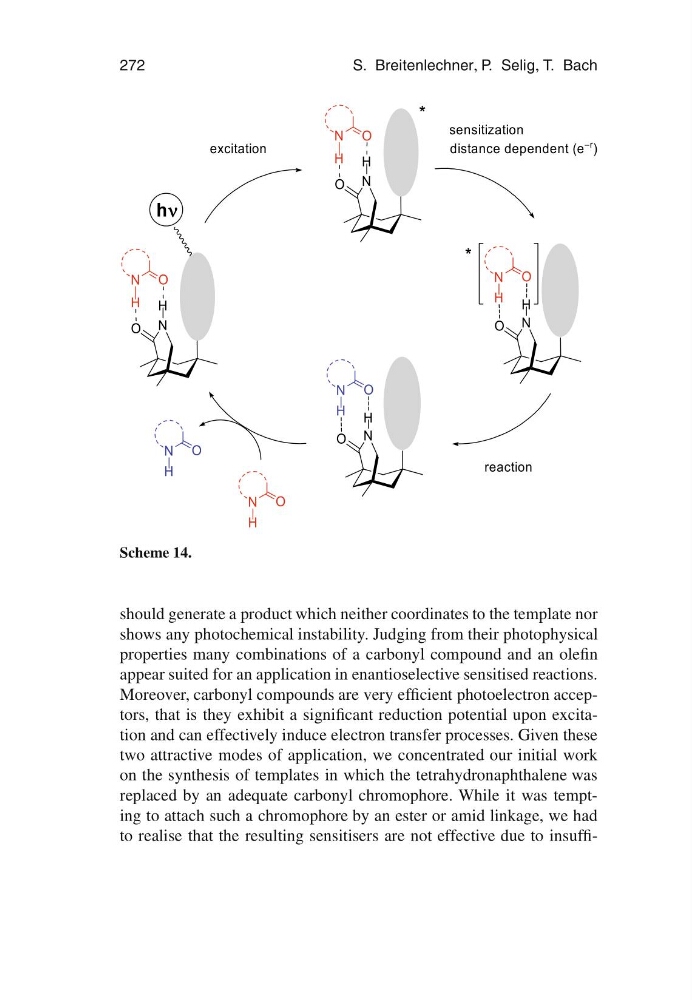
Scheme 14.
should generate a product which neither coordinates to the template nor
shows any photochemical instability. Judging from their photophysical
properties many combinations of a carbonyl compound and an olefin
appear suited for an application in enantioselective sensitised reactions.
Moreover, carbonyl compounds are very efficient photoelectron acceptors, that is they exhibit a significant reduction potential upon excitation and can effectively induce electron transfer processes. Given these
two attractive modes of application, we concentrated our initial work
on the synthesis of templates in which the tetrahydronaphthalene was
replaced by an adequate carbonyl chromophore. While it was tempting to attach such a chromophore by an ester or amid linkage, we had
to realise that the resulting sensitisers are not effective due to insuffi-