

Enantioselective Photochemistry
261
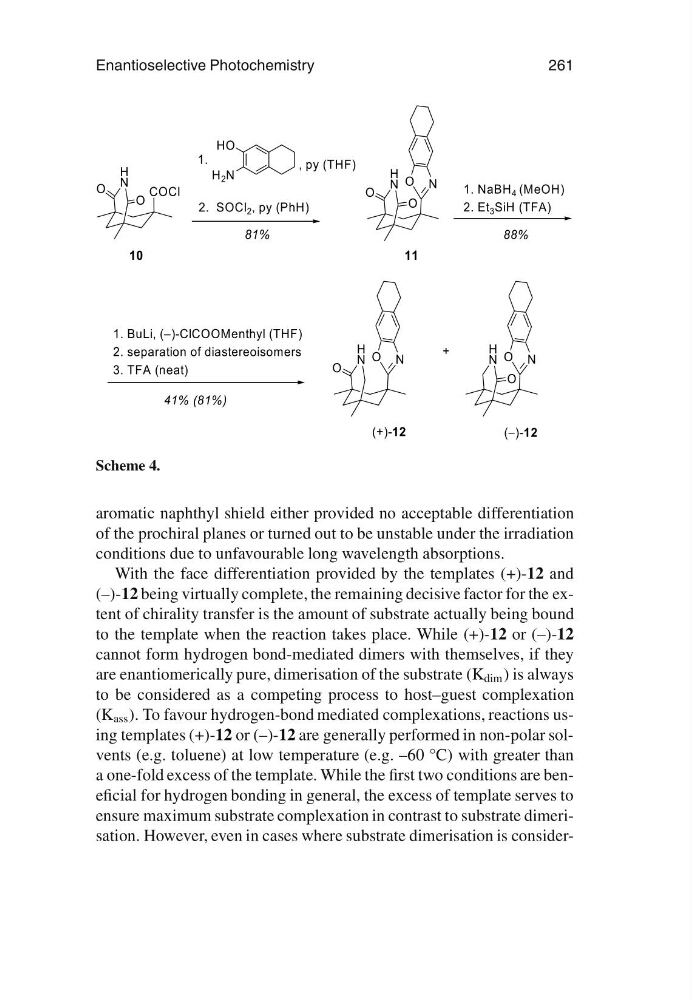
Scheme 4.
aromatic naphthyl shield either provided no acceptable differentiation
of the prochiral planes or turned out to be unstable under the irradiation
conditions due to unfavourable long wavelength absorptions.
With the face differentiation provided by the templates (+)-12 and
(–)-12 being virtually complete, the remaining decisive factor for the extent of chirality transfer is the amount of substrate actually being bound
to the template when the reaction takes place. While (+)-12 or (–)-12
cannot form hydrogen bond-mediated dimers with themselves, if they
are enantiomerically pure, dimerisation of the substrate (K dim ) is always
to be considered as a competing process to host–guest complexation
(K ass ). To favour hydrogen-bond mediated complexations, reactions using templates (+)-12 or (–)-12 are generally performed in non-polar solvents (e.g. toluene) at low temperature (e.g. –60 °C) with greater than
a one-fold excess of the template. While the first two conditions are beneficial for hydrogen bonding in general, the excess of template serves to
ensure maximum substrate complexation in contrast to substrate dimerisation. However, even in cases where substrate dimerisation is consider-