

New Developments in EnantioselectiveBrønsted Acid Catalysis
227
Itoh 2000; Blaser et al. 2003; Tang and Zhang 2003). This is particularly true with regard to the enantioselective hydrogenation of substituted pyridine derivatives (metal-catalyzed enantioselective reductions
of pyridines: Legault and Charette 2005; Lei et al. 2006; an efficient
diastereoselective pyridine reduction: Glorius et al. 2004), which can
readily be prepared using various methods. The corresponding chiral
piperidines are not only important starting materials for numerous biologically active compounds but also important structural building blocks
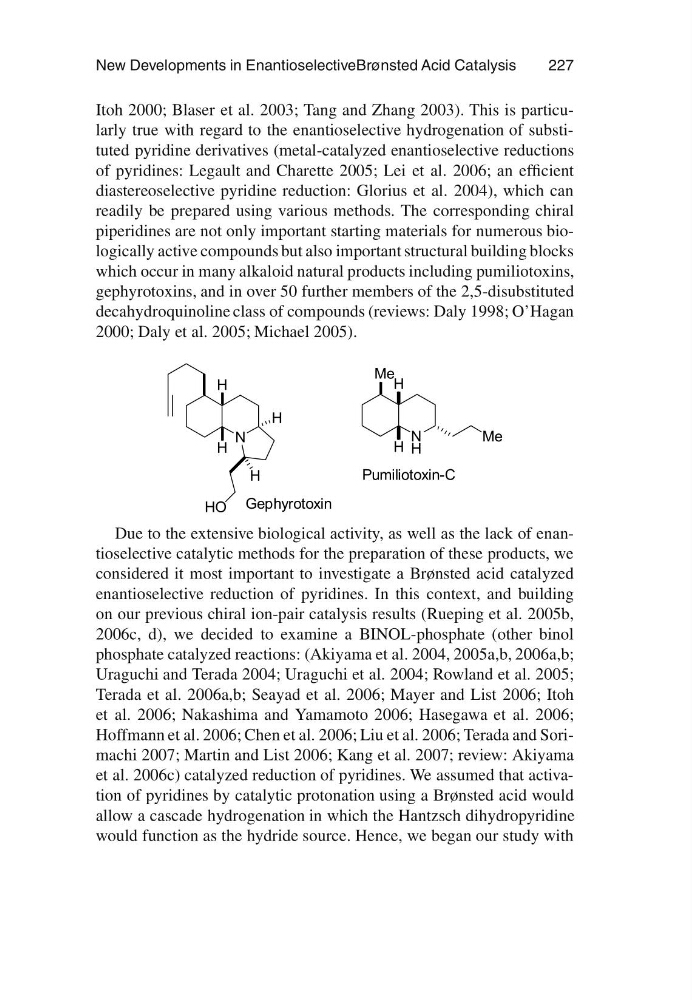
which occur in many alkaloid natural products including pumiliotoxins,
gephyrotoxins, and in over 50 further members of the 2,5-disubstituted
decahydroquinoline class of compounds (reviews: Daly 1998; O’Hagan
2000; Daly et al. 2005; Michael 2005).
Due to the extensive biological activity, as well as the lack of enantioselective catalytic methods for the preparation of these products, we
considered it most important to investigate a Brønsted acid catalyzed
enantioselective reduction of pyridines. In this context, and building
on our previous chiral ion-pair catalysis results (Rueping et al. 2005b,
2006c, d), we decided to examine a BINOL-phosphate (other binol
phosphate catalyzed reactions: (Akiyama et al. 2004, 2005a,b, 2006a,b;
Uraguchi and Terada 2004; Uraguchi et al. 2004; Rowland et al. 2005;
Terada et al. 2006a,b; Seayad et al. 2006; Mayer and List 2006; Itoh
et al. 2006; Nakashima and Yamamoto 2006; Hasegawa et al. 2006;
Hoffmann et al. 2006; Chen et al. 2006; Liu et al. 2006; Terada and Sorimachi 2007; Martin and List 2006; Kang et al. 2007; review: Akiyama
et al. 2006c) catalyzed reduction of pyridines. We assumed that activation of pyridines by catalytic protonation using a Brønsted acid would
allow a cascade hydrogenation in which the Hantzsch dihydropyridine
would function as the hydride source. Hence, we began our study with