

New Developments in EnantioselectiveBrønsted Acid Catalysis
225
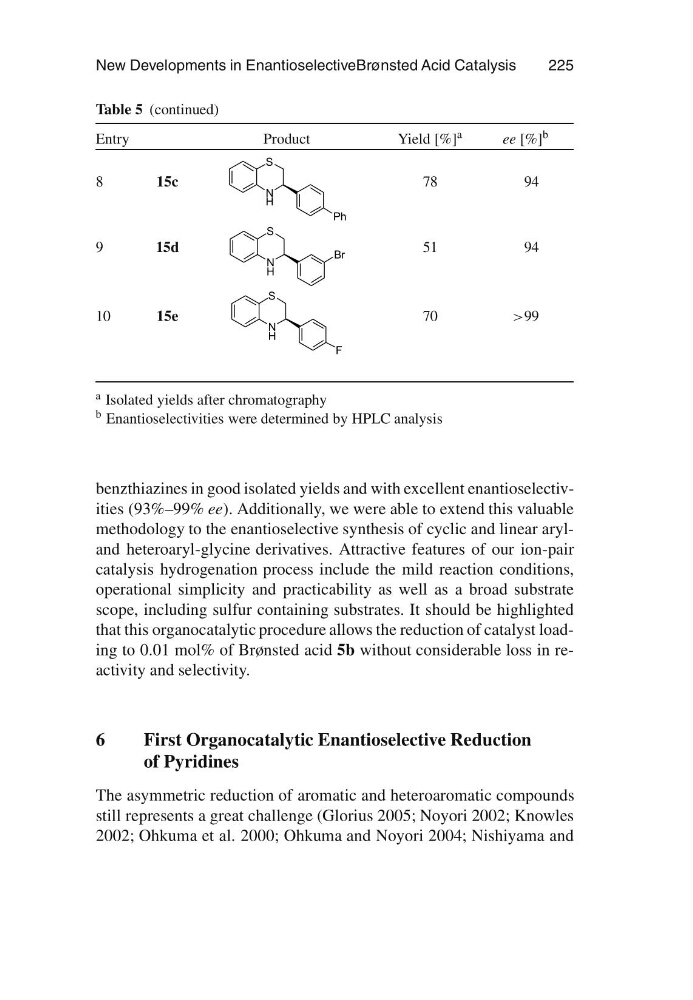
Table 5 (continued)
Entry
Product
Yield [%] a
ee [%] b
8
15c
78
94
9
15d
51
94
10
15e
70
>99
a Isolated yields after chromatography
b Enantioselectivities were determined by HPLC analysis
benzthiazines in good isolated yields and with excellent enantioselectivities (93%–99% ee). Additionally, we were able to extend this valuable
methodology to the enantioselective synthesis of cyclic and linear aryland heteroaryl-glycine derivatives. Attractive features of our ion-pair
catalysis hydrogenation process include the mild reaction conditions,
operational simplicity and practicability as well as a broad substrate
scope, including sulfur containing substrates. It should be highlighted
that this organocatalytic procedure allows the reduction of catalyst loading to 0.01 mol% of Brønsted acid 5b without considerable loss in reactivity and selectivity.
6
First Organocatalytic Enantioselective Reduction
of Pyridines
The asymmetric reduction of aromatic and heteroaromatic compounds
still represents a great challenge (Glorius 2005; Noyori 2002; Knowles
2002; Ohkuma et al. 2000; Ohkuma and Noyori 2004; Nishiyama and