

New Developments in EnantioselectiveBrønsted Acid Catalysis
219
Jacquemond-Collet et al. 1999) and Angustureine (Jacquemond-Collet
et al. 1999).
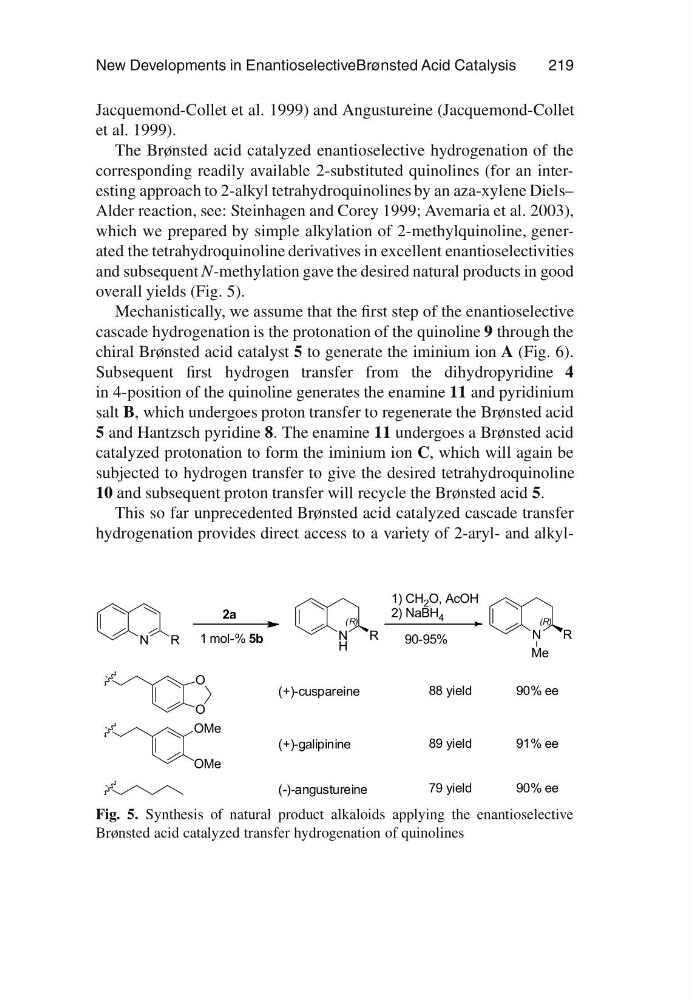
The Brønsted acid catalyzed enantioselective hydrogenation of the
corresponding readily available 2-substituted quinolines (for an interesting approach to 2-alkyl tetrahydroquinolines by an aza-xylene Diels–
Alder reaction, see: Steinhagen and Corey 1999; Avemaria et al. 2003),
which we prepared by simple alkylation of 2-methylquinoline, generated the tetrahydroquinoline derivatives in excellent enantioselectivities
and subsequent N-methylation gave the desired natural products in good
overall yields (Fig. 5).
Mechanistically, we assume that the first step of the enantioselective
cascade hydrogenation is the protonation of the quinoline 9 through the
chiral Brønsted acid catalyst 5 to generate the iminium ion A (Fig. 6).
Subsequent first hydrogen transfer from the dihydropyridine 4
in 4-position of the quinoline generates the enamine 11 and pyridinium
salt B, which undergoes proton transfer to regenerate the Brønsted acid
5 and Hantzsch pyridine 8. The enamine 11 undergoes a Brønsted acid
catalyzed protonation to form the iminium ion C, which will again be
subjected to hydrogen transfer to give the desired tetrahydroquinoline
10 and subsequent proton transfer will recycle the Brønsted acid 5.
This so far unprecedented Brønsted acid catalyzed cascade transfer
hydrogenation provides direct access to a variety of 2-aryl- and alkylFig. 5. Synthesis of natural product alkaloids applying the enantioselective
Brønsted acid catalyzed transfer hydrogenation of quinolines