

104
D. Enders, M.R.M. Hüttl, O. Niemeier
camphanylester [Fig. 14; CCDC 607797 (6a) and CCDC 607796 (6f)
contain the supplementary crystallographic data, which can be obtained
free of charge from the Cambridge Crystallographic Data Centre via
www.ccdc.cam.ac.uk/data_request/cif]. Thus, the absolute configuration of the quaternary stereocenter was determined to be S utilizing precatalyst 127, which is in accordance with our postulated transition state
(Enders et al. 2006c; Takikawa et al. 2006).
3.3
The Stetter Reaction
3.3.1 Asymmetric Intermolecular Stetter Reactions
In the early 1970s Stetter and co-workers succeeded in transferring the
concept of the thiazolium catalyzed nucleophilic acylation to the substrate class of Michael acceptors (Stetter 1976; Stetter and Schreckenberg 1973). Since then, the catalytic 1,4-addition of aldehydes 6 to
an acceptor bearing an activated double bond 131 carries his name.
The Stetter reaction enables a new catalytic pathway for the synthesis
of 1,4-bifunctional molecules 132, such as 1,4-diketones, 4-ketoesters
and 4-ketonitriles (Stetter and Kuhlmann 1991; for a short review, see:
Christmann 2005). The reaction can be catalyzed by a broad range of
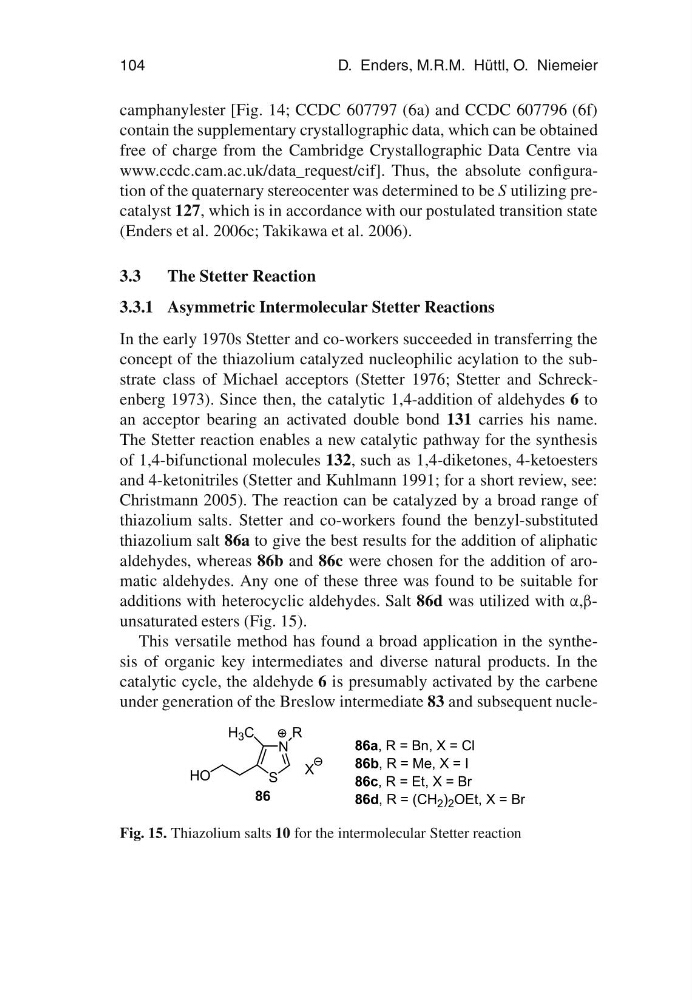
thiazolium salts. Stetter and co-workers found the benzyl-substituted
thiazolium salt 86a to give the best results for the addition of aliphatic
aldehydes, whereas 86b and 86c were chosen for the addition of aromatic aldehydes. Any one of these three was found to be suitable for
additions with heterocyclic aldehydes. Salt 86d was utilized with α,βunsaturated esters (Fig. 15).
This versatile method has found a broad application in the synthesis of organic key intermediates and diverse natural products. In the
catalytic cycle, the aldehyde 6 is presumably activated by the carbene
under generation of the Breslow intermediate 83 and subsequent nucleFig. 15. Thiazolium salts 10 for the intermolecular Stetter reaction