

90
D. Enders, M.R.M. Hüttl, O. Niemeier
low catalyst loadings were necessary (1.25 mol%), which indicated that
the activity increased by almost two orders of magnitude compared
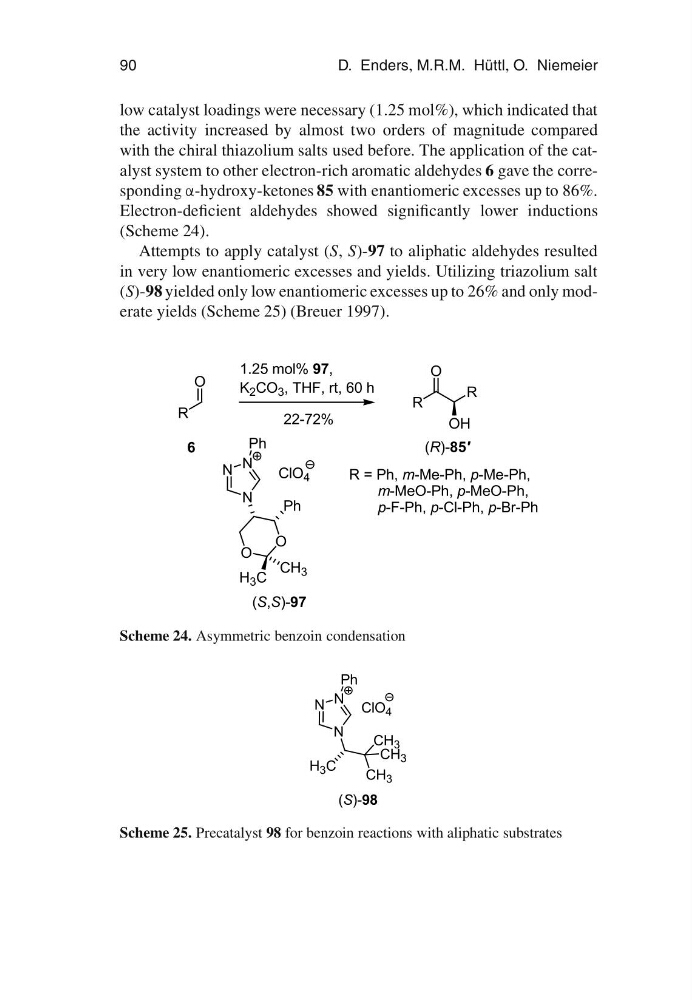
with the chiral thiazolium salts used before. The application of the catalyst system to other electron-rich aromatic aldehydes 6 gave the corresponding α-hydroxy-ketones 85 with enantiomeric excesses up to 86%.
Electron-deficient aldehydes showed significantly lower inductions
(Scheme 24).
Attempts to apply catalyst (S, S)-97 to aliphatic aldehydes resulted
in very low enantiomeric excesses and yields. Utilizing triazolium salt
(S)-98 yielded only low enantiomeric excesses up to 26% and only moderate yields (Scheme 25) (Breuer 1997).
Scheme 24. Asymmetric benzoin condensation
Scheme 25. Precatalyst 98 for benzoin reactions with aliphatic substrates
D. Enders, M.R.M. Hüttl, O. Niemeier
low catalyst loadings were necessary (1.25 mol%), which indicated that
the activity increased by almost two orders of magnitude compared
with the chiral thiazolium salts used before. The application of the catalyst system to other electron-rich aromatic aldehydes 6 gave the corresponding α-hydroxy-ketones 85 with enantiomeric excesses up to 86%.
Electron-deficient aldehydes showed significantly lower inductions
(Scheme 24).
Attempts to apply catalyst (S, S)-97 to aliphatic aldehydes resulted
in very low enantiomeric excesses and yields. Utilizing triazolium salt
(S)-98 yielded only low enantiomeric excesses up to 26% and only moderate yields (Scheme 25) (Breuer 1997).
Scheme 24. Asymmetric benzoin condensation
Scheme 25. Precatalyst 98 for benzoin reactions with aliphatic substrates