

76
D. Enders, M.R.M. Hüttl, O. Niemeier
et al. 2006; Chapman and Frost 2007). These reactions avoid timeconsuming and costly processes, including the purification of intermediates and steps involving the protection and deprotection of functional
groups, and they are environmentally friendly and often proceed with
excellent stereoselectivities (Tietze and Beifuss 1993; Tietze 1996; Tietze and Haunert 2000; Wasilke et al. 2005; Ramón and Yus 2005; Guo
and Ma 2006; Pellissier 2006; Pellisier 2006; Tietze et al. 2006; Chapman and Frost 2007). Therefore, the design of new catalytic and stereoselective cascade reactions is a continuing challenge at the forefront of
synthetic chemistry (for a review see Enders et al. 2007a). In addition,
organocatalytic cascade reactions can be described as biomimetic, as
they are reminiscent of tandem reactions that may occur during biosyntheses of complex natural products (AL Lehninger 1993; Katz 1997;
Koshla 1997; Koshla et al. 1999; Mann 1999; Staunton and Weissmann
2001). In particular, secondary amines-capable of both enamine as well
as iminium catalysis-can be used to design domino processes (Enders
et al. 2007a). Recently, List (Yang et al. 2005), MacMillan (Huang et al.
2005) and Jørgensen (Marigo et al. 2005b) showed examples of this
property by merging first iminium and then enamine activation. In contrast, we embarked on a reverse strategy using enamine activation of the
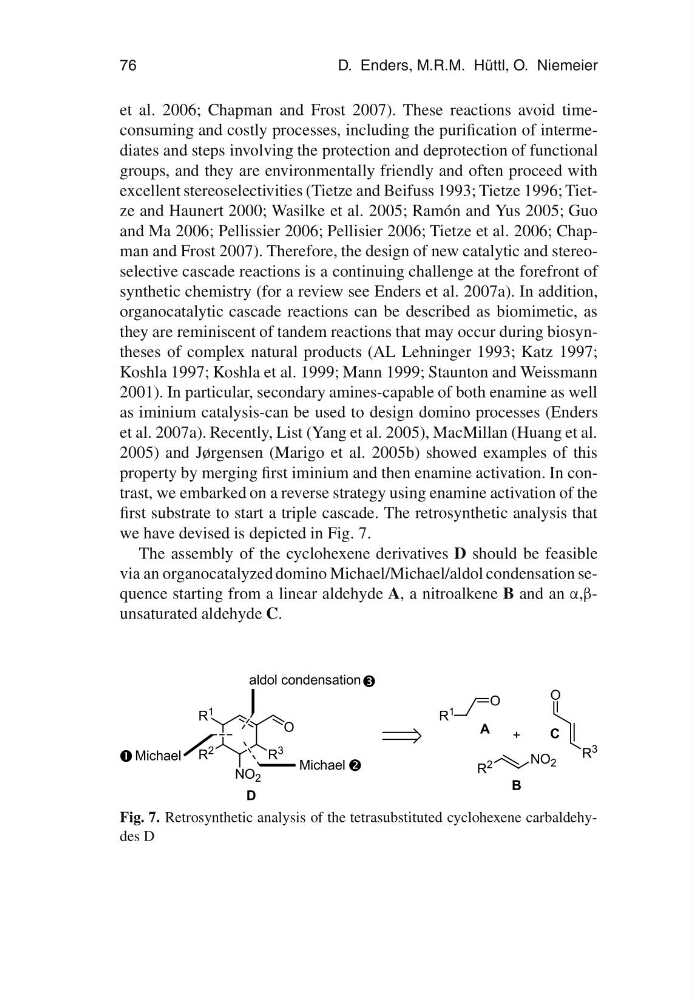
first substrate to start a triple cascade. The retrosynthetic analysis that
we have devised is depicted in Fig. 7.
The assembly of the cyclohexene derivatives D should be feasible
via an organocatalyzed domino Michael/Michael/aldol condensation sequence starting from a linear aldehyde A, a nitroalkene B and an α,βunsaturated aldehyde C.
Fig. 7. Retrosynthetic analysis of the tetrasubstituted cyclohexene carbaldehydes D
D. Enders, M.R.M. Hüttl, O. Niemeier
et al. 2006; Chapman and Frost 2007). These reactions avoid timeconsuming and costly processes, including the purification of intermediates and steps involving the protection and deprotection of functional
groups, and they are environmentally friendly and often proceed with
excellent stereoselectivities (Tietze and Beifuss 1993; Tietze 1996; Tietze and Haunert 2000; Wasilke et al. 2005; Ramón and Yus 2005; Guo
and Ma 2006; Pellissier 2006; Pellisier 2006; Tietze et al. 2006; Chapman and Frost 2007). Therefore, the design of new catalytic and stereoselective cascade reactions is a continuing challenge at the forefront of
synthetic chemistry (for a review see Enders et al. 2007a). In addition,
organocatalytic cascade reactions can be described as biomimetic, as
they are reminiscent of tandem reactions that may occur during biosyntheses of complex natural products (AL Lehninger 1993; Katz 1997;
Koshla 1997; Koshla et al. 1999; Mann 1999; Staunton and Weissmann
2001). In particular, secondary amines-capable of both enamine as well
as iminium catalysis-can be used to design domino processes (Enders
et al. 2007a). Recently, List (Yang et al. 2005), MacMillan (Huang et al.
2005) and Jørgensen (Marigo et al. 2005b) showed examples of this
property by merging first iminium and then enamine activation. In contrast, we embarked on a reverse strategy using enamine activation of the
first substrate to start a triple cascade. The retrosynthetic analysis that
we have devised is depicted in Fig. 7.
The assembly of the cyclohexene derivatives D should be feasible
via an organocatalyzed domino Michael/Michael/aldol condensation sequence starting from a linear aldehyde A, a nitroalkene B and an α,βunsaturated aldehyde C.
Fig. 7. Retrosynthetic analysis of the tetrasubstituted cyclohexene carbaldehydes D