

74
D. Enders, M.R.M. Hüttl, O. Niemeier
(Shimizu and Hiyama 2005; Welch and Eswarakrishnan 1991; Soloshonok 1999; Chambers 2004; for recent reviews on catalytic α-fluorination,
see: Taylor et al. 1999; Muñiz 2003; Ma and Cahard 2004; Pihko 2006;
Prakash and Beier 2006; Bobbio and Gouverneur 2006; Hamashima and
Sodeoka 2006). In 1997 our group developed an asymmetric synthesis of α-fluoroketones using chiral α-silylketones (Enders and Potthoff
1997; Enders et al. 2001). Eight years later we expanded the entry to
α-fluorocompounds by an organocatalytic approach (Enders and Hüttl
2005). Inspired by the organocatalytic enantioselective α-chlorination
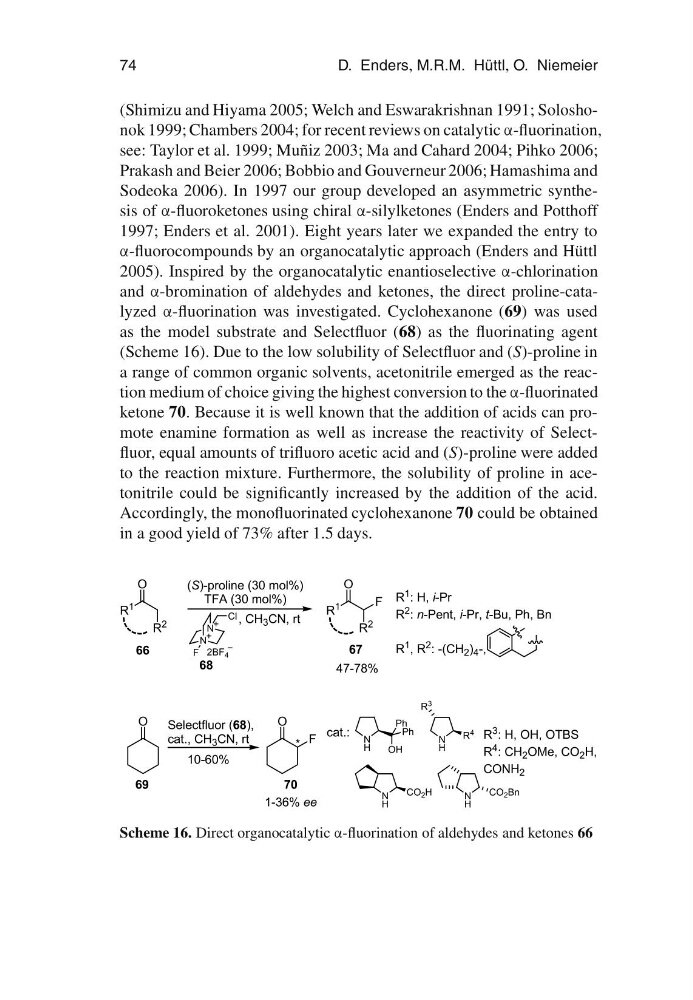
and α-bromination of aldehydes and ketones, the direct proline-catalyzed α-fluorination was investigated. Cyclohexanone (69) was used
as the model substrate and Selectfluor (68) as the fluorinating agent
(Scheme 16). Due to the low solubility of Selectfluor and (S)-proline in
a range of common organic solvents, acetonitrile emerged as the reaction medium of choice giving the highest conversion to the α-fluorinated
ketone 70. Because it is well known that the addition of acids can promote enamine formation as well as increase the reactivity of Selectfluor, equal amounts of trifluoro acetic acid and (S)-proline were added
to the reaction mixture. Furthermore, the solubility of proline in acetonitrile could be significantly increased by the addition of the acid.
Accordingly, the monofluorinated cyclohexanone 70 could be obtained
in a good yield of 73% after 1.5 days.
Scheme 16. Direct organocatalytic α-fluorination of aldehydes and ketones 66
D. Enders, M.R.M. Hüttl, O. Niemeier
(Shimizu and Hiyama 2005; Welch and Eswarakrishnan 1991; Soloshonok 1999; Chambers 2004; for recent reviews on catalytic α-fluorination,
see: Taylor et al. 1999; Muñiz 2003; Ma and Cahard 2004; Pihko 2006;
Prakash and Beier 2006; Bobbio and Gouverneur 2006; Hamashima and
Sodeoka 2006). In 1997 our group developed an asymmetric synthesis of α-fluoroketones using chiral α-silylketones (Enders and Potthoff
1997; Enders et al. 2001). Eight years later we expanded the entry to
α-fluorocompounds by an organocatalytic approach (Enders and Hüttl
2005). Inspired by the organocatalytic enantioselective α-chlorination
and α-bromination of aldehydes and ketones, the direct proline-catalyzed α-fluorination was investigated. Cyclohexanone (69) was used
as the model substrate and Selectfluor (68) as the fluorinating agent
(Scheme 16). Due to the low solubility of Selectfluor and (S)-proline in
a range of common organic solvents, acetonitrile emerged as the reaction medium of choice giving the highest conversion to the α-fluorinated
ketone 70. Because it is well known that the addition of acids can promote enamine formation as well as increase the reactivity of Selectfluor, equal amounts of trifluoro acetic acid and (S)-proline were added
to the reaction mixture. Furthermore, the solubility of proline in acetonitrile could be significantly increased by the addition of the acid.
Accordingly, the monofluorinated cyclohexanone 70 could be obtained
in a good yield of 73% after 1.5 days.
Scheme 16. Direct organocatalytic α-fluorination of aldehydes and ketones 66