

Biomimetic Organocatalytic C–C-Bond Formations
67
for the synthesis of amino sugars. Our protocol facilitates the synthesis
of different amino pentoses and hexoses with high diversity in only one
to two steps.
2.1.5 Asymmetric Organocatalytic Synthesis
of (+)-Polyoxamic Acid
The polyoxins are a family of important agricultural pest control agents
isolated from Streptomyces cacaoi var. asoensis (Isono et al. 1969).
They act by inhibiting the synthesis of chitin, which constitutes an important component of the fungal cell wall structure. They have also been
found to be of potential therapeutic value against the human fungal
pathogen Candida albicans (Shenbagamurthi et al. 1983). A common
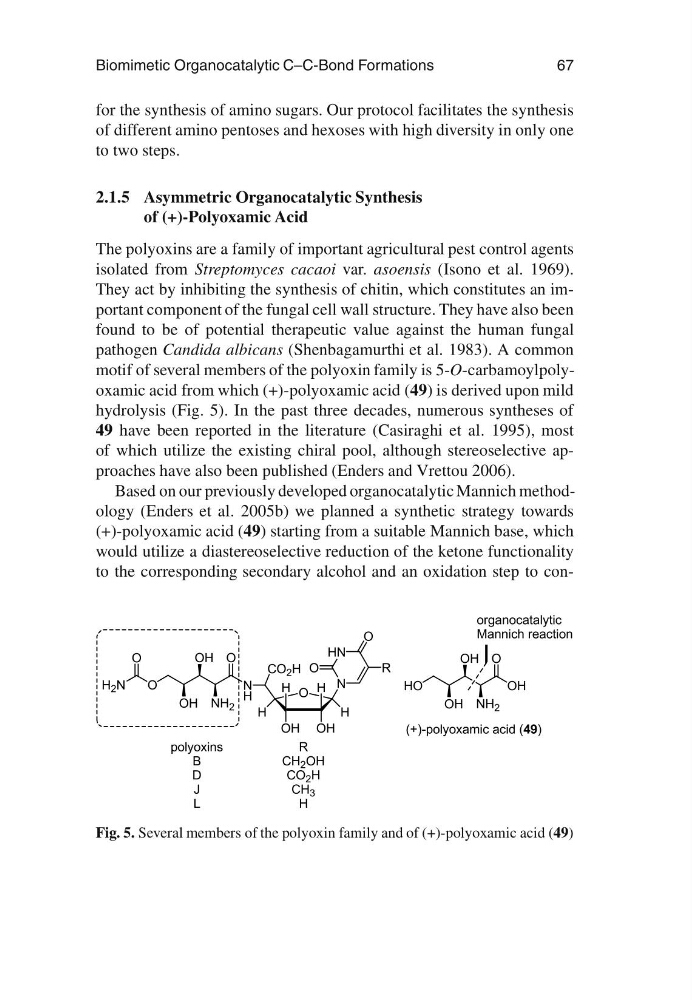
motif of several members of the polyoxin family is 5-O-carbamoylpolyoxamic acid from which (+)-polyoxamic acid (49) is derived upon mild
hydrolysis (Fig. 5). In the past three decades, numerous syntheses of
49 have been reported in the literature (Casiraghi et al. 1995), most
of which utilize the existing chiral pool, although stereoselective approaches have also been published (Enders and Vrettou 2006).
Based on our previously developed organocatalytic Mannich methodology (Enders et al. 2005b) we planned a synthetic strategy towards
(+)-polyoxamic acid (49) starting from a suitable Mannich base, which
would utilize a diastereoselective reduction of the ketone functionality
to the corresponding secondary alcohol and an oxidation step to conFig. 5. Several members of the polyoxin family and of (+)-polyoxamic acid (49)
67
for the synthesis of amino sugars. Our protocol facilitates the synthesis
of different amino pentoses and hexoses with high diversity in only one
to two steps.
2.1.5 Asymmetric Organocatalytic Synthesis
of (+)-Polyoxamic Acid
The polyoxins are a family of important agricultural pest control agents
isolated from Streptomyces cacaoi var. asoensis (Isono et al. 1969).
They act by inhibiting the synthesis of chitin, which constitutes an important component of the fungal cell wall structure. They have also been
found to be of potential therapeutic value against the human fungal
pathogen Candida albicans (Shenbagamurthi et al. 1983). A common
motif of several members of the polyoxin family is 5-O-carbamoylpolyoxamic acid from which (+)-polyoxamic acid (49) is derived upon mild
hydrolysis (Fig. 5). In the past three decades, numerous syntheses of
49 have been reported in the literature (Casiraghi et al. 1995), most
of which utilize the existing chiral pool, although stereoselective approaches have also been published (Enders and Vrettou 2006).
Based on our previously developed organocatalytic Mannich methodology (Enders et al. 2005b) we planned a synthetic strategy towards
(+)-polyoxamic acid (49) starting from a suitable Mannich base, which
would utilize a diastereoselective reduction of the ketone functionality
to the corresponding secondary alcohol and an oxidation step to conFig. 5. Several members of the polyoxin family and of (+)-polyoxamic acid (49)