

New Concepts for Organocatalysis
31
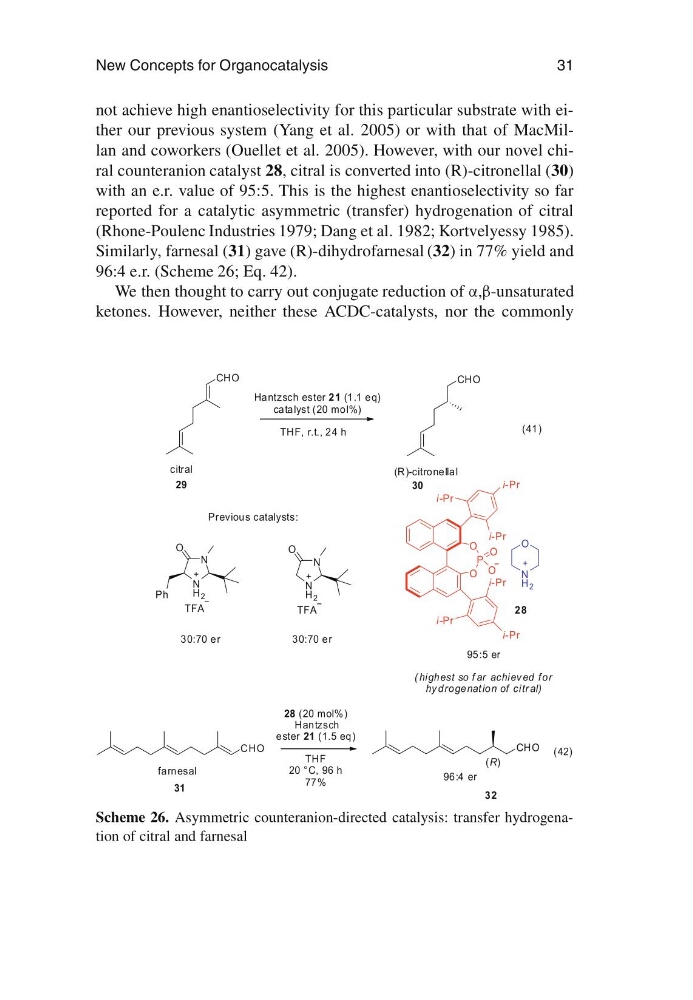
not achieve high enantioselectivity for this particular substrate with either our previous system (Yang et al. 2005) or with that of MacMillan and coworkers (Ouellet et al. 2005). However, with our novel chiral counteranion catalyst 28, citral is converted into (R)-citronellal (30)
with an e.r. value of 95:5. This is the highest enantioselectivity so far
reported for a catalytic asymmetric (transfer) hydrogenation of citral
(Rhone-Poulenc Industries 1979; Dang et al. 1982; Kortvelyessy 1985).
Similarly, farnesal (31) gave (R)-dihydrofarnesal (32) in 77% yield and
96:4 e.r. (Scheme 26; Eq. 42).
We then thought to carry out conjugate reduction of α,β-unsaturated
ketones. However, neither these ACDC-catalysts, nor the commonly
Scheme 26. Asymmetric counteranion-directed catalysis: transfer hydrogenation of citral and farnesal
31
not achieve high enantioselectivity for this particular substrate with either our previous system (Yang et al. 2005) or with that of MacMillan and coworkers (Ouellet et al. 2005). However, with our novel chiral counteranion catalyst 28, citral is converted into (R)-citronellal (30)
with an e.r. value of 95:5. This is the highest enantioselectivity so far
reported for a catalytic asymmetric (transfer) hydrogenation of citral
(Rhone-Poulenc Industries 1979; Dang et al. 1982; Kortvelyessy 1985).
Similarly, farnesal (31) gave (R)-dihydrofarnesal (32) in 77% yield and
96:4 e.r. (Scheme 26; Eq. 42).
We then thought to carry out conjugate reduction of α,β-unsaturated
ketones. However, neither these ACDC-catalysts, nor the commonly
Scheme 26. Asymmetric counteranion-directed catalysis: transfer hydrogenation of citral and farnesal