

12
S.C. Pan, B. List
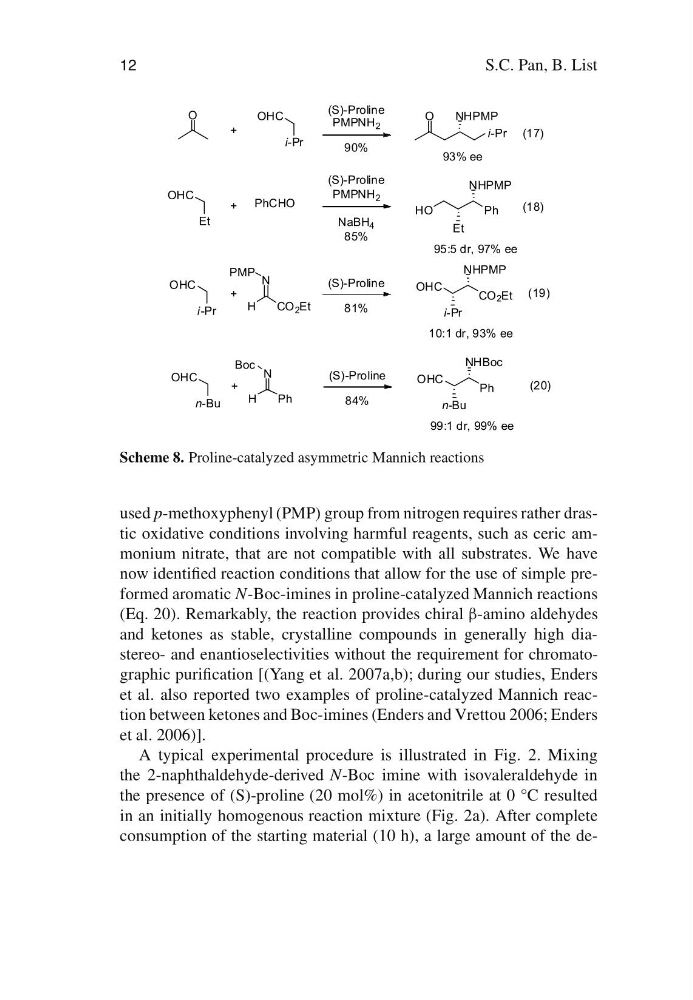
Scheme 8. Proline-catalyzed asymmetric Mannich reactions
used p-methoxyphenyl (PMP) group from nitrogen requires rather drastic oxidative conditions involving harmful reagents, such as ceric ammonium nitrate, that are not compatible with all substrates. We have
now identified reaction conditions that allow for the use of simple preformed aromatic N-Boc-imines in proline-catalyzed Mannich reactions
(Eq. 20). Remarkably, the reaction provides chiral β-amino aldehydes
and ketones as stable, crystalline compounds in generally high diastereo- and enantioselectivities without the requirement for chromatographic purification [(Yang et al. 2007a,b); during our studies, Enders
et al. also reported two examples of proline-catalyzed Mannich reaction between ketones and Boc-imines (Enders and Vrettou 2006; Enders
et al. 2006)].
A typical experimental procedure is illustrated in Fig. 2. Mixing
the 2-naphthaldehyde-derived N-Boc imine with isovaleraldehyde in
the presence of (S)-proline (20 mol%) in acetonitrile at 0 °C resulted
in an initially homogenous reaction mixture (Fig. 2a). After complete
consumption of the starting material (10 h), a large amount of the de-
S.C. Pan, B. List
Scheme 8. Proline-catalyzed asymmetric Mannich reactions
used p-methoxyphenyl (PMP) group from nitrogen requires rather drastic oxidative conditions involving harmful reagents, such as ceric ammonium nitrate, that are not compatible with all substrates. We have
now identified reaction conditions that allow for the use of simple preformed aromatic N-Boc-imines in proline-catalyzed Mannich reactions
(Eq. 20). Remarkably, the reaction provides chiral β-amino aldehydes
and ketones as stable, crystalline compounds in generally high diastereo- and enantioselectivities without the requirement for chromatographic purification [(Yang et al. 2007a,b); during our studies, Enders
et al. also reported two examples of proline-catalyzed Mannich reaction between ketones and Boc-imines (Enders and Vrettou 2006; Enders
et al. 2006)].
A typical experimental procedure is illustrated in Fig. 2. Mixing
the 2-naphthaldehyde-derived N-Boc imine with isovaleraldehyde in
the presence of (S)-proline (20 mol%) in acetonitrile at 0 °C resulted
in an initially homogenous reaction mixture (Fig. 2a). After complete
consumption of the starting material (10 h), a large amount of the de-