

2
S.C. Pan, B. List
organocatalysis from our laboratories include several new and broadly useful concepts such as enamine catalysis and asymmetric counteranion-directed
catalysis. Our laboratory has discovered the proline-catalyzed direct asymmetric intermolecular aldol reaction and introduced several other organocatalytic
reactions.
1
Introduction: Organocatalysis
When chemists make chiral compounds—molecules that behave like
object and mirror image, such as amino acids, sugars, drugs, or nucleic
acids—they like to use asymmetric catalysis, in which a chiral catalyst
selectively accelerates the reaction that leads to one mirror-image isomer, also called enantiomer. For decades, the generally accepted view
has been that there are two classes of efficient asymmetric catalysts: enzymes and synthetic metal complexes (Nicolaou and Sorensen 1996).
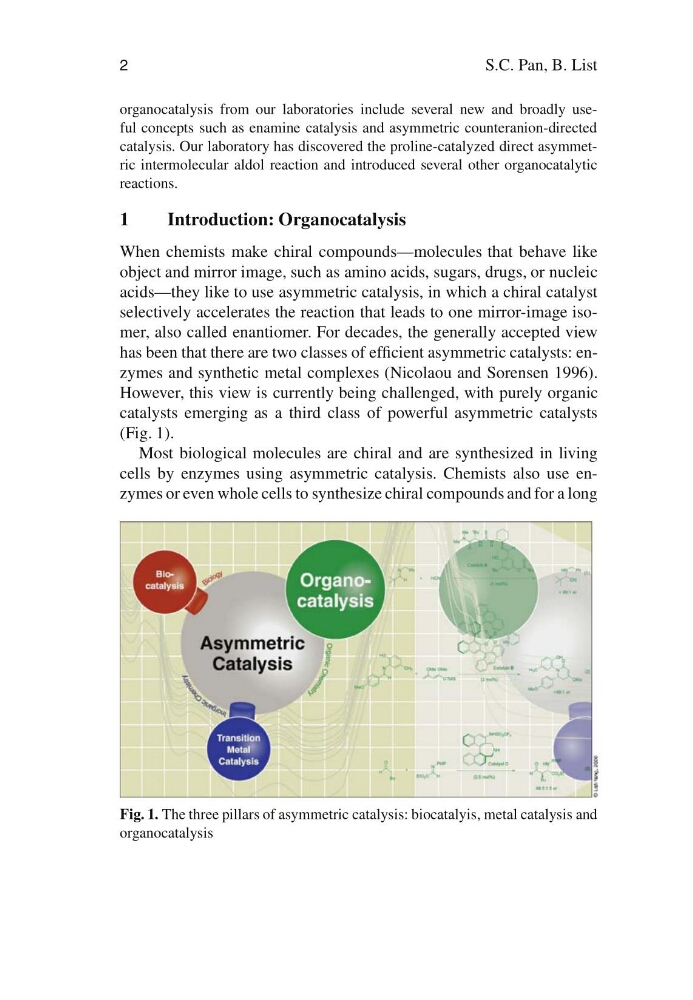
However, this view is currently being challenged, with purely organic
catalysts emerging as a third class of powerful asymmetric catalysts
(Fig. 1).
Most biological molecules are chiral and are synthesized in living
cells by enzymes using asymmetric catalysis. Chemists also use enzymes or even whole cells to synthesize chiral compounds and for a long
Fig. 1. The three pillars of asymmetric catalysis: biocatalyis, metal catalysis and
organocatalysis
S.C. Pan, B. List
organocatalysis from our laboratories include several new and broadly useful concepts such as enamine catalysis and asymmetric counteranion-directed
catalysis. Our laboratory has discovered the proline-catalyzed direct asymmetric intermolecular aldol reaction and introduced several other organocatalytic
reactions.
1
Introduction: Organocatalysis
When chemists make chiral compounds—molecules that behave like
object and mirror image, such as amino acids, sugars, drugs, or nucleic
acids—they like to use asymmetric catalysis, in which a chiral catalyst
selectively accelerates the reaction that leads to one mirror-image isomer, also called enantiomer. For decades, the generally accepted view
has been that there are two classes of efficient asymmetric catalysts: enzymes and synthetic metal complexes (Nicolaou and Sorensen 1996).
However, this view is currently being challenged, with purely organic
catalysts emerging as a third class of powerful asymmetric catalysts
(Fig. 1).
Most biological molecules are chiral and are synthesized in living
cells by enzymes using asymmetric catalysis. Chemists also use enzymes or even whole cells to synthesize chiral compounds and for a long
Fig. 1. The three pillars of asymmetric catalysis: biocatalyis, metal catalysis and
organocatalysis