

CHAPTER 3 • Photooxidation of Dissolved Organic Matter
77
3.2
Absorption of Sunlight by eDOM
In many surface waters, eDOM is the predominant light absorbing component. These
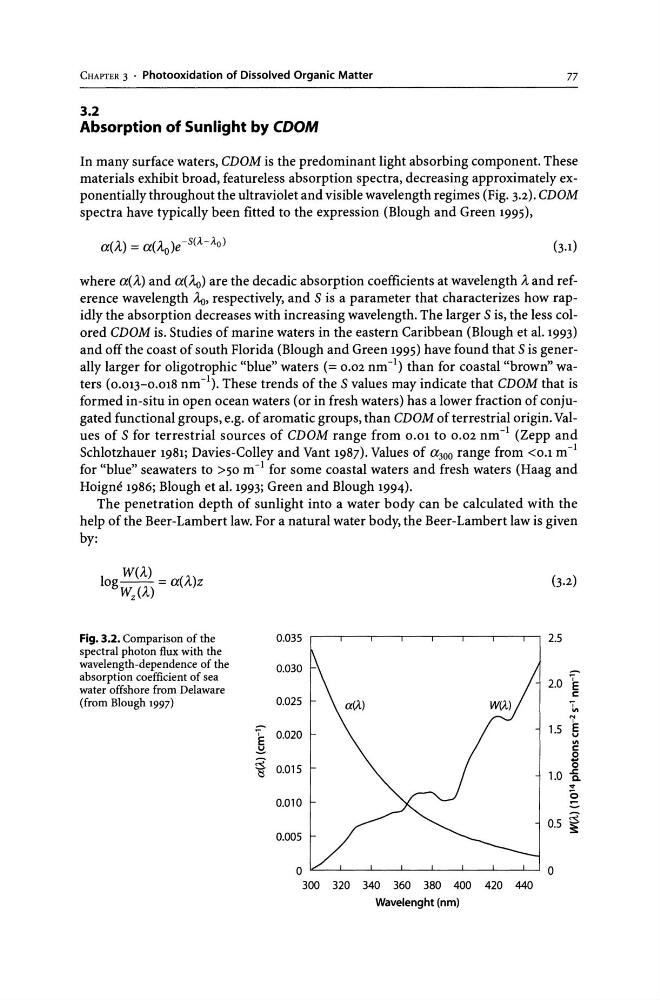
materials exhibit broad, featureless absorption spectra, decreasing approximatelyexponentially throughout the ultraviolet and visible wavelength regimes (Fig. 3.2). eDOM
spectra have typically been fitted to the expression (Blough and Green 1995),
where a(A) and a(Ao) are the decadic absorption coefficients at wavelength A and reference wavelength Ao, respectively, and S is a parameter that characterizes how rapidly the absorption decreases with increasing wavelength. The larger S is, the less colored eDOM is. Studies of marine waters in the eastern Caribbean (Blough et al. 1993)
and off the coast of south Florida (Blough and Green 1995) have found that S is generally larger for oligotrophic "blue" waters (= 0.02 nm- I ) than for coastal "brown" waters (0.013-0.0l8 nm- I ). These trends of the S values may indicate that eDOM that is
formed in-situ in open ocean waters (or in fresh waters) has a lower fraction of conjugated functional groups, e.g. of aromatic groups, than eDOM of terrestrial origin. Values of S for terrestrial sources of eDOM range from 0.01 to 0.02 nm- I (Zepp and
Schlotzhauer 1981; Davies-Colley and Vant 1987). Values of a300 range from <0.1 m- I
for "blue" seawaters to >50 m- I for some coastal waters and fresh waters (Haag and
Hoigne 1986; Blough et al. 1993; Green and Blough 1994).
The penetration depth of sunlight into a water body can be calculated with the
help of the Beer-Lambert law. For a natural water body, the Beer-Lambert law is given
by:
W(A)
10g--1 = a(A)z
Wz(A,)
Fig. 3.2. Comparison of the
spectral photon flux with the
wavelength-dependence of the
absorption coefficient of sea
water offshore from Delaware
(from Blough 1997)
~
~
~
0.035
0.030
0.025
0.020
0.D15
0.010
0.005
320 340 360 380 400 420 440
Wavelenght (nm)
2.5
' 1'
1.5 5
l£
~
1.0 -a
~
'0
:::::.
77
3.2
Absorption of Sunlight by eDOM
In many surface waters, eDOM is the predominant light absorbing component. These
materials exhibit broad, featureless absorption spectra, decreasing approximatelyexponentially throughout the ultraviolet and visible wavelength regimes (Fig. 3.2). eDOM
spectra have typically been fitted to the expression (Blough and Green 1995),
where a(A) and a(Ao) are the decadic absorption coefficients at wavelength A and reference wavelength Ao, respectively, and S is a parameter that characterizes how rapidly the absorption decreases with increasing wavelength. The larger S is, the less colored eDOM is. Studies of marine waters in the eastern Caribbean (Blough et al. 1993)
and off the coast of south Florida (Blough and Green 1995) have found that S is generally larger for oligotrophic "blue" waters (= 0.02 nm- I ) than for coastal "brown" waters (0.013-0.0l8 nm- I ). These trends of the S values may indicate that eDOM that is
formed in-situ in open ocean waters (or in fresh waters) has a lower fraction of conjugated functional groups, e.g. of aromatic groups, than eDOM of terrestrial origin. Values of S for terrestrial sources of eDOM range from 0.01 to 0.02 nm- I (Zepp and
Schlotzhauer 1981; Davies-Colley and Vant 1987). Values of a300 range from <0.1 m- I
for "blue" seawaters to >50 m- I for some coastal waters and fresh waters (Haag and
Hoigne 1986; Blough et al. 1993; Green and Blough 1994).
The penetration depth of sunlight into a water body can be calculated with the
help of the Beer-Lambert law. For a natural water body, the Beer-Lambert law is given
by:
W(A)
10g--1 = a(A)z
Wz(A,)
Fig. 3.2. Comparison of the
spectral photon flux with the
wavelength-dependence of the
absorption coefficient of sea
water offshore from Delaware
(from Blough 1997)
~
~
~
0.035
0.030
0.025
0.020
0.D15
0.010
0.005
320 340 360 380 400 420 440
Wavelenght (nm)
2.5
' 1'
1.5 5
l£
~
1.0 -a
~
'0
:::::.