

68
S. Pantoja . S. Wakeham
The progressive alterations of organic matter that occur during diagenesis in the
oceanic water column and sediments efficiently remove the readily identifiable organic
constituents and leave behind a large fraction that cannot be characterized. This chemical recalcitrance, however, does not imply a corresponding biological recalcitrance,
since the rain of organic matter to the sea floor fuels benthic metabolism and indeed
the benthic boundary layer is a "hotspot" of organic matter degradation (Mayer 1993;
Deming and Baross 1993). Nonetheless, the challenge to organic geochemists of extracting molecular information from this as yet uncharacterized material will require
application of novel analytical tools. But how is this uncharacterized material generated, and what is its role in preservation of organic matter?
The uncharacterized organic matter is largely macromolecular in nature. Tissot and
Welte (1984) described the classical view that macromolecular material results from
sequential and random polymerization and polycondensation of biomonomers that
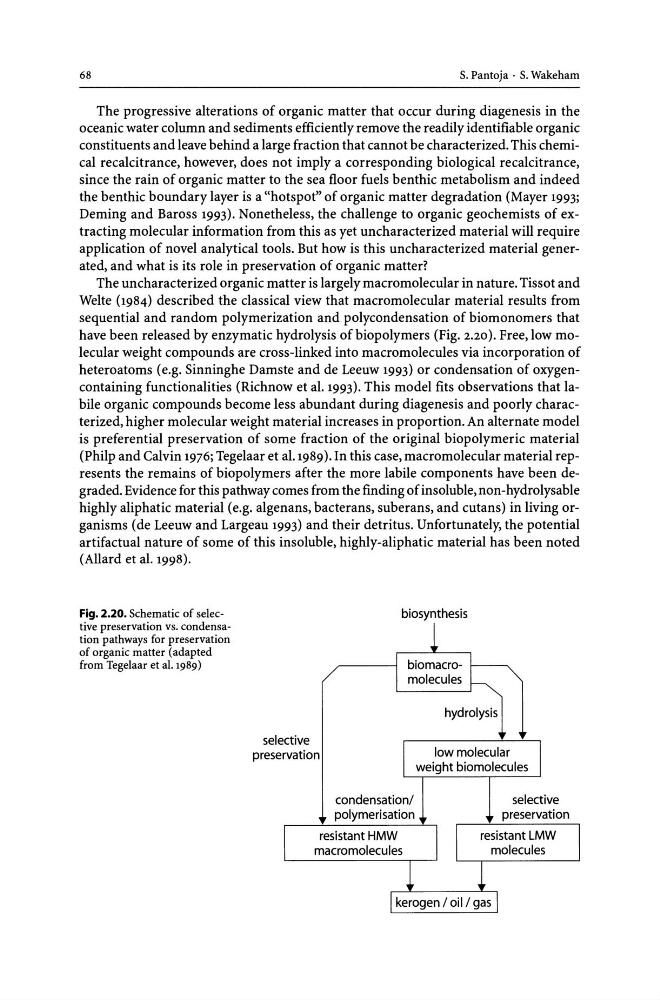
have been released by enzymatic hydrolysis of biopolymers (Fig. 2.20). Free, low molecular weight compounds are cross-linked into macromolecules via incorporation of
heteroatoms (e.g. Sinninghe Damste and de Leeuw 1993) or condensation of oxygencontaining functionalities (Richnow et al. 1993). This model fits observations that labile organic compounds become less abundant during diagenesis and poorly characterized, higher molecular weight material increases in proportion. An alternate model
is preferential preservation of some fraction of the original biopolymeric material
(Philp and Calvin 1976; Tegelaar et al. 1989). In this case, macromolecular material represents the remains of biopolymers after the more labile components have been degraded. Evidence for this pathway comes from the finding of insoluble, non-hydrolysable
highly aliphatic material (e.g. algenans, bacterans, suberans, and cutans) in living organisms (de Leeuw and Largeau 1993) and their detritus. Unfortunately, the potential
artifactual nature of some of this insoluble, highly-aliphatic material has been noted
(Allard et al. 1998).
Fig. 2.20. Schematic of selective preservation vs. condensation pathways for preservation
of organic matter (adapted
from Tegelaar et al.1989)
biosynthesis
selective
preservation
condensation/
polymerisation
resistant HMW
macromolecules
hydrolysis
low molecular
weight biomolecules
selective
preservation
resistant LMW
molecules
S. Pantoja . S. Wakeham
The progressive alterations of organic matter that occur during diagenesis in the
oceanic water column and sediments efficiently remove the readily identifiable organic
constituents and leave behind a large fraction that cannot be characterized. This chemical recalcitrance, however, does not imply a corresponding biological recalcitrance,
since the rain of organic matter to the sea floor fuels benthic metabolism and indeed
the benthic boundary layer is a "hotspot" of organic matter degradation (Mayer 1993;
Deming and Baross 1993). Nonetheless, the challenge to organic geochemists of extracting molecular information from this as yet uncharacterized material will require
application of novel analytical tools. But how is this uncharacterized material generated, and what is its role in preservation of organic matter?
The uncharacterized organic matter is largely macromolecular in nature. Tissot and
Welte (1984) described the classical view that macromolecular material results from
sequential and random polymerization and polycondensation of biomonomers that
have been released by enzymatic hydrolysis of biopolymers (Fig. 2.20). Free, low molecular weight compounds are cross-linked into macromolecules via incorporation of
heteroatoms (e.g. Sinninghe Damste and de Leeuw 1993) or condensation of oxygencontaining functionalities (Richnow et al. 1993). This model fits observations that labile organic compounds become less abundant during diagenesis and poorly characterized, higher molecular weight material increases in proportion. An alternate model
is preferential preservation of some fraction of the original biopolymeric material
(Philp and Calvin 1976; Tegelaar et al. 1989). In this case, macromolecular material represents the remains of biopolymers after the more labile components have been degraded. Evidence for this pathway comes from the finding of insoluble, non-hydrolysable
highly aliphatic material (e.g. algenans, bacterans, suberans, and cutans) in living organisms (de Leeuw and Largeau 1993) and their detritus. Unfortunately, the potential
artifactual nature of some of this insoluble, highly-aliphatic material has been noted
(Allard et al. 1998).
Fig. 2.20. Schematic of selective preservation vs. condensation pathways for preservation
of organic matter (adapted
from Tegelaar et al.1989)
biosynthesis
selective
preservation
condensation/
polymerisation
resistant HMW
macromolecules
hydrolysis
low molecular
weight biomolecules
selective
preservation
resistant LMW
molecules