

CHAPTER 2 • Marine Organic Geochemistry: A General Overview
atmospheric COl
terrestrial primary
produdion
60
1
land biomass
570
soilOC
1670
i
upllft/weathering
0.15
750
45
l
marine primary
50
production
1
sedimentation 4
1
preservation 0.15
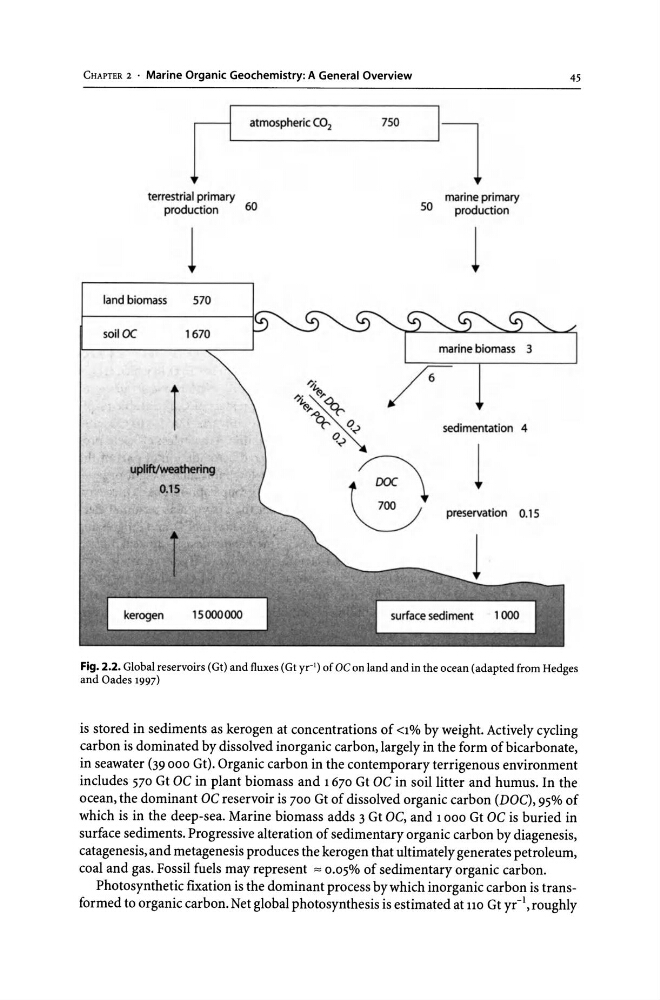
Fig. 2.2. Global reservoirs (Gt) and fluxes (Gt ye- I ) of OC on land and in the ocean (adapted from Hedges
and Oades 1997)
is stored in sediments as kerogen at concentrations of <1% by weight. Actively cycling
carbon is dominated by dissolved inorganic carbon, largely in the form of bicarbonate,
in seawater (39000 Gt). Organic carbon in the contemporary terrigenous environment
includes 570 Gt OC in plant biomass and 1670 Gt OC in soil litter and humus. In the
ocean, the dominant OC reservoir is 700 Gt of dissolved organic carbon (DOC), 95% of
which is in the deep-sea. Marine biomass adds 3 Gt ~C, and 1000 Gt OC is buried in
surface sediments. Progressive alteration of sedimentary organic carbon by diagenesis,
catagenesis, and metagenesis produces the kerogen that ultimately generates petroleum,
coal and gas. Fossil fuels may represent '" 0.05% of sedimentary organic carbon.
Photosynthetic fIxation is the dominant process by which inorganic carbon is transformed to organic carbon. Net global photosynthesis is estimated at 110 Gt yr- 1 , roughly
atmospheric COl
terrestrial primary
produdion
60
1
land biomass
570
soilOC
1670
i
upllft/weathering
0.15
750
45
l
marine primary
50
production
1
sedimentation 4
1
preservation 0.15
Fig. 2.2. Global reservoirs (Gt) and fluxes (Gt ye- I ) of OC on land and in the ocean (adapted from Hedges
and Oades 1997)
is stored in sediments as kerogen at concentrations of <1% by weight. Actively cycling
carbon is dominated by dissolved inorganic carbon, largely in the form of bicarbonate,
in seawater (39000 Gt). Organic carbon in the contemporary terrigenous environment
includes 570 Gt OC in plant biomass and 1670 Gt OC in soil litter and humus. In the
ocean, the dominant OC reservoir is 700 Gt of dissolved organic carbon (DOC), 95% of
which is in the deep-sea. Marine biomass adds 3 Gt ~C, and 1000 Gt OC is buried in
surface sediments. Progressive alteration of sedimentary organic carbon by diagenesis,
catagenesis, and metagenesis produces the kerogen that ultimately generates petroleum,
coal and gas. Fossil fuels may represent '" 0.05% of sedimentary organic carbon.
Photosynthetic fIxation is the dominant process by which inorganic carbon is transformed to organic carbon. Net global photosynthesis is estimated at 110 Gt yr- 1 , roughly