

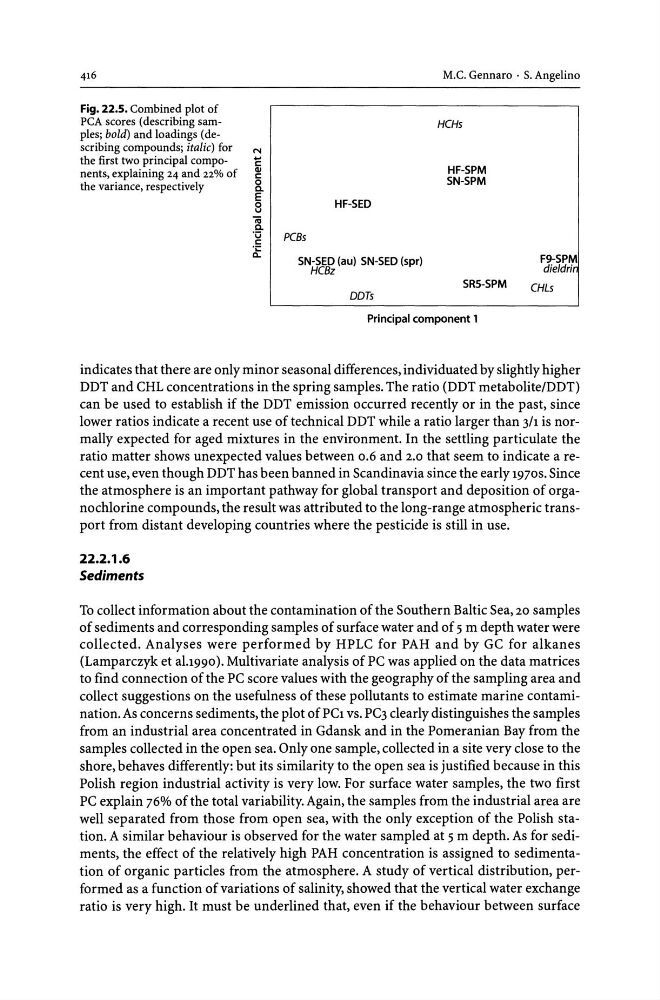
Fig. 22.5. Combined plot of
PCA scores (describing samples; bold) and loadings (describing compounds; italic) for
the first two principal components, explaining 24 and 22% of
the variance, respectively
N
1: cu
c:
8.
E
8
1 'u c:
d:
HF-SED
PCBs
SN-SED (au) SN-SED (spr)
HCBz
DOTs
M.C. Gennaro . S. Angelino
HCHs
HF-SPM
SN-SPM
SRS-SPM
F9-SPM
dieldrin
CHLs
Principal component 1
indicates that there are only minor seasonal differences, individuated by slightly higher
DDT and CHL concentrations in the spring samples. The ratio (DDT metabolite/DDT)
can be used to establish if the DDT emission occurred recently or in the past, since
lower ratios indicate a recent use of technical DDT while a ratio larger than 311 is normally expected for aged mixtures in the environment. In the settling particulate the
ratio matter shows unexpected values between 0.6 and 2.0 that seem to indicate a recent use, even though DDT has been banned in Scandinavia since the early 1970S. Since
the atmosphere is an important pathway for global transport and deposition of organochlorine compounds, the result was attributed to the long-range atmospheric transport from distant developing countries where the pesticide is still in use.
22.2.1.6
Sediments
To collect information about the contamination of the Southern Baltic Sea, 20 samples
of sediments and corresponding samples of surface water and of 5 m depth water were
collected. Analyses were performed by HPLC for PAH and by GC for alkanes
(Lamparczyk et al.!990). Multivariate analysis of PC was applied on the data matrices
to find connection of the PC score values with the geography of the sampling area and
collect suggestions on the usefulness of these pollutants to estimate marine contamination. As concerns sediments, the plot of PC1 vs. PC3 clearly distinguishes the samples
from an industrial area concentrated in Gdansk and in the Pomeranian Bay from the
samples collected in the open sea. Only one sample, collected in a site very close to the
shore, behaves differently: but its similarity to the open sea is justified because in this
Polish region industrial activity is very low. For surface water samples, the two first
PC explain 76% of the total variability. Again, the samples from the industrial area are
well separated from those from open sea, with the only exception of the Polish station. A similar behaviour is observed for the water sampled at 5 m depth. As for sediments, the effect of the relatively high PAH concentration is assigned to sedimentation of organic particles from the atmosphere. A study of vertical distribution, performed as a function of variations of salinity, showed that the vertical water exchange
ratio is very high. It must be underlined that, even if the behaviour between surface
PCA scores (describing samples; bold) and loadings (describing compounds; italic) for
the first two principal components, explaining 24 and 22% of
the variance, respectively
N
1: cu
c:
8.
E
8
1 'u c:
d:
HF-SED
PCBs
SN-SED (au) SN-SED (spr)
HCBz
DOTs
M.C. Gennaro . S. Angelino
HCHs
HF-SPM
SN-SPM
SRS-SPM
F9-SPM
dieldrin
CHLs
Principal component 1
indicates that there are only minor seasonal differences, individuated by slightly higher
DDT and CHL concentrations in the spring samples. The ratio (DDT metabolite/DDT)
can be used to establish if the DDT emission occurred recently or in the past, since
lower ratios indicate a recent use of technical DDT while a ratio larger than 311 is normally expected for aged mixtures in the environment. In the settling particulate the
ratio matter shows unexpected values between 0.6 and 2.0 that seem to indicate a recent use, even though DDT has been banned in Scandinavia since the early 1970S. Since
the atmosphere is an important pathway for global transport and deposition of organochlorine compounds, the result was attributed to the long-range atmospheric transport from distant developing countries where the pesticide is still in use.
22.2.1.6
Sediments
To collect information about the contamination of the Southern Baltic Sea, 20 samples
of sediments and corresponding samples of surface water and of 5 m depth water were
collected. Analyses were performed by HPLC for PAH and by GC for alkanes
(Lamparczyk et al.!990). Multivariate analysis of PC was applied on the data matrices
to find connection of the PC score values with the geography of the sampling area and
collect suggestions on the usefulness of these pollutants to estimate marine contamination. As concerns sediments, the plot of PC1 vs. PC3 clearly distinguishes the samples
from an industrial area concentrated in Gdansk and in the Pomeranian Bay from the
samples collected in the open sea. Only one sample, collected in a site very close to the
shore, behaves differently: but its similarity to the open sea is justified because in this
Polish region industrial activity is very low. For surface water samples, the two first
PC explain 76% of the total variability. Again, the samples from the industrial area are
well separated from those from open sea, with the only exception of the Polish station. A similar behaviour is observed for the water sampled at 5 m depth. As for sediments, the effect of the relatively high PAH concentration is assigned to sedimentation of organic particles from the atmosphere. A study of vertical distribution, performed as a function of variations of salinity, showed that the vertical water exchange
ratio is very high. It must be underlined that, even if the behaviour between surface