

18
F.J. Millero
As mentioned earlier, any two combinations of the four observable parameters can
be used to characterize the carbonate system. It is also possible to use three parameters. This gives a total of ten combinations that can be used. The investigator must make
a selection based on his or her needs after considering both the desired analytical precision and area of interest. The basic equations for determining the various parameters
are given elsewhere (Park 1969). A number of computer codes are available to calculate
the components of the carbonate system in sea water (Millero 1995; Lewis and Wallace
1998) from various inputs of the measured parameters. As mentioned earlier, the equations ofMillero and Roy (1997) can be used to estimate the dissociation constants of acids
in any natural water of known composition. Our computer code (Millero 1995) has been
combined with the equations of Millero and Roy (1997), and can be used to determine
the components of the carbonate system in any natural water (Gleitz et al. 1995).
To select the best two parameters needed to study the carbonate system, we can
examine how the system changes during the formation and breakdown of organic
carbon and the dissolution or precipitation of CaC03. The largest changes in the CO2
system in deep waters are due to the oxidation of organic carbon. This oxidation
can be followed by considering the changes in the apparent oxygen utilization
(AOU == [02]meas - [02]sat). The effects of a change in AOU of 0.13 and 0.26 mM are given
in Table 1.3 and shown in Fig. 1.6. The largest change occurs in Pc0 2 followed by TC02
and pH. The carbonate alkalinity (CA == [HCO;-] + 2 [CO~-]), does not change. If one
considers the present capabilities of measuring Pc0 2 (±0.1%), TC02 (±0.17%), TA
(±0.2%) and pH (±0.04%), the best selection would be Pc0 2 -TC02 followed bypH-TC02
and PC02 -TA.
The changes in the CO2 system due to the dissolution of CaC03 in deep waters are
are given in Table 1.4 and shown in Fig. 1.7. The greatest change occurs in Pc0 2 , with
CA and pH following. The best combination is CAITC02, followed by pH/CA and
CAITC02 obtained by an acid titration; this represents the best approach for studying
changes in the carbonate system.
If one combines the AOU and CaC03 effects (Brewer et al.1975; Chen 1978), one finds
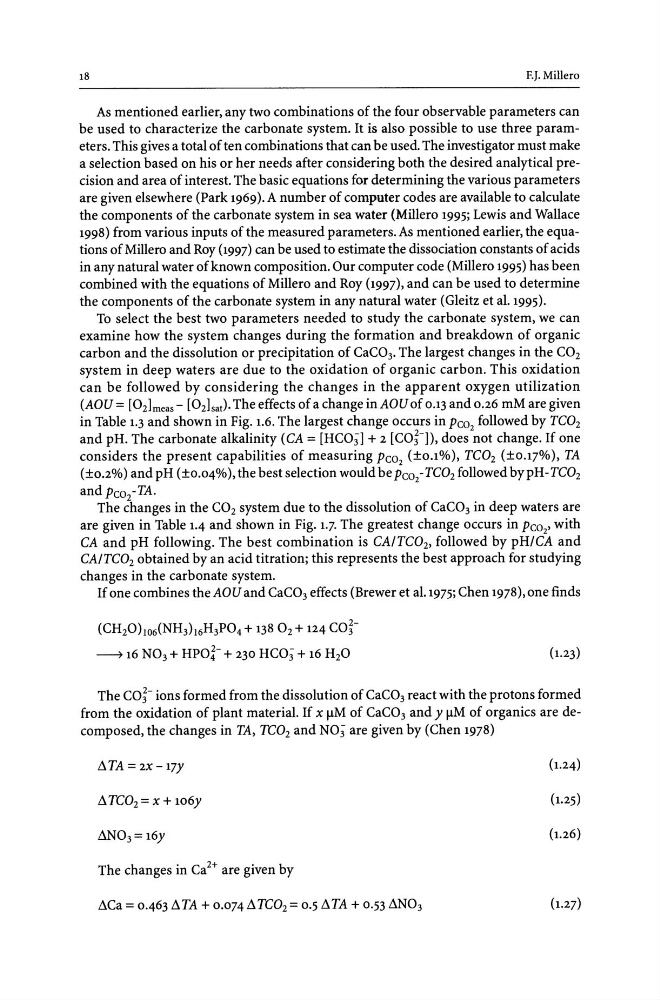
(CH20ho6(NH3h6H3P04 + 138 O2 + 124 CO~~ 16 N03 + HPO~- + 230 HCO;- + 16 H20
The CO~- ions formed from the dissolution of CaC0 3 react with the protons formed
from the oxidation of plant material. If x 11M of CaC03 and Y 11M of organics are decomposed, the changes in TA, Te02 and NO;- are given by (Chen 1978)
~TA ==2X-17Y
~TC02 == X + 106y
(1.26)
The changes in Ca 2 + are given by
F.J. Millero
As mentioned earlier, any two combinations of the four observable parameters can
be used to characterize the carbonate system. It is also possible to use three parameters. This gives a total of ten combinations that can be used. The investigator must make
a selection based on his or her needs after considering both the desired analytical precision and area of interest. The basic equations for determining the various parameters
are given elsewhere (Park 1969). A number of computer codes are available to calculate
the components of the carbonate system in sea water (Millero 1995; Lewis and Wallace
1998) from various inputs of the measured parameters. As mentioned earlier, the equations ofMillero and Roy (1997) can be used to estimate the dissociation constants of acids
in any natural water of known composition. Our computer code (Millero 1995) has been
combined with the equations of Millero and Roy (1997), and can be used to determine
the components of the carbonate system in any natural water (Gleitz et al. 1995).
To select the best two parameters needed to study the carbonate system, we can
examine how the system changes during the formation and breakdown of organic
carbon and the dissolution or precipitation of CaC03. The largest changes in the CO2
system in deep waters are due to the oxidation of organic carbon. This oxidation
can be followed by considering the changes in the apparent oxygen utilization
(AOU == [02]meas - [02]sat). The effects of a change in AOU of 0.13 and 0.26 mM are given
in Table 1.3 and shown in Fig. 1.6. The largest change occurs in Pc0 2 followed by TC02
and pH. The carbonate alkalinity (CA == [HCO;-] + 2 [CO~-]), does not change. If one
considers the present capabilities of measuring Pc0 2 (±0.1%), TC02 (±0.17%), TA
(±0.2%) and pH (±0.04%), the best selection would be Pc0 2 -TC02 followed bypH-TC02
and PC02 -TA.
The changes in the CO2 system due to the dissolution of CaC03 in deep waters are
are given in Table 1.4 and shown in Fig. 1.7. The greatest change occurs in Pc0 2 , with
CA and pH following. The best combination is CAITC02, followed by pH/CA and
CAITC02 obtained by an acid titration; this represents the best approach for studying
changes in the carbonate system.
If one combines the AOU and CaC03 effects (Brewer et al.1975; Chen 1978), one finds
(CH20ho6(NH3h6H3P04 + 138 O2 + 124 CO~~ 16 N03 + HPO~- + 230 HCO;- + 16 H20
The CO~- ions formed from the dissolution of CaC0 3 react with the protons formed
from the oxidation of plant material. If x 11M of CaC03 and Y 11M of organics are decomposed, the changes in TA, Te02 and NO;- are given by (Chen 1978)
~TA ==2X-17Y
~TC02 == X + 106y
(1.26)
The changes in Ca 2 + are given by