

CHAPTER 17 • Characterization of Marine Toxins with LC-ESI-MS
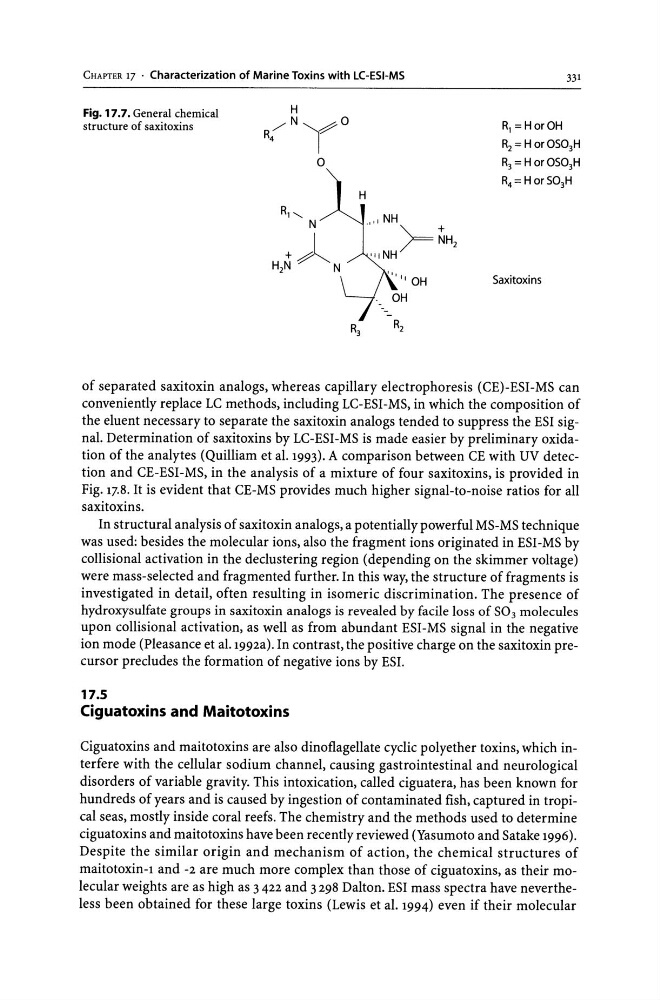
Fig. 17.7. General chemical
structure of saxitoxins
R, "H
",I NH
)=~H2
'IINH
331
R, = HorOH
R2 = H or OS03H
R3 = H or OS03H
R4= H orS0 3 H
Saxitoxins
of separated saxitoxin analogs, whereas capillary electrophoresis (CE)-ESI-MS can
conveniently replace LC methods, including LC-ESI-MS, in which the composition of
the eluent necessary to separate the saxitoxin analogs tended to suppress the ESI signal. Determination of saxitoxins by LC-ESI-MS is made easier by preliminary oxidation of the analytes (Quilliam et al. 1993). A comparison between CE with UV detection and CE-ESI-MS, in the analysis of a mixture of four saxitoxins, is provided in
Fig. 17.8. It is evident that CE-MS provides much higher signal-to-noise ratios for all
saxitoxins.
In structural analysis of saxitoxin analogs, a potentially powerful MS-MS technique
was used: besides the molecular ions, also the fragment ions originated in ESI-MS by
collisional activation in the declustering region (depending on the skimmer voltage)
were mass-selected and fragmented further. In this way, the structure of fragments is
investigated in detail, often resulting in isomeric discrimination. The presence of
hydroxysulfate groups in saxitoxin analogs is revealed by facile loss of S03 molecules
upon collisional activation, as well as from abundant ESI-MS signal in the negative
ion mode (Pleasance et al.1992a). In contrast, the positive charge on the saxitoxin precursor precludes the formation of negative ions by ESI.
17.5
Ciguatoxins and Maitotoxins
Ciguatoxins and maitotoxins are also dinoflagellate cyclic polyether toxins, which interfere with the cellular sodium channel, causing gastrointestinal and neurological
disorders of variable gravity. This intoxication, called ciguatera, has been known for
hundreds of years and is caused by ingestion of contaminated fish, captured in tropical seas, mostly inside coral reefs. The chemistry and the methods used to determine
ciguatoxins and maitotoxins have been recently reviewed (Yasumoto and Satake 1996).
Despite the similar origin and mechanism of action, the chemical structures of
maitotoxin-1 and -2 are much more complex than those of ciguatoxins, as their molecular weights are as high as 3 422 and 3298 Dalton. ESI mass spectra have nevertheless been obtained for these large toxins (Lewis et al. 1994) even if their molecular
Fig. 17.7. General chemical
structure of saxitoxins
R, "H
",I NH
)=~H2
'IINH
331
R, = HorOH
R2 = H or OS03H
R3 = H or OS03H
R4= H orS0 3 H
Saxitoxins
of separated saxitoxin analogs, whereas capillary electrophoresis (CE)-ESI-MS can
conveniently replace LC methods, including LC-ESI-MS, in which the composition of
the eluent necessary to separate the saxitoxin analogs tended to suppress the ESI signal. Determination of saxitoxins by LC-ESI-MS is made easier by preliminary oxidation of the analytes (Quilliam et al. 1993). A comparison between CE with UV detection and CE-ESI-MS, in the analysis of a mixture of four saxitoxins, is provided in
Fig. 17.8. It is evident that CE-MS provides much higher signal-to-noise ratios for all
saxitoxins.
In structural analysis of saxitoxin analogs, a potentially powerful MS-MS technique
was used: besides the molecular ions, also the fragment ions originated in ESI-MS by
collisional activation in the declustering region (depending on the skimmer voltage)
were mass-selected and fragmented further. In this way, the structure of fragments is
investigated in detail, often resulting in isomeric discrimination. The presence of
hydroxysulfate groups in saxitoxin analogs is revealed by facile loss of S03 molecules
upon collisional activation, as well as from abundant ESI-MS signal in the negative
ion mode (Pleasance et al.1992a). In contrast, the positive charge on the saxitoxin precursor precludes the formation of negative ions by ESI.
17.5
Ciguatoxins and Maitotoxins
Ciguatoxins and maitotoxins are also dinoflagellate cyclic polyether toxins, which interfere with the cellular sodium channel, causing gastrointestinal and neurological
disorders of variable gravity. This intoxication, called ciguatera, has been known for
hundreds of years and is caused by ingestion of contaminated fish, captured in tropical seas, mostly inside coral reefs. The chemistry and the methods used to determine
ciguatoxins and maitotoxins have been recently reviewed (Yasumoto and Satake 1996).
Despite the similar origin and mechanism of action, the chemical structures of
maitotoxin-1 and -2 are much more complex than those of ciguatoxins, as their molecular weights are as high as 3 422 and 3298 Dalton. ESI mass spectra have nevertheless been obtained for these large toxins (Lewis et al. 1994) even if their molecular