

314
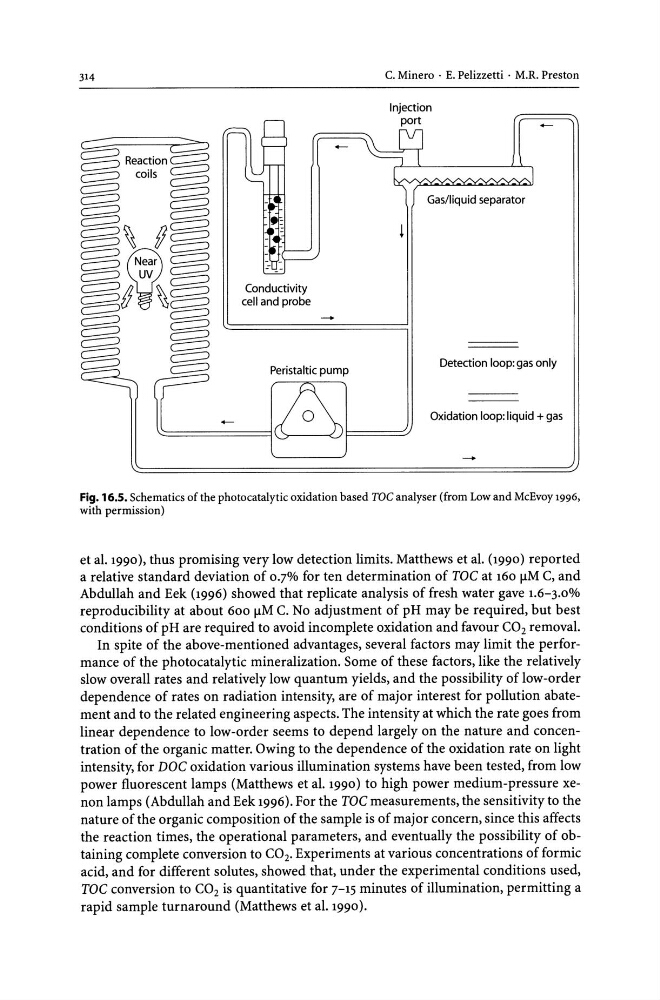
Conductivity
cell and probe
Peristaltic pump
c. Minero . E. Pelizzetti . M.R. Preston
Injection
port
Gas/liquid separator
Detection loop: gas only
Oxidation loop: liquid + gas
Fig. 16.5. Schematics of the photocatalytic oxidation based TOC analyser (from Low and McEvoy 1996,
with permission)
et al. 1990), thus promising very low detection limits. Matthews et al. (1990) reported
a relative standard deviation of 0.7% for ten determination of Toe at 160 JlM e, and
Abdullah and Eek (1996) showed that replicate analysis of fresh water gave 1.6-3.0%
reproducibility at about 600 JlM e. No adjustment of pH may be required, but best
conditions of pH are required to avoid incomplete oxidation and favour CO2 removal.
In spite of the above-mentioned advantages, several factors may limit the performance of the photocatalytic mineralization. Some of these factors, like the relatively
slow overall rates and relatively low quantum yields, and the possibility of low-order
dependence of rates on radiation intensity, are of major interest for pollution abatement and to the related engineering aspects. The intensity at which the rate goes from
linear dependence to low-order seems to depend largely on the nature and concentration of the organic matter. Owing to the dependence of the oxidation rate on light
intensity, for Doe oxidation various illumination systems have been tested, from low
power fluorescent lamps (Matthews et al. 1990) to high power medium-pressure xenon lamps (Abdullah and Eek 1996). For the Toe measurements, the sensitivity to the
nature of the organic composition of the sample is of major concern, since this affects
the reaction times, the operational parameters, and eventually the possibility of obtaining complete conversion to CO 2 • Experiments at various concentrations of formic
acid, and for different solutes, showed that, under the experimental conditions used,
TOe conversion to CO 2 is quantitative for 7-15 minutes of illumination, permitting a
rapid sample turnaround (Matthews et al. 1990).
Conductivity
cell and probe
Peristaltic pump
c. Minero . E. Pelizzetti . M.R. Preston
Injection
port
Gas/liquid separator
Detection loop: gas only
Oxidation loop: liquid + gas
Fig. 16.5. Schematics of the photocatalytic oxidation based TOC analyser (from Low and McEvoy 1996,
with permission)
et al. 1990), thus promising very low detection limits. Matthews et al. (1990) reported
a relative standard deviation of 0.7% for ten determination of Toe at 160 JlM e, and
Abdullah and Eek (1996) showed that replicate analysis of fresh water gave 1.6-3.0%
reproducibility at about 600 JlM e. No adjustment of pH may be required, but best
conditions of pH are required to avoid incomplete oxidation and favour CO2 removal.
In spite of the above-mentioned advantages, several factors may limit the performance of the photocatalytic mineralization. Some of these factors, like the relatively
slow overall rates and relatively low quantum yields, and the possibility of low-order
dependence of rates on radiation intensity, are of major interest for pollution abatement and to the related engineering aspects. The intensity at which the rate goes from
linear dependence to low-order seems to depend largely on the nature and concentration of the organic matter. Owing to the dependence of the oxidation rate on light
intensity, for Doe oxidation various illumination systems have been tested, from low
power fluorescent lamps (Matthews et al. 1990) to high power medium-pressure xenon lamps (Abdullah and Eek 1996). For the Toe measurements, the sensitivity to the
nature of the organic composition of the sample is of major concern, since this affects
the reaction times, the operational parameters, and eventually the possibility of obtaining complete conversion to CO 2 • Experiments at various concentrations of formic
acid, and for different solutes, showed that, under the experimental conditions used,
TOe conversion to CO 2 is quantitative for 7-15 minutes of illumination, permitting a
rapid sample turnaround (Matthews et al. 1990).