

308
40000
35000
';i
30000
~
(II
25000
'" c:
8.
'" ~ 20000
~
ti 15000
c
10000
5000
0
0
Methanol
Sulfathiazole
5
C. Minero . E. Pelizzetti . M.R. Preston
EDTA
650·(
10
Time (min)
Seawater
15
20
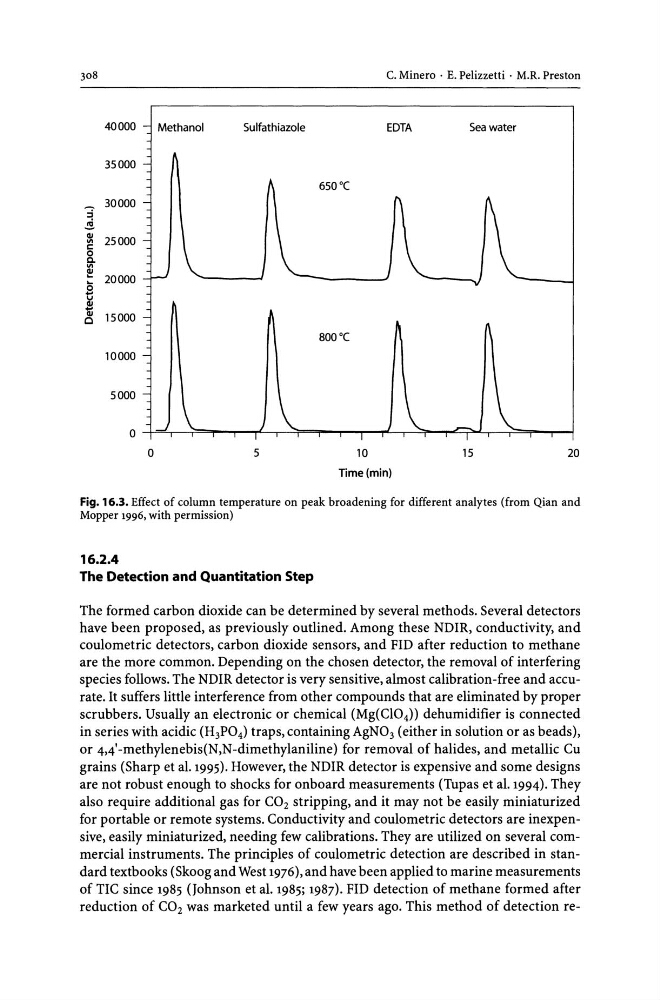
Fig. 16.3. Effect of column temperature on peak broadening for different analytes (from Qian and
Mopper 1996, with permission)
16.2.4
The Detection and Quantitation Step
The formed carbon dioxide can be determined by several methods. Several detectors
have been proposed, as previously outlined. Among these NDIR, conductivity, and
coulometric detectors, carbon dioxide sensors, and FID after reduction to methane
are the more common. Depending on the chosen detector, the removal of interfering
species follows. The NDIR detector is very sensitive, almost calibration-free and accurate. It suffers little interference from other compounds that are eliminated by proper
scrubbers. Usually an electronic or chemical (Mg(CI04» dehumidifier is connected
in series with acidic (H 3 P0 4 ) traps, containing AgN03 (either in solution or as beads),
or 4,4'-methylenebis(N,N-dimethylaniline) for removal of halides, and metallic Cu
grains (Sharp et al. 1995). However, the NDIR detector is expensive and some designs
are not robust enough to shocks for onboard measurements (Tupas et al.1994). They
also require additional gas for CO2 stripping, and it may not be easily miniaturized
for portable or remote systems. Conductivity and coulometric detectors are inexpensive, easily miniaturized, needing few calibrations. They are utilized on several commercial instruments. The principles of coulometric detection are described in standard textbooks (Skoog and West 1976), and have been applied to marine measurements
of TIC since 1985 (Johnson et al. 1985; 1987). FID detection of methane formed after
reduction of CO 2 was marketed until a few years ago. This method of detection re-
40000
35000
';i
30000
~
(II
25000
'" c:
8.
'" ~ 20000
~
ti 15000
c
10000
5000
0
0
Methanol
Sulfathiazole
5
C. Minero . E. Pelizzetti . M.R. Preston
EDTA
650·(
10
Time (min)
Seawater
15
20
Fig. 16.3. Effect of column temperature on peak broadening for different analytes (from Qian and
Mopper 1996, with permission)
16.2.4
The Detection and Quantitation Step
The formed carbon dioxide can be determined by several methods. Several detectors
have been proposed, as previously outlined. Among these NDIR, conductivity, and
coulometric detectors, carbon dioxide sensors, and FID after reduction to methane
are the more common. Depending on the chosen detector, the removal of interfering
species follows. The NDIR detector is very sensitive, almost calibration-free and accurate. It suffers little interference from other compounds that are eliminated by proper
scrubbers. Usually an electronic or chemical (Mg(CI04» dehumidifier is connected
in series with acidic (H 3 P0 4 ) traps, containing AgN03 (either in solution or as beads),
or 4,4'-methylenebis(N,N-dimethylaniline) for removal of halides, and metallic Cu
grains (Sharp et al. 1995). However, the NDIR detector is expensive and some designs
are not robust enough to shocks for onboard measurements (Tupas et al.1994). They
also require additional gas for CO2 stripping, and it may not be easily miniaturized
for portable or remote systems. Conductivity and coulometric detectors are inexpensive, easily miniaturized, needing few calibrations. They are utilized on several commercial instruments. The principles of coulometric detection are described in standard textbooks (Skoog and West 1976), and have been applied to marine measurements
of TIC since 1985 (Johnson et al. 1985; 1987). FID detection of methane formed after
reduction of CO 2 was marketed until a few years ago. This method of detection re-