

CHAPTER 1 • The Carbonate System in Marine Environments
15
where [H+h= [H+]p+ [HS04"] + [HF], [CO;] = [C0 2 ] + [H 2 C0 3 ] and the subscripts F
and T are used to denote free and total concentrations. The concentration of dissolved
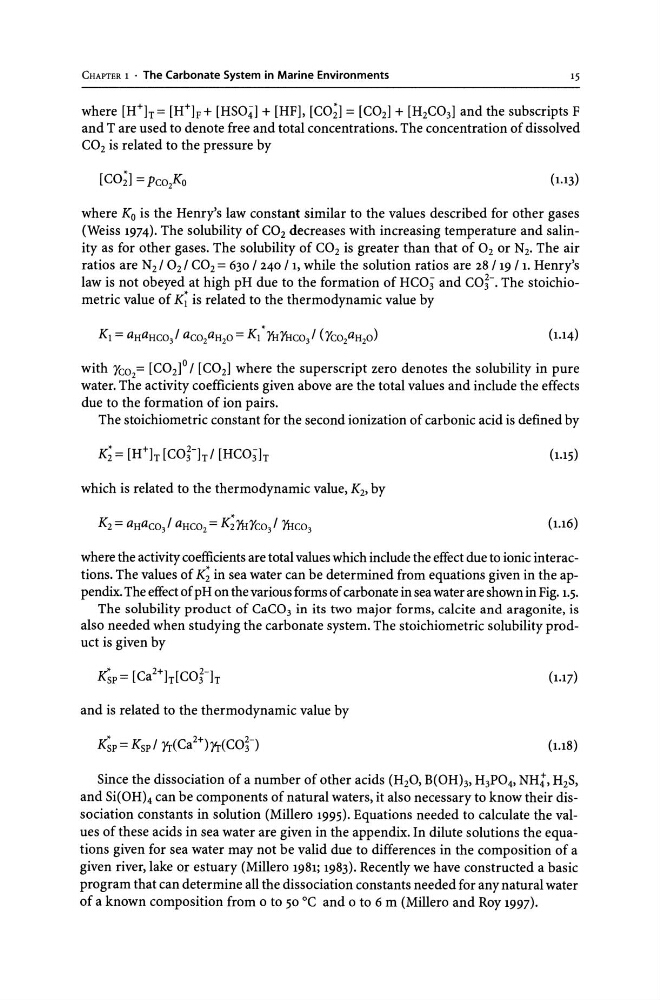
CO2 is related to the pressure by
(1.13)
where Ko is the Henry's law constant similar to the values described for other gases
(Weiss 1974). The solubility of CO2 decreases with increasing temperature and salinity as for other gases. The solubility of CO2 is greater than that of O2 or N2• The air
ratios are N2 / O2 / CO2 = 630/240/1, while the solution ratios are 28/19/1. Henry's
law is not obeyed at high pH due to the formation of HCO; and CO~-. The stoichiometric value of K; is related to the thermodynamic value by
with re0 2 = [C02]o / [C02] where the superscript zero denotes the solubility in pure
water. The activity coefficients given above are the total values and include the effects
due to the formation of ion pairs.
The stoichiometric constant for the second ionization of carbonic acid is defined by
which is related to the thermodynamic value, K2, by
(1.16)
where the activity coefficients are total values which include the effect due to ionic interactions. The values of K; in sea water can be determined from equations given in the appendix. The effect of pH on the various forms of carbonate in sea water are shown in Fig. 1.5.
The solubility product of CaC03 in its two major forms, calcite and aragonite, is
also needed when studying the carbonate system. The stoichiometric solubility product is given by
and is related to the thermodynamic value by
(1.18)
Since the dissociation of a number of other acids (H20, B(OHh, H 3 P0 4 , NHt, H 2 S,
and Si(OH)4 can be components of natural waters, it also necessary to know their dissociation constants in solution (Millero 1995). Equations needed to calculate the values of these acids in sea water are given in the appendix. In dilute solutions the equations given for sea water may not be valid due to differences in the composition of a
given river, lake or estuary (Millero 1981; 1983). Recently we have constructed a basic
program that can determine all the dissociation constants needed for any natural water
of a known composition from 0 to 50°C and 0 to 6 m (Millero and Roy 1997).
15
where [H+h= [H+]p+ [HS04"] + [HF], [CO;] = [C0 2 ] + [H 2 C0 3 ] and the subscripts F
and T are used to denote free and total concentrations. The concentration of dissolved
CO2 is related to the pressure by
(1.13)
where Ko is the Henry's law constant similar to the values described for other gases
(Weiss 1974). The solubility of CO2 decreases with increasing temperature and salinity as for other gases. The solubility of CO2 is greater than that of O2 or N2• The air
ratios are N2 / O2 / CO2 = 630/240/1, while the solution ratios are 28/19/1. Henry's
law is not obeyed at high pH due to the formation of HCO; and CO~-. The stoichiometric value of K; is related to the thermodynamic value by
with re0 2 = [C02]o / [C02] where the superscript zero denotes the solubility in pure
water. The activity coefficients given above are the total values and include the effects
due to the formation of ion pairs.
The stoichiometric constant for the second ionization of carbonic acid is defined by
which is related to the thermodynamic value, K2, by
(1.16)
where the activity coefficients are total values which include the effect due to ionic interactions. The values of K; in sea water can be determined from equations given in the appendix. The effect of pH on the various forms of carbonate in sea water are shown in Fig. 1.5.
The solubility product of CaC03 in its two major forms, calcite and aragonite, is
also needed when studying the carbonate system. The stoichiometric solubility product is given by
and is related to the thermodynamic value by
(1.18)
Since the dissociation of a number of other acids (H20, B(OHh, H 3 P0 4 , NHt, H 2 S,
and Si(OH)4 can be components of natural waters, it also necessary to know their dissociation constants in solution (Millero 1995). Equations needed to calculate the values of these acids in sea water are given in the appendix. In dilute solutions the equations given for sea water may not be valid due to differences in the composition of a
given river, lake or estuary (Millero 1981; 1983). Recently we have constructed a basic
program that can determine all the dissociation constants needed for any natural water
of a known composition from 0 to 50°C and 0 to 6 m (Millero and Roy 1997).