

292
M.Pettine
iron (Millero et al. 1995). Half times for the reduction of Cr(VI) with Fe(II) are much
faster than those estimated for the reduction with sulfide: at pH 8.0 and 25°C they are
about 0.5 and 58 h in sea water in the presence of 1 and 0.01 f1M Fe(II).
15.5
The Chromium Cycle in Sea Water
Total dissolved chromium concentrations in the oceans show a slight depletion at the
surface (2-3 nM) compared to deep waters (4-5 nM) and a general increase toward
the bottom (up to 15'.8 nM) (Jeandel and Minster 1984). Surface depletion suggests that
Cr is affected by biochemical activity (Richard and Bourg 1991), and significant correlations of Cr with Si and P support the involvement of chromium in both a deep and
shallow regeneration cycle, consisting in the release of Cr from siliceous parts and soft
tissues of organisms, respectively (Cranston 1983).
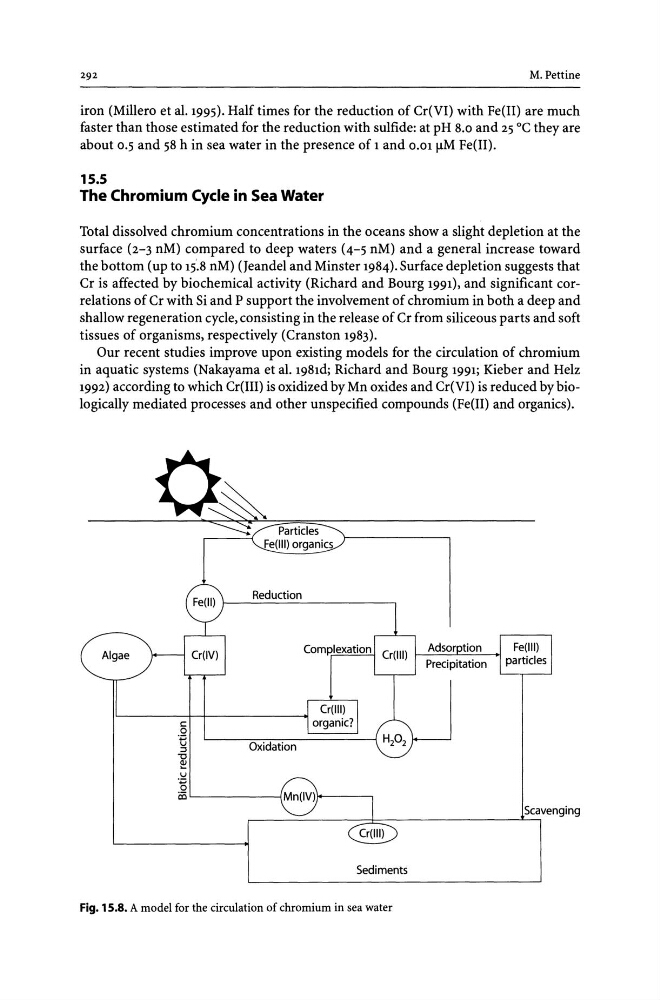
Our recent studies improve upon existing models for the circulation of chromium
in aquatic systems (Nakayama et al. 1981d; Richard and Bourg 1991; Kieber and Helz
1992) according to which Cr(I1I) is oxidized by Mn oxides and Cr(VI) is reduced by biologically mediated processes and other unspecified compounds (Fe (II) and organics).
c:
o
"tj
::J
]
U
.~
Fe(lll) organics
Reduction
Oxidation
jijL-_ _ _ _ -{
Scavenging
r--~~--~±=-------~~
Sediments
Fig. 15.8. A model for the circulation of chromium in sea water
M.Pettine
iron (Millero et al. 1995). Half times for the reduction of Cr(VI) with Fe(II) are much
faster than those estimated for the reduction with sulfide: at pH 8.0 and 25°C they are
about 0.5 and 58 h in sea water in the presence of 1 and 0.01 f1M Fe(II).
15.5
The Chromium Cycle in Sea Water
Total dissolved chromium concentrations in the oceans show a slight depletion at the
surface (2-3 nM) compared to deep waters (4-5 nM) and a general increase toward
the bottom (up to 15'.8 nM) (Jeandel and Minster 1984). Surface depletion suggests that
Cr is affected by biochemical activity (Richard and Bourg 1991), and significant correlations of Cr with Si and P support the involvement of chromium in both a deep and
shallow regeneration cycle, consisting in the release of Cr from siliceous parts and soft
tissues of organisms, respectively (Cranston 1983).
Our recent studies improve upon existing models for the circulation of chromium
in aquatic systems (Nakayama et al. 1981d; Richard and Bourg 1991; Kieber and Helz
1992) according to which Cr(I1I) is oxidized by Mn oxides and Cr(VI) is reduced by biologically mediated processes and other unspecified compounds (Fe (II) and organics).
c:
o
"tj
::J
]
U
.~
Fe(lll) organics
Reduction
Oxidation
jijL-_ _ _ _ -{
Scavenging
r--~~--~±=-------~~
Sediments
Fig. 15.8. A model for the circulation of chromium in sea water