

CHAPTER 14 • Occurrence. Formation and Fate of Organoantimony Compounds
275
lurium (Fatoki 1997). Methy1cobalamin is a derivative of vitamin B12, and has been
established as the methylating agent for mercury (Choi et al. 1994). In contrast to Sadenosylmethionine, methyl group transfer by methy1cobalamin requires that the acceptor atoms be electrophilic (e.g. Hg 2 +). Other methylating agents reported in the literature include selenoadenosylmethionine (Kajander et al. 1991) (the selenium analogue of S-adenosylmethionine), coenzyme F-430 (Jaun 1993) and dimethyl-fipropiothetin (Brinckman et al. 1985). The attatchment of a methyl group to a heavy
metal atom can profoundly influence the chemical, physical, and toxicological properties of the element. The general effect is an increase in the lipophilic nature and
volatility. Biomethylation can therefore lead to increased mobility of metals and metalloids in the environment and enhance their accumulation in biological systems, including higher organisms. The toxicity of that element in its compound may increase
(e.g. mercury) or decrease (e.g. arsenic). Antimony and arsenic are two related elements belonging to group 15 of the periodic table. The biomethylation of arsenic is
well established and has been extensively reviewed (Cullen and Reimer 1989; Pratt
1993). A range of microorganisms can convert this metalloid to methylated arsenic
species. Challenger in the 1930S resolved the phenomenon of the evolution of Gosio
gas, trimethylarsine, by moulds present on wallpaper containing Scheele's green pigment [Cu (As02hl. Scopulariopsis brevicaulis, a filamentous fungus, growing on breadcrumbs produced trimethylarsine when supplied with As 2 0 3 • The mechanism proposed
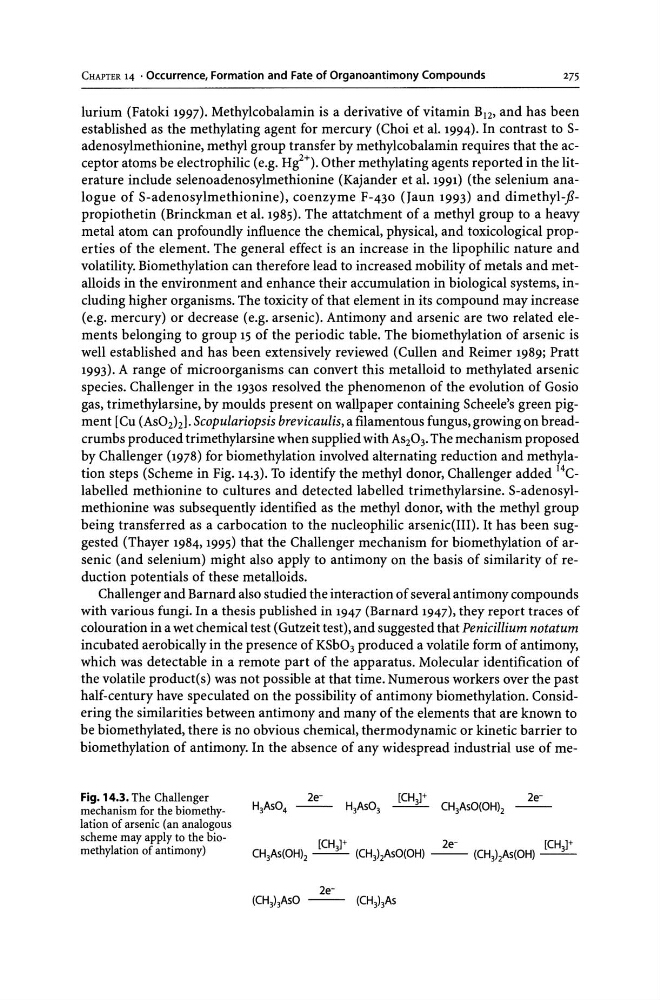
by Challenger (1978) for biomethylation involved alternating reduction and methylation steps (Scheme in Fig. 14.3). To identify the methyl donor, Challenger added 14C_
labelled methionine to cultures and detected labelled trimethylarsine. S-adenosylmethionine was subsequently identified as the methyl donor, with the methyl group
being transferred as a carbocation to the nucleophilic arsenic(III). It has been suggested (Thayer 1984, 1995) that the Challenger mechanism for biomethylation of arsenic (and selenium) might also apply to antimony on the basis of similarity of reduction potentials of these metalloids.
Challenger and Barnard also studied the interaction of several antimony compounds
wiili various fungi. In a iliesis published in 1947 (Barnard 1947), they report traces of
colouration in a wet chemical test (Gutzeit test), and suggested that Penicillium notatum
incubated aerobically in the presence of KSb0 3 produced a volatile form of antimony,
which was detectable in a remote part of the apparatus. Molecular identification of
the volatile product(s) was not possible at that time. Numerous workers over the past
half-century have speculated on the possibility of antimony biomethylation. Considering the similarities between antimony and many of the elements that are known to
be biomethylated, there is no obvious chemical, thermodynamic or kinetic barrier to
biomethylation of antimony. In the absence of any widespread industrial use of meFig. 14.3. The Challenger
mechanism for the biomethylation of arsenic (an analogous
scheme may apply to the biomethylation of antimony)
2e2e-
275
lurium (Fatoki 1997). Methy1cobalamin is a derivative of vitamin B12, and has been
established as the methylating agent for mercury (Choi et al. 1994). In contrast to Sadenosylmethionine, methyl group transfer by methy1cobalamin requires that the acceptor atoms be electrophilic (e.g. Hg 2 +). Other methylating agents reported in the literature include selenoadenosylmethionine (Kajander et al. 1991) (the selenium analogue of S-adenosylmethionine), coenzyme F-430 (Jaun 1993) and dimethyl-fipropiothetin (Brinckman et al. 1985). The attatchment of a methyl group to a heavy
metal atom can profoundly influence the chemical, physical, and toxicological properties of the element. The general effect is an increase in the lipophilic nature and
volatility. Biomethylation can therefore lead to increased mobility of metals and metalloids in the environment and enhance their accumulation in biological systems, including higher organisms. The toxicity of that element in its compound may increase
(e.g. mercury) or decrease (e.g. arsenic). Antimony and arsenic are two related elements belonging to group 15 of the periodic table. The biomethylation of arsenic is
well established and has been extensively reviewed (Cullen and Reimer 1989; Pratt
1993). A range of microorganisms can convert this metalloid to methylated arsenic
species. Challenger in the 1930S resolved the phenomenon of the evolution of Gosio
gas, trimethylarsine, by moulds present on wallpaper containing Scheele's green pigment [Cu (As02hl. Scopulariopsis brevicaulis, a filamentous fungus, growing on breadcrumbs produced trimethylarsine when supplied with As 2 0 3 • The mechanism proposed
by Challenger (1978) for biomethylation involved alternating reduction and methylation steps (Scheme in Fig. 14.3). To identify the methyl donor, Challenger added 14C_
labelled methionine to cultures and detected labelled trimethylarsine. S-adenosylmethionine was subsequently identified as the methyl donor, with the methyl group
being transferred as a carbocation to the nucleophilic arsenic(III). It has been suggested (Thayer 1984, 1995) that the Challenger mechanism for biomethylation of arsenic (and selenium) might also apply to antimony on the basis of similarity of reduction potentials of these metalloids.
Challenger and Barnard also studied the interaction of several antimony compounds
wiili various fungi. In a iliesis published in 1947 (Barnard 1947), they report traces of
colouration in a wet chemical test (Gutzeit test), and suggested that Penicillium notatum
incubated aerobically in the presence of KSb0 3 produced a volatile form of antimony,
which was detectable in a remote part of the apparatus. Molecular identification of
the volatile product(s) was not possible at that time. Numerous workers over the past
half-century have speculated on the possibility of antimony biomethylation. Considering the similarities between antimony and many of the elements that are known to
be biomethylated, there is no obvious chemical, thermodynamic or kinetic barrier to
biomethylation of antimony. In the absence of any widespread industrial use of meFig. 14.3. The Challenger
mechanism for the biomethylation of arsenic (an analogous
scheme may apply to the biomethylation of antimony)
2e2e-