

CHAPTER 14 . Occurrence, Formation and Fate of Organoantimony Compounds
273
120 a
(CH 3 hSb+
b
100
151
151
l
~
80
I:
"'
"0
153
153
I:
(CH 3 hSb+
::I
60
.c
CH 3 Sb+
"'
Sb+
~
166
166
.+l
40
136
168
136
168
"'
Qj
121 123 ' ] 13. 149
121 123
138 149
a:
135
20
J
0
III ... I
....
III
m/z
m/z
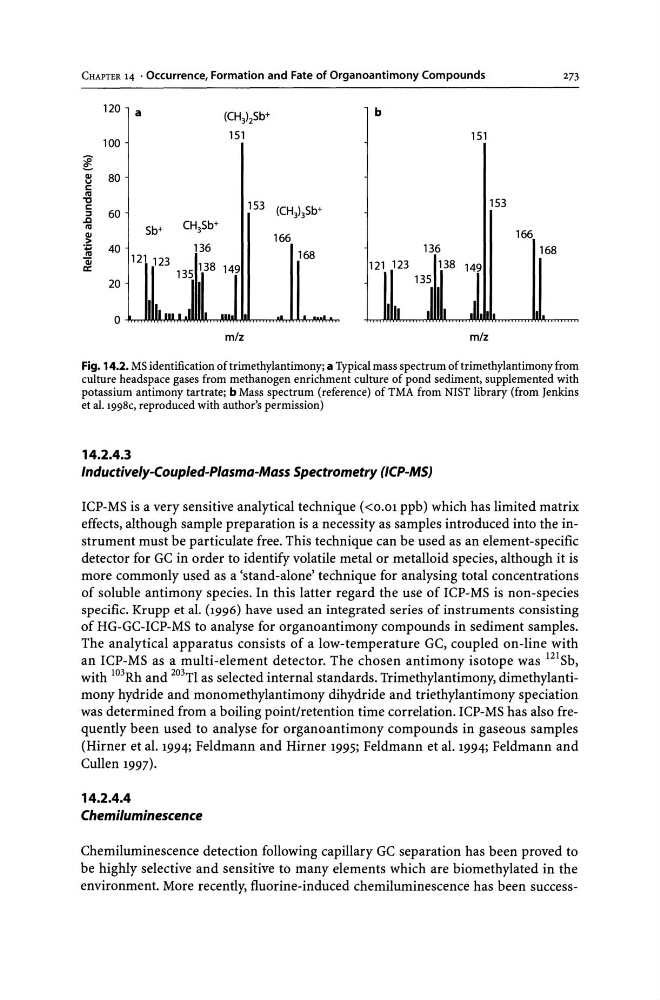
Fig. 14.2. MS identification of trimethylantimony; a Typical mass spectrum of trimethylantimony from
culture headspace gases from methanogen enrichment culture of pond sediment, supplemented with
potassium antimony tartrate; b Mass spectrum (reference) of TMA from NIST library (from Jenkins
et al. 1998c, reproduced with author's permission)
14.2.4.3
Inductively-Coupled-Plasma-Mass Spectrometry (ICP-MS)
ICP-MS is a very sensitive analytical technique «0.01 ppb) which has limited matrix
effects, although sample preparation is a necessity as samples introduced into the instrument must be particulate free. This technique can be used as an element-specific
detector for GC in order to identify volatile metal or metalloid species, although it is
more commonly used as a 'stand-alone' technique for analysing total concentrations
of soluble antimony species. In this latter regard the use of ICP-MS is non-species
specific. Krupp et al. (1996) have used an integrated series of instruments consisting
of HG-GC-ICP-MS to analyse for organoantimony compounds in sediment samples.
The analytical apparatus consists of a low-temperature GC, coupled on-line with
an ICP-MS as a multi-element detector. The chosen antimony isotope was 121Sb,
with 103Rh and 203Tl as selected internal standards. Trimethylantimony, dimethylantimony hydride and monomethylantimony diliydride and triethylantimony speciation
was determined from a boiling point/retention time correlation. ICP-MS has also frequently been used to analyse for organoantimony compounds in gaseous samples
(Hirner et al. 1994; Feldmann and Hirner 1995; Feldmann et al. 1994; Feldmann and
Cullen 1997).
14.2.4.4
Chemiluminescence
Chemiluminescence detection following capillary GC separation has been proved to
be highly selective and sensitive to many elements which are biomethylated in the
environment. More recently, fluorine-induced chemiluminescence has been success-
273
120 a
(CH 3 hSb+
b
100
151
151
l
~
80
I:
"'
"0
153
153
I:
(CH 3 hSb+
::I
60
.c
CH 3 Sb+
"'
Sb+
~
166
166
.+l
40
136
168
136
168
"'
Qj
121 123 ' ] 13. 149
121 123
138 149
a:
135
20
J
0
III ... I
....
III
m/z
m/z
Fig. 14.2. MS identification of trimethylantimony; a Typical mass spectrum of trimethylantimony from
culture headspace gases from methanogen enrichment culture of pond sediment, supplemented with
potassium antimony tartrate; b Mass spectrum (reference) of TMA from NIST library (from Jenkins
et al. 1998c, reproduced with author's permission)
14.2.4.3
Inductively-Coupled-Plasma-Mass Spectrometry (ICP-MS)
ICP-MS is a very sensitive analytical technique «0.01 ppb) which has limited matrix
effects, although sample preparation is a necessity as samples introduced into the instrument must be particulate free. This technique can be used as an element-specific
detector for GC in order to identify volatile metal or metalloid species, although it is
more commonly used as a 'stand-alone' technique for analysing total concentrations
of soluble antimony species. In this latter regard the use of ICP-MS is non-species
specific. Krupp et al. (1996) have used an integrated series of instruments consisting
of HG-GC-ICP-MS to analyse for organoantimony compounds in sediment samples.
The analytical apparatus consists of a low-temperature GC, coupled on-line with
an ICP-MS as a multi-element detector. The chosen antimony isotope was 121Sb,
with 103Rh and 203Tl as selected internal standards. Trimethylantimony, dimethylantimony hydride and monomethylantimony diliydride and triethylantimony speciation
was determined from a boiling point/retention time correlation. ICP-MS has also frequently been used to analyse for organoantimony compounds in gaseous samples
(Hirner et al. 1994; Feldmann and Hirner 1995; Feldmann et al. 1994; Feldmann and
Cullen 1997).
14.2.4.4
Chemiluminescence
Chemiluminescence detection following capillary GC separation has been proved to
be highly selective and sensitive to many elements which are biomethylated in the
environment. More recently, fluorine-induced chemiluminescence has been success-