

266
P.J. Craig· S.N. Forster· R.O. Jenkins· D.P. Miller· N.Ostah . L.M. Smith· T.-A. Morris
mony compounds has been significantly expanded over the last 30 years. Previously,
only aromatic compounds of antimony were known and well characterized; this is due
to the greater stability of these species (Doak and Freedman 1970). Antimony(V) organometallic compounds are generally more stable than antimony(III) species and
antimony(V) compounds were the first to be synthesized and characterized (Doak and
Freedman 1970). Trimethylantimony(V) dihalides were characterized in 1968 (Doak
et al. 1967), although a synthesis had been previously published (Morgan and Davies
1926). Formation of organometallic antimony compounds in the environment, rather
than their use, is the most logical explanation for their presence. Present information
suggests that methyl to metal bonds are the only organometallic products of any natural
environmental organometallic synthesis. This process is called biomethylation and
is well established for arsenic and a number of other heavy elements, such as Hg, Se,
Sn and Te (Fatoki 1997). One example of an environmental ethyl to metal linkage is
known (C2H5Hg-) (Cai et a1.1997), but this may have been caused by a transalkylation.
Antimony biomethylation was reported in a Ph.D. thesis (Barnard 1947), where it
was noted that an inorganic antimony compound, when incubated with mould cultures, appeared to be mobilised (possibly as (CH3)3Sb) to a distant part of the apparatus. The techniques at that time (1947) did not allow any conclusive identification.
Very recently, similar work has demonstrated that methylated antimony is actually
formed in such experiments (Jenkins et al. 1998a, 1998b). Oxidation of this compound
is reported to be rapid and to cause some breakage of the antimony carbon bonds
(Parris and Brinckman 1976). This suggests an overview indicating which organometallic species we might expect to find in the natural environment i.e. antimony(V) compounds with between one and three antimony carbon bonds. Oxidation would also
give rise to oxide hydroxide linkages that would increase solubility of the antimony
compounds.
The first modern report of organometallic antimony compounds in the aquatic environment was by Andreae et al. in 1981. They reported that methyl and dimethyl
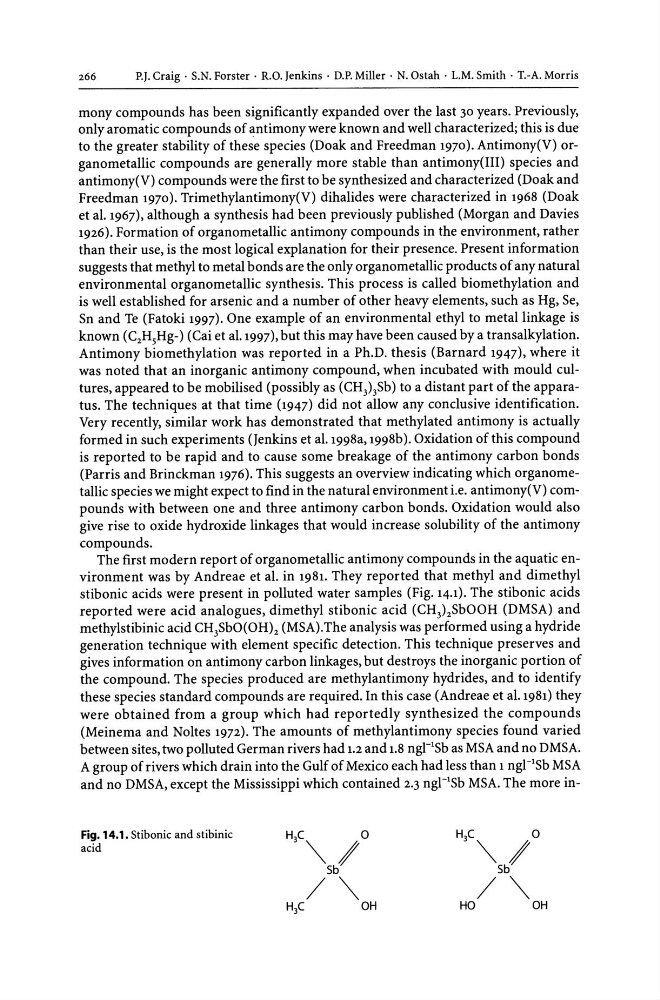
stibonic acids were present in polluted water samples (Fig. 14.1). The stibonic acids
reported were acid analogues, dimethyl stibonic acid (CH3)2SbOOH (DMSA) and
methylstibinic acid CH 3 SbO(OH)2 (MSA).The analysis was performed using a hydride
generation technique with element specific detection. This technique preserves and
gives information on antimony carbon linkages, but destroys the inorganic portion of
the compound. The species produced are methylantimony hydrides, and to identify
these species standard compounds are required. In this case (Andreae et al. 1981) they
were obtained from a group which had reportedly synthesized the compounds
(Meinema and Noltes 1972). The amounts of methylantimony species found varied
between sites, two polluted German rivers had 1.2 and 1.8 ngl-'Sb as MSA and no DMSA.
A group of rivers which drain into the Gulf of Mexico each had less than 1 ngt'Sb MSA
and no DMSA, except the Mississippi which contained 2.3 ngl-'Sb MSA. The more inFig. 14.1. Stibonic and stibinic
acid
P.J. Craig· S.N. Forster· R.O. Jenkins· D.P. Miller· N.Ostah . L.M. Smith· T.-A. Morris
mony compounds has been significantly expanded over the last 30 years. Previously,
only aromatic compounds of antimony were known and well characterized; this is due
to the greater stability of these species (Doak and Freedman 1970). Antimony(V) organometallic compounds are generally more stable than antimony(III) species and
antimony(V) compounds were the first to be synthesized and characterized (Doak and
Freedman 1970). Trimethylantimony(V) dihalides were characterized in 1968 (Doak
et al. 1967), although a synthesis had been previously published (Morgan and Davies
1926). Formation of organometallic antimony compounds in the environment, rather
than their use, is the most logical explanation for their presence. Present information
suggests that methyl to metal bonds are the only organometallic products of any natural
environmental organometallic synthesis. This process is called biomethylation and
is well established for arsenic and a number of other heavy elements, such as Hg, Se,
Sn and Te (Fatoki 1997). One example of an environmental ethyl to metal linkage is
known (C2H5Hg-) (Cai et a1.1997), but this may have been caused by a transalkylation.
Antimony biomethylation was reported in a Ph.D. thesis (Barnard 1947), where it
was noted that an inorganic antimony compound, when incubated with mould cultures, appeared to be mobilised (possibly as (CH3)3Sb) to a distant part of the apparatus. The techniques at that time (1947) did not allow any conclusive identification.
Very recently, similar work has demonstrated that methylated antimony is actually
formed in such experiments (Jenkins et al. 1998a, 1998b). Oxidation of this compound
is reported to be rapid and to cause some breakage of the antimony carbon bonds
(Parris and Brinckman 1976). This suggests an overview indicating which organometallic species we might expect to find in the natural environment i.e. antimony(V) compounds with between one and three antimony carbon bonds. Oxidation would also
give rise to oxide hydroxide linkages that would increase solubility of the antimony
compounds.
The first modern report of organometallic antimony compounds in the aquatic environment was by Andreae et al. in 1981. They reported that methyl and dimethyl
stibonic acids were present in polluted water samples (Fig. 14.1). The stibonic acids
reported were acid analogues, dimethyl stibonic acid (CH3)2SbOOH (DMSA) and
methylstibinic acid CH 3 SbO(OH)2 (MSA).The analysis was performed using a hydride
generation technique with element specific detection. This technique preserves and
gives information on antimony carbon linkages, but destroys the inorganic portion of
the compound. The species produced are methylantimony hydrides, and to identify
these species standard compounds are required. In this case (Andreae et al. 1981) they
were obtained from a group which had reportedly synthesized the compounds
(Meinema and Noltes 1972). The amounts of methylantimony species found varied
between sites, two polluted German rivers had 1.2 and 1.8 ngl-'Sb as MSA and no DMSA.
A group of rivers which drain into the Gulf of Mexico each had less than 1 ngt'Sb MSA
and no DMSA, except the Mississippi which contained 2.3 ngl-'Sb MSA. The more inFig. 14.1. Stibonic and stibinic
acid