

CHAPTER 13 . Mercury in Marine Environments
259
13.6.3.3
The Faroe Islands
In addition to seafood, which constitutes a large proportion of the diet of inhabitants
of the Faroe Islands, the meat and blubber from the pilot whale are also consumed. The
concentration of mercury in the muscle of the Faroese pilot whale is about 3.3 Jlg g-I,
half of which is methyl mercury (Weihe et al. 1997). Grandjean et al. (1997, 1998) have
studied a cohort of children borne in the Faroe Islands, and prenatal exposure was
assessed from the concentration of mercury in the maternal hair. At the age of seven a
detailed neurobehavioural examination was carried out. A case group of 112 children,
where the prenatal maternal hair concentrations were in the range 10-20 Jlg g-I (considered to be "safe"), were matched with a control group of children where the concentration was <3 Jlg g -I. The case group showed mild decrements, relative to controls,
in motor function, language and memory. Thus, effects are being noticed at levels of
prenatal exposure previously considered to be safe. Effects are not severe clinical symptoms as observed in Minamata disease, but resemble the effects of early lead exposure.
13.6.3.4
The Island of Madeira
Volcanic sources enhance mercury in the waters off the Atlantic Island of Madeira. High
mercury levels in hair were found in coastal fisherman and their families (Renzoni 1992;
Renzoni et al. 1998; Gaggi et al. 1996). In the village of Camara de Lobos, mean mercury
concentrations in scalp hair were for males: 38.9 Jlg g-I, maximum 114.3 Jlg g-l (n = 66);
and for females 16.2 Jlg g-I, maximum 56.1 Jlg g-I (n = 22). A more detailed study was
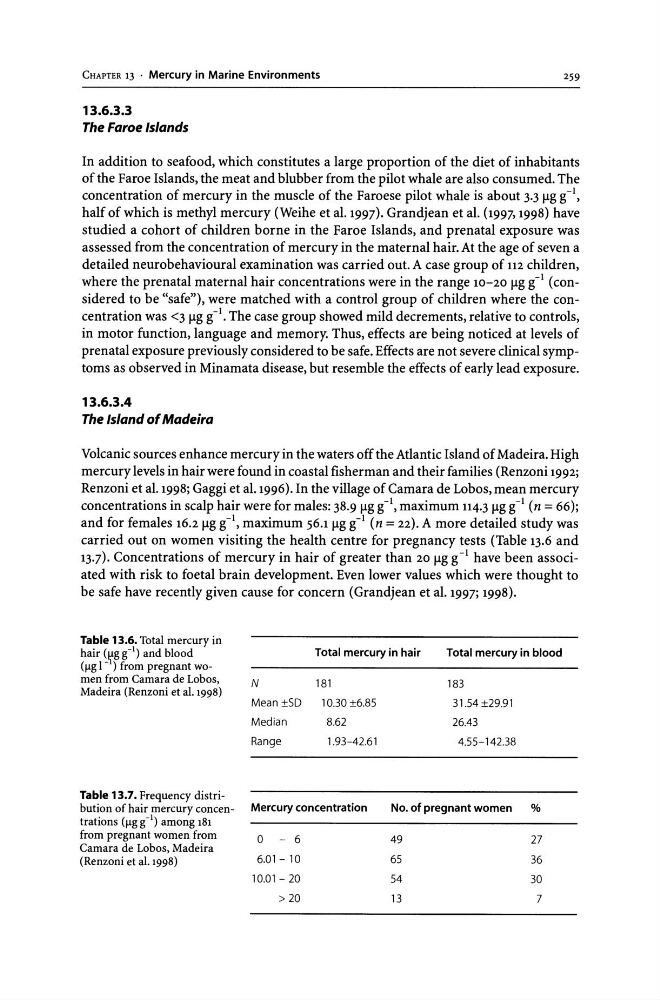
carried out on women visiting the health centre for pregnancy tests (Table 13.6 and
13.7). Concentrations of mercury in hair of greater than 20 Jlg g-I have been associated with risk to foetal brain development. Even lower values which were thought to
be safe have recently given cause for concern (Grandjean et al. 1997; 1998).
Table 13.6. Total mercury in
hair (~gg-l) and blood
(j.lg 1- ) from pregnant women from Camara de Lobos,
Madeira (Renzoni et al.1998)
Table 13.7. Frequency distribution of hair mercury concentrations (j.lgg-l) among 181
from pregnant women from
Camara de Lobos, Madeira
(Renzoni et al.1998)
Total mercury in hair
Total mercury in blood
N
181
Mean ±SD
10.30 ±6.85
Median
8.62
Range
1.93-42.61
Mercury concentration
0 - 6
6.01- 10
10.01 - 20
> 20
183
31.54 ±29.91
26.43
4.55- 142.38
No. of pregnant women
49
65
54
13
%
27
36
30
7
259
13.6.3.3
The Faroe Islands
In addition to seafood, which constitutes a large proportion of the diet of inhabitants
of the Faroe Islands, the meat and blubber from the pilot whale are also consumed. The
concentration of mercury in the muscle of the Faroese pilot whale is about 3.3 Jlg g-I,
half of which is methyl mercury (Weihe et al. 1997). Grandjean et al. (1997, 1998) have
studied a cohort of children borne in the Faroe Islands, and prenatal exposure was
assessed from the concentration of mercury in the maternal hair. At the age of seven a
detailed neurobehavioural examination was carried out. A case group of 112 children,
where the prenatal maternal hair concentrations were in the range 10-20 Jlg g-I (considered to be "safe"), were matched with a control group of children where the concentration was <3 Jlg g -I. The case group showed mild decrements, relative to controls,
in motor function, language and memory. Thus, effects are being noticed at levels of
prenatal exposure previously considered to be safe. Effects are not severe clinical symptoms as observed in Minamata disease, but resemble the effects of early lead exposure.
13.6.3.4
The Island of Madeira
Volcanic sources enhance mercury in the waters off the Atlantic Island of Madeira. High
mercury levels in hair were found in coastal fisherman and their families (Renzoni 1992;
Renzoni et al. 1998; Gaggi et al. 1996). In the village of Camara de Lobos, mean mercury
concentrations in scalp hair were for males: 38.9 Jlg g-I, maximum 114.3 Jlg g-l (n = 66);
and for females 16.2 Jlg g-I, maximum 56.1 Jlg g-I (n = 22). A more detailed study was
carried out on women visiting the health centre for pregnancy tests (Table 13.6 and
13.7). Concentrations of mercury in hair of greater than 20 Jlg g-I have been associated with risk to foetal brain development. Even lower values which were thought to
be safe have recently given cause for concern (Grandjean et al. 1997; 1998).
Table 13.6. Total mercury in
hair (~gg-l) and blood
(j.lg 1- ) from pregnant women from Camara de Lobos,
Madeira (Renzoni et al.1998)
Table 13.7. Frequency distribution of hair mercury concentrations (j.lgg-l) among 181
from pregnant women from
Camara de Lobos, Madeira
(Renzoni et al.1998)
Total mercury in hair
Total mercury in blood
N
181
Mean ±SD
10.30 ±6.85
Median
8.62
Range
1.93-42.61
Mercury concentration
0 - 6
6.01- 10
10.01 - 20
> 20
183
31.54 ±29.91
26.43
4.55- 142.38
No. of pregnant women
49
65
54
13
%
27
36
30
7