

CHAPTER 12 . 119Sn Mossbauer Spectroscopy Studies: Organotin(lV) Salts and Complexes
239
Me
/,'0, I . . . . . . . . . OH2
(RO) P "
'Sn/
2~ /I~
°
S
Me
a
M caled = {+)4.09
Me~l\
Sn--S
Me/I
{RO)2P02
C
Mcaled = {-)3.19
e
Mealed = {-)2.37
Me
L,~ I/OH2"
/sn~
L2
I S
Me
b
L, = Hp. L2 = {RO)2P02:~Eealed = {+)4.10
L, = {RO)2P02' L2 = Hp: ~Eealed = {+ )4.12
Me
L'~I/Me
Sn
L2/ I ~N
5.--/
d
L, = {RO)2P02' L2 = H20: ~Eealed = {-)2.78
L, = Hp. L2 = {RO)2P02:~Eealed = {-)2.82
Me
( S~I/N)
/sn~
N
I 5
{RO)2P02
Mealed = {-)1.68
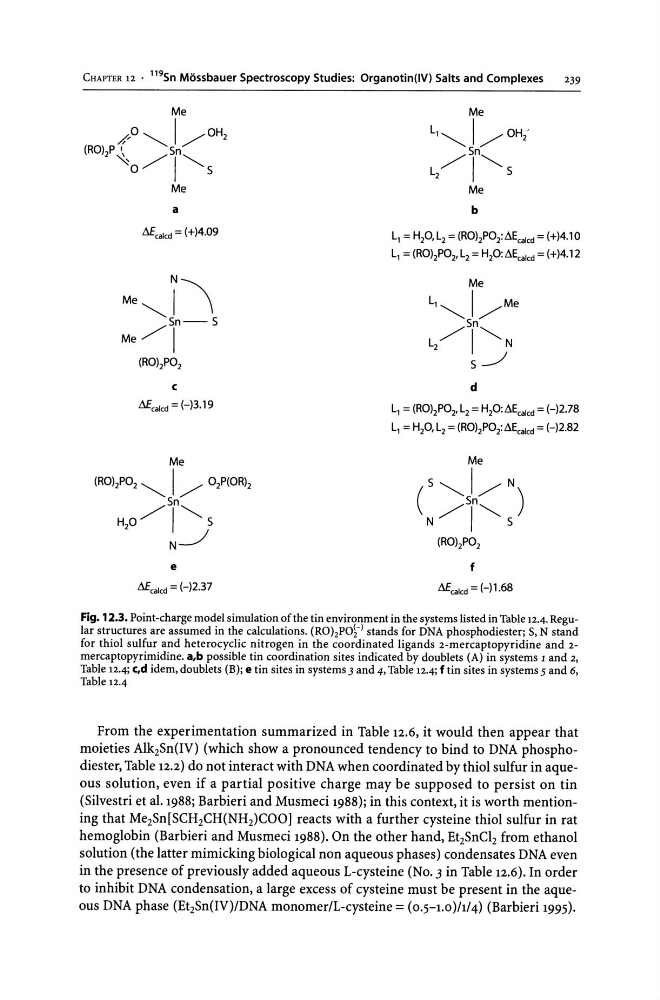
Fig. 12.3. Point -charge model simulation of the tin environment in the systems listed in Table 12.4. Regular structures are assumed in the calculations. (ROhPO~-) stands for DNA phosphodiester; S, N stand
for thiol sulfur and heterocyclic nitrogen in the coordinated ligands 2-mercaptopyridine and 2mercaptopyrimidine. a,b possible tin coordination sites indicated by doublets (Al in systems 1 and 2,
Table 12.4; c,d idem, doublets (B); e tin sites in systems 3 and 4, Table 12.4; f tin sites in systems 5 and 6,
Table 12.4
From the experimentation summarized in Table 12.6, it would then appear that
moieties Alk1Sn(IV) (which show a pronounced tendency to bind to DNA phosphodiester, Table 12.2) do not interact with DNA when coordinated by thiol sulfur in aqueous solution, even if a partial positive charge may be supposed to persist on tin
(Silvestri et al. 1988; Barbieri and Musmeci 1988); in this context, it is worth mentioning that MezSn[SCH1CH(NH1)COO] reacts with a further cysteine thiol sulfur in rat
hemoglobin (Barbieri and Musmeci 1988). On the other hand, EtzSnCl1 from ethanol
solution (the latter mimicking biological non aqueous phases) condensates DNA even
in the presence of previously added aqueous L-cysteine (No.3 in Table 12.6). In order
to inhibit DNA condensation, a large excess of cysteine must be present in the aqueous DNA phase (EtzSn(IV)IDNA monomer/L-cysteine = (0.5-1.0)/1/4) (Barbieri 1995).
239
Me
/,'0, I . . . . . . . . . OH2
(RO) P "
'Sn/
2~ /I~
°
S
Me
a
M caled = {+)4.09
Me~l\
Sn--S
Me/I
{RO)2P02
C
Mcaled = {-)3.19
e
Mealed = {-)2.37
Me
L,~ I/OH2"
/sn~
L2
I S
Me
b
L, = Hp. L2 = {RO)2P02:~Eealed = {+)4.10
L, = {RO)2P02' L2 = Hp: ~Eealed = {+ )4.12
Me
L'~I/Me
Sn
L2/ I ~N
5.--/
d
L, = {RO)2P02' L2 = H20: ~Eealed = {-)2.78
L, = Hp. L2 = {RO)2P02:~Eealed = {-)2.82
Me
( S~I/N)
/sn~
N
I 5
{RO)2P02
Mealed = {-)1.68
Fig. 12.3. Point -charge model simulation of the tin environment in the systems listed in Table 12.4. Regular structures are assumed in the calculations. (ROhPO~-) stands for DNA phosphodiester; S, N stand
for thiol sulfur and heterocyclic nitrogen in the coordinated ligands 2-mercaptopyridine and 2mercaptopyrimidine. a,b possible tin coordination sites indicated by doublets (Al in systems 1 and 2,
Table 12.4; c,d idem, doublets (B); e tin sites in systems 3 and 4, Table 12.4; f tin sites in systems 5 and 6,
Table 12.4
From the experimentation summarized in Table 12.6, it would then appear that
moieties Alk1Sn(IV) (which show a pronounced tendency to bind to DNA phosphodiester, Table 12.2) do not interact with DNA when coordinated by thiol sulfur in aqueous solution, even if a partial positive charge may be supposed to persist on tin
(Silvestri et al. 1988; Barbieri and Musmeci 1988); in this context, it is worth mentioning that MezSn[SCH1CH(NH1)COO] reacts with a further cysteine thiol sulfur in rat
hemoglobin (Barbieri and Musmeci 1988). On the other hand, EtzSnCl1 from ethanol
solution (the latter mimicking biological non aqueous phases) condensates DNA even
in the presence of previously added aqueous L-cysteine (No.3 in Table 12.6). In order
to inhibit DNA condensation, a large excess of cysteine must be present in the aqueous DNA phase (EtzSn(IV)IDNA monomer/L-cysteine = (0.5-1.0)/1/4) (Barbieri 1995).