

R. Barbieri et al.
of RnSn complexes-DNA systems (Li et al.1996b, 1997). We report here studies on the
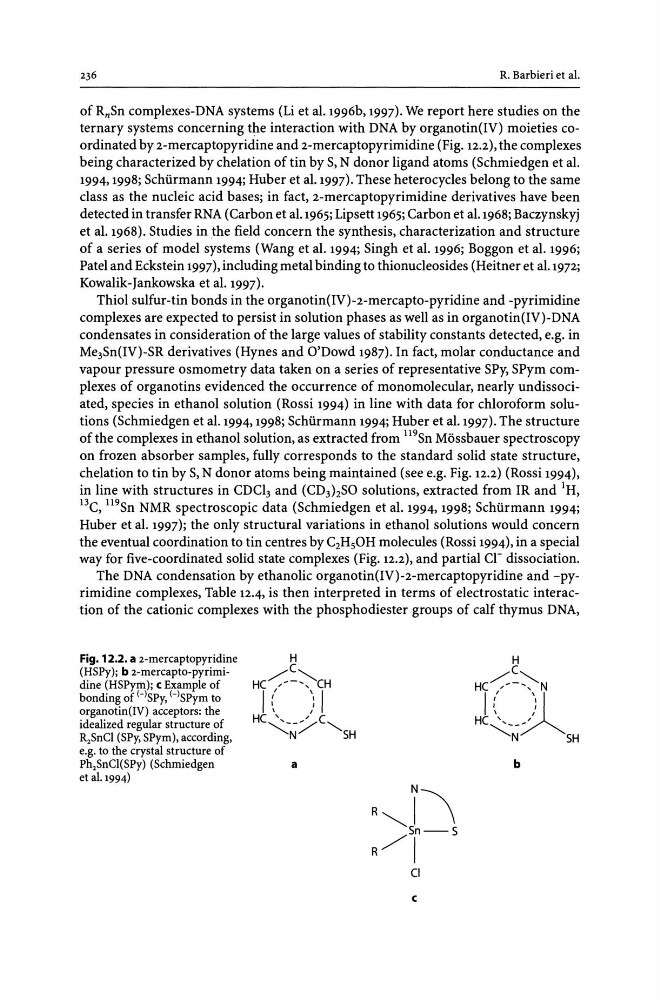
ternary systems concerning the interaction with DNA by organotin(IV) moieties coordinated by 2-mercaptopyridine and 2-mercaptopyrimidine (Fig. 12.2), the complexes
being characterized by chelation of tin by S, N donor ligand atoms (Schmiedgen et al.
1994,1998; Schiirmann 1994; Huber et al. 1997). These heterocycles belong to the same
class as the nucleic acid bases; in fact, 2-mercaptopyrimidine derivatives have been
detected in transfer RNA (Carbon et al.1965; Lipsett 1965; Carbon et al.1968; Baczynskyj
et al. 1968). Studies in the field concern the synthesis, characterization and structure
of a series of model systems (Wang et al. 1994; Singh et al. 1996; Boggon et al. 1996;
Patel and Eckstein 1997), including metal binding to thionucleosides (Heitner et al.1972;
Kowalik-Jankowska et al.1997).
Thiol sulfur-tin bonds in the organotin(IV)-2-mercapto-pyridine and -pyrimidine
complexes are expected to persist in solution phases as well as in organotin(IV)-DNA
condensates in consideration of the large values of stability constants detected, e.g. in
Me3Sn(IV)-SR derivatives (Hynes and O'Dowd 1987). In fact, molar conductance and
vapour pressure osmometry data taken on a series of representative SPy, SPym complexes of organotins evidenced the occurrence of monomolecular, nearly undissociated, species in ethanol solution (Rossi 1994) in line with data for chloroform solutions (Schmiedgen et al. 1994, 1998; Schiirmann 1994; Huber et al. 1997). The structure
of the complexes in ethanol solution, as extracted from 119Sn Mossbauer spectroscopy
on frozen absorber samples, fully corresponds to the standard solid state structure,
chelation to tin by S, N donor atoms being maintained (see e.g. Fig. 12.2) (Rossi 1994),
in line with structures in CDCl 3 and (CD 3 hSO solutions, extracted from IR and IH,
l3C, 119Sn NMR spectroscopic data (Schmiedgen et al. 1994, 1998; Schiirmann 1994;
Huber et al. 1997); the only structural variations in ethanol solutions would concern
the eventual coordination to tin centres by C2HsOH molecules (Rossi 1994), in a special
way for five-coordinated solid state complexes (Fig. 12.2), and partial cr dissociation.
The DNA condensation by ethanolic organotin(IV)-2-mercaptopyridine and -pyrimidine complexes, Table 12.4, is then interpreted in terms of electrostatic interaction of the cationic complexes with the phospho diester groups of calf thymus DNA,
Fig. 12.2. a 2-mercaptopyridine
(HSPy); b 2-mercapto-pyrimidine (HSPym); c Example of
bonding of (-lSpy, (-lSPym to
organotin(IV) acceptors: the
idealized regular structure of
R,SnCI (SPy, SPym), according,
e.g. to the crystal structure of
Ph,SnCl(SPy) (Schmiedgen
et al.1994)
a
c
of RnSn complexes-DNA systems (Li et al.1996b, 1997). We report here studies on the
ternary systems concerning the interaction with DNA by organotin(IV) moieties coordinated by 2-mercaptopyridine and 2-mercaptopyrimidine (Fig. 12.2), the complexes
being characterized by chelation of tin by S, N donor ligand atoms (Schmiedgen et al.
1994,1998; Schiirmann 1994; Huber et al. 1997). These heterocycles belong to the same
class as the nucleic acid bases; in fact, 2-mercaptopyrimidine derivatives have been
detected in transfer RNA (Carbon et al.1965; Lipsett 1965; Carbon et al.1968; Baczynskyj
et al. 1968). Studies in the field concern the synthesis, characterization and structure
of a series of model systems (Wang et al. 1994; Singh et al. 1996; Boggon et al. 1996;
Patel and Eckstein 1997), including metal binding to thionucleosides (Heitner et al.1972;
Kowalik-Jankowska et al.1997).
Thiol sulfur-tin bonds in the organotin(IV)-2-mercapto-pyridine and -pyrimidine
complexes are expected to persist in solution phases as well as in organotin(IV)-DNA
condensates in consideration of the large values of stability constants detected, e.g. in
Me3Sn(IV)-SR derivatives (Hynes and O'Dowd 1987). In fact, molar conductance and
vapour pressure osmometry data taken on a series of representative SPy, SPym complexes of organotins evidenced the occurrence of monomolecular, nearly undissociated, species in ethanol solution (Rossi 1994) in line with data for chloroform solutions (Schmiedgen et al. 1994, 1998; Schiirmann 1994; Huber et al. 1997). The structure
of the complexes in ethanol solution, as extracted from 119Sn Mossbauer spectroscopy
on frozen absorber samples, fully corresponds to the standard solid state structure,
chelation to tin by S, N donor atoms being maintained (see e.g. Fig. 12.2) (Rossi 1994),
in line with structures in CDCl 3 and (CD 3 hSO solutions, extracted from IR and IH,
l3C, 119Sn NMR spectroscopic data (Schmiedgen et al. 1994, 1998; Schiirmann 1994;
Huber et al. 1997); the only structural variations in ethanol solutions would concern
the eventual coordination to tin centres by C2HsOH molecules (Rossi 1994), in a special
way for five-coordinated solid state complexes (Fig. 12.2), and partial cr dissociation.
The DNA condensation by ethanolic organotin(IV)-2-mercaptopyridine and -pyrimidine complexes, Table 12.4, is then interpreted in terms of electrostatic interaction of the cationic complexes with the phospho diester groups of calf thymus DNA,
Fig. 12.2. a 2-mercaptopyridine
(HSPy); b 2-mercapto-pyrimidine (HSPym); c Example of
bonding of (-lSpy, (-lSPym to
organotin(IV) acceptors: the
idealized regular structure of
R,SnCI (SPy, SPym), according,
e.g. to the crystal structure of
Ph,SnCl(SPy) (Schmiedgen
et al.1994)
a
c