

222
C. De Stefano . C. Foti . A. Gianguzza . S. Sammartano
Table 11.5. Mf values for the formation of alkyltin(IV) hydrolytic species, at 25°C and 1=0 mol dm- 3
Compound
t:.H' values
Compound
t:.H~la = -30.0 (CH)2Sn2+ b
t:.H~2 = -57.0
t:.H'values
t:.H~l =-27.5
t:.H~2 = -53.0
t:.H~3 = -71.8
t:.H~2=-50.6
t:.H~3 =-87.0
Compound
a t:.Ho(kJ mol-\ relative to the reaction t:.Hpq: pM z + + q Hp = Mp(OH)~-q) + q H+
b 1=0.1 mol KN0 3 dm- 3
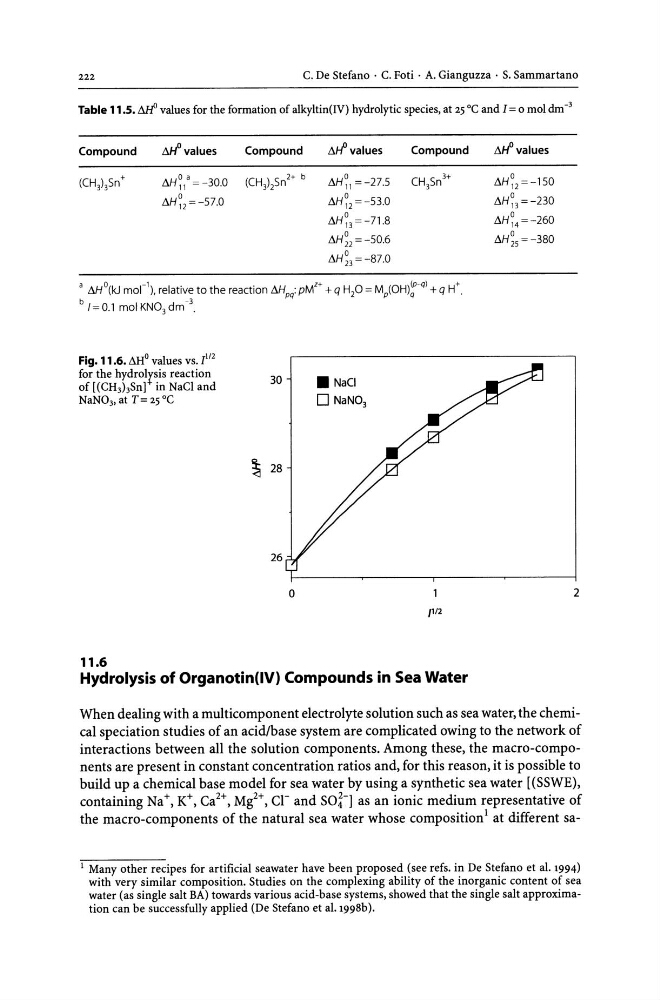
Fig. 11.6. t:.Ho values vs. tl2
for the hydrolrsis reaction
of [(CH3hSnj in NaCI and
NaN03, at T= 25°C
11.6
30
~ 28
26
o
• NaCi
D NaN0 3
/1/2
Hydrolysis of Organotin(lV) Compounds in Sea Water
t:.H'values
t:.H~2 = -150
t:.H~3=-230
t:.H~4 =-260
t:.H~5 = -380
2
When dealing with a multicomponent electrolyte solution such as sea water, the chemical speciation studies of an acid/base system are complicated owing to the network of
interactions between all the solution components. Among these, the macro-components are present in constant concentration ratios and, for this reason, it is possible to
build up a chemical base model for sea water by using a synthetic sea water [(SSWE),
containing Na+, K+, Ca 2 +, Mg2+, cr and SOl-] as an ionic medium representative of
the macro-components of the natural sea water whose composition! at different sa1 Many other recipes for artificial seawater have been proposed (see refs. in De Stefano et al. 1994)
with very similar composition. Studies on the complexing ability of the inorganic content of sea
water (as single salt BA) towards various acid-base systems, showed that the single salt approximation can be successfully applied (De Stefano et al. 1998b).
C. De Stefano . C. Foti . A. Gianguzza . S. Sammartano
Table 11.5. Mf values for the formation of alkyltin(IV) hydrolytic species, at 25°C and 1=0 mol dm- 3
Compound
t:.H' values
Compound
t:.H~la = -30.0 (CH)2Sn2+ b
t:.H~2 = -57.0
t:.H'values
t:.H~l =-27.5
t:.H~2 = -53.0
t:.H~3 = -71.8
t:.H~2=-50.6
t:.H~3 =-87.0
Compound
a t:.Ho(kJ mol-\ relative to the reaction t:.Hpq: pM z + + q Hp = Mp(OH)~-q) + q H+
b 1=0.1 mol KN0 3 dm- 3
Fig. 11.6. t:.Ho values vs. tl2
for the hydrolrsis reaction
of [(CH3hSnj in NaCI and
NaN03, at T= 25°C
11.6
30
~ 28
26
o
• NaCi
D NaN0 3
/1/2
Hydrolysis of Organotin(lV) Compounds in Sea Water
t:.H'values
t:.H~2 = -150
t:.H~3=-230
t:.H~4 =-260
t:.H~5 = -380
2
When dealing with a multicomponent electrolyte solution such as sea water, the chemical speciation studies of an acid/base system are complicated owing to the network of
interactions between all the solution components. Among these, the macro-components are present in constant concentration ratios and, for this reason, it is possible to
build up a chemical base model for sea water by using a synthetic sea water [(SSWE),
containing Na+, K+, Ca 2 +, Mg2+, cr and SOl-] as an ionic medium representative of
the macro-components of the natural sea water whose composition! at different sa1 Many other recipes for artificial seawater have been proposed (see refs. in De Stefano et al. 1994)
with very similar composition. Studies on the complexing ability of the inorganic content of sea
water (as single salt BA) towards various acid-base systems, showed that the single salt approximation can be successfully applied (De Stefano et al. 1998b).