

220
C. De Stefano . C. Foti . A. Gianguzza . S. Sammartano
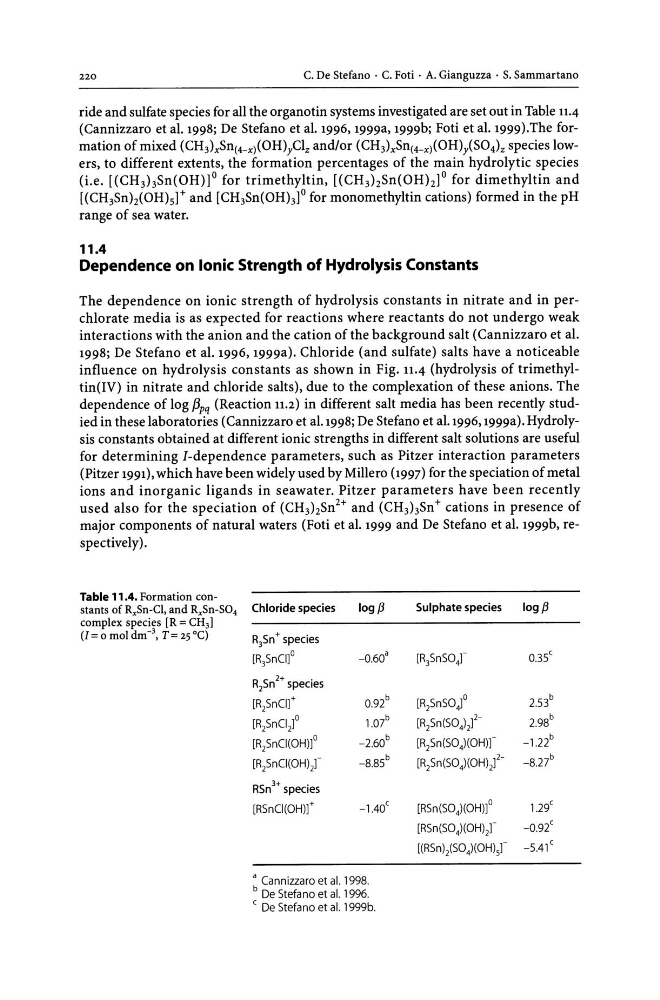
ride and sulfate species for all the organotin systems investigated are set out in Table 11.4
(Cannizzaro et al. 1998; De Stefano et al. 1996, 1999a, 1999b; Foti et al. 1999).The formation of mixed (CH3)xSn(4_x)(OH)yClz and/or (CH3)XSn(4_X)(OH)iS04)Z species lowers, to different extents, the formation percentages of the main hydrolytic species
(i.e. [(CH 3 hSn(OH)]o for trimethyltin, [(CH3hSn(OHh]o for dimethyltin and
[(CH 3 Snh(OH)st and [CH 3 Sn(OHh]o for monomethyltin cations) formed in the pH
range of sea water.
11.4
Dependence on Ionic Strength of Hydrolysis Constants
The dependence on ionic strength of hydrolysis constants in nitrate and in perchlorate media is as expected for reactions where reactants do not undergo weak
interactions with the anion and the cation of the background salt (Cannizzaro et al.
1998; De Stefano et al. 1996, 1999a). Chloride (and sulfate) salts have a noticeable
influence on hydrolysis constants as shown in Fig. 11.4 (hydrolysis of trimethyltin(IV) in nitrate and chloride salts), due to the complexation of these anions. The
dependence of log f3 pq (Reaction 11.2) in different salt media has been recently studied in these laboratories (Cannizzaro et al.1998; De Stefano et al.1996, 1999a). Hydrolysis constants obtained at different ionic strengths in different salt solutions are useful
for determining I-dependence parameters, such as Pitzer interaction parameters
(Pitzer 1991), which have been widely used by Millero (1997) for the speciation of metal
ions and inorganic ligands in seawater. Pitzer parameters have been recently
used also for the speciation of (CH 3 hSn 2 + and (CH 3 hSn+ cations in presence of
major components of natural waters (Foti et al. 1999 and De Stefano et al. 1999b, respectively).
Table 11.4. Formation constants of RxSn-Cl, and RxSn-S04 Chloride species
log f3
Sulphate species
10gf3
complex species [R = CH31
(I = 0 mol dm-3, T= 25°C)
R 3 Sn + species
[R 3 SnCI]°
-0.60 a
[R 3 SnS0 4 ]
O.3s c
R 2 Sn 2 + species
[R 2 SnClt
0.92 b
[R 2 SnSOl
2.53 b
[R 2 SnCI/
1.07 b
[R 2 Sn(S04)i2.98 b
[R 2 SnCI(OH)lO
-2.60 b
[R 2 Sn(SO 4)(OH)]
_l.22 b
[R 2 SnCI(OH)2]
-8.8s b
[R 2 Sn(SO 4)(OHli-8.27 b
RSn 3 + species
[RSnCl(OH)t
-1.40 c
[RSn(SO 4)(OH)]o
1.29 c
[RSn(S04)(OHU
-0.9/
[(RSn)2(SO )(OH)s]
-5.41 c
: Cannizzaro et al. 1998.
De Stefano et al. 1996.
c De Stefano et al. 1999b.
C. De Stefano . C. Foti . A. Gianguzza . S. Sammartano
ride and sulfate species for all the organotin systems investigated are set out in Table 11.4
(Cannizzaro et al. 1998; De Stefano et al. 1996, 1999a, 1999b; Foti et al. 1999).The formation of mixed (CH3)xSn(4_x)(OH)yClz and/or (CH3)XSn(4_X)(OH)iS04)Z species lowers, to different extents, the formation percentages of the main hydrolytic species
(i.e. [(CH 3 hSn(OH)]o for trimethyltin, [(CH3hSn(OHh]o for dimethyltin and
[(CH 3 Snh(OH)st and [CH 3 Sn(OHh]o for monomethyltin cations) formed in the pH
range of sea water.
11.4
Dependence on Ionic Strength of Hydrolysis Constants
The dependence on ionic strength of hydrolysis constants in nitrate and in perchlorate media is as expected for reactions where reactants do not undergo weak
interactions with the anion and the cation of the background salt (Cannizzaro et al.
1998; De Stefano et al. 1996, 1999a). Chloride (and sulfate) salts have a noticeable
influence on hydrolysis constants as shown in Fig. 11.4 (hydrolysis of trimethyltin(IV) in nitrate and chloride salts), due to the complexation of these anions. The
dependence of log f3 pq (Reaction 11.2) in different salt media has been recently studied in these laboratories (Cannizzaro et al.1998; De Stefano et al.1996, 1999a). Hydrolysis constants obtained at different ionic strengths in different salt solutions are useful
for determining I-dependence parameters, such as Pitzer interaction parameters
(Pitzer 1991), which have been widely used by Millero (1997) for the speciation of metal
ions and inorganic ligands in seawater. Pitzer parameters have been recently
used also for the speciation of (CH 3 hSn 2 + and (CH 3 hSn+ cations in presence of
major components of natural waters (Foti et al. 1999 and De Stefano et al. 1999b, respectively).
Table 11.4. Formation constants of RxSn-Cl, and RxSn-S04 Chloride species
log f3
Sulphate species
10gf3
complex species [R = CH31
(I = 0 mol dm-3, T= 25°C)
R 3 Sn + species
[R 3 SnCI]°
-0.60 a
[R 3 SnS0 4 ]
O.3s c
R 2 Sn 2 + species
[R 2 SnClt
0.92 b
[R 2 SnSOl
2.53 b
[R 2 SnCI/
1.07 b
[R 2 Sn(S04)i2.98 b
[R 2 SnCI(OH)lO
-2.60 b
[R 2 Sn(SO 4)(OH)]
_l.22 b
[R 2 SnCI(OH)2]
-8.8s b
[R 2 Sn(SO 4)(OHli-8.27 b
RSn 3 + species
[RSnCl(OH)t
-1.40 c
[RSn(SO 4)(OH)]o
1.29 c
[RSn(S04)(OHU
-0.9/
[(RSn)2(SO )(OH)s]
-5.41 c
: Cannizzaro et al. 1998.
De Stefano et al. 1996.
c De Stefano et al. 1999b.